
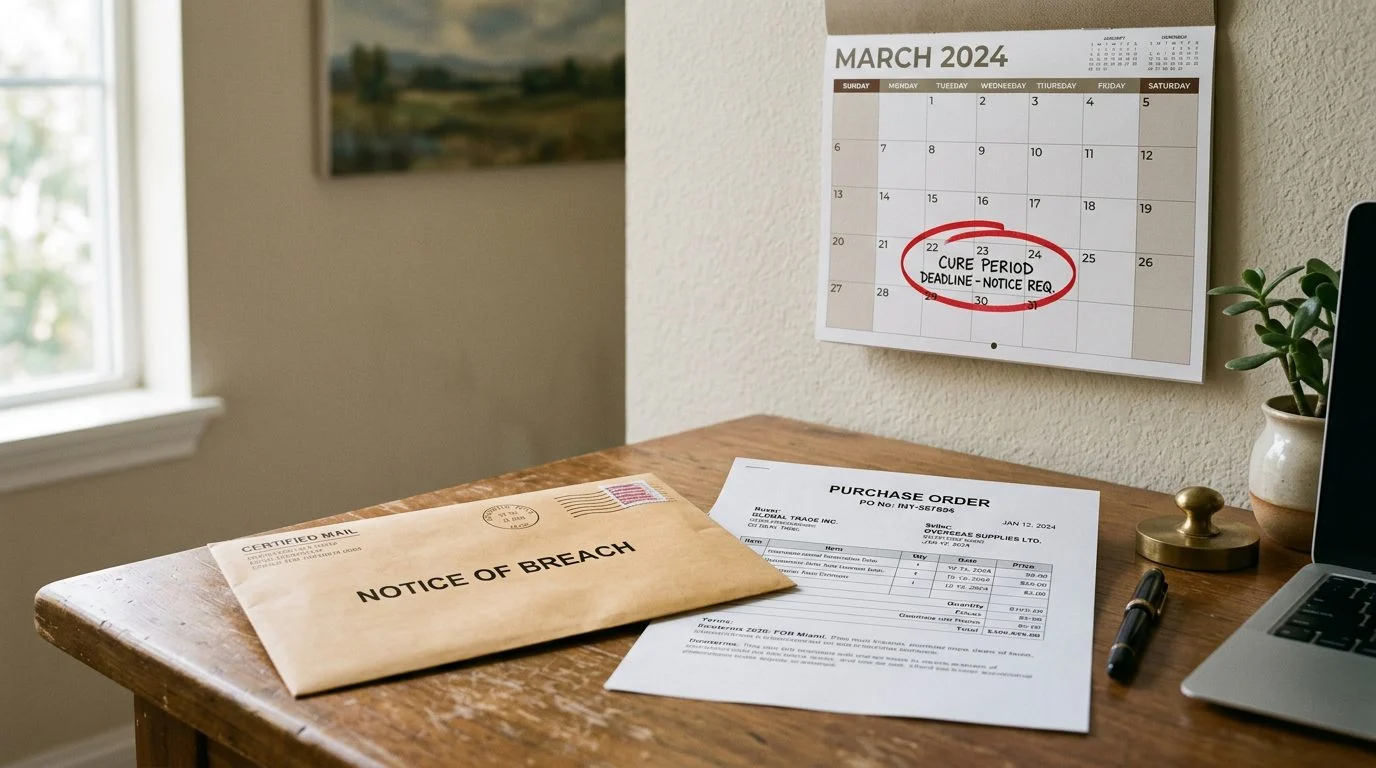
Statute of Limitations for International Sales Contracts in Florida
If you’re asking about the statute of limitations for an international sales contract in Florida, the short answer is that there’s no single deadline. Florida’s time limits depend on the type of claim, and the start date depends on what happened and when. This page explains the main Florida rules that shape that timeline. It is general information, not legal advice, and it does not set a filing deadline for any specific matter.
Not sure what your next step is?
Talk it through with our team — we can walk you through how a situation like yours is usually handled and what your options are.
The Short Answer: Florida Uses More Than One Deadline
Florida has no single deadline for every contract claim. Florida’s general limitations statute sets different time periods for different kinds of actions. The type of claim decides which period fits, so classify the claim before you count days.
Different types of disputes can be subject to different deadlines. A claim over goods, a services fee, a distribution deal or a refused letter of credit payment can each follow different rules.
Start with three facts: the type of contract, the date of the breach, and the date you first raised the problem. Write them down before you count anything.
Florida also applies a rule called laches, which is covered later in this article.
For the wider picture, read our cross-border business disputes overview.
Which Florida Statute Covers a Sale of Goods?
Under Fla. Stat. § 672.102, this chapter applies to transactions in goods and, in a hybrid transaction, depends on whether the sale-of-goods aspects predominate. Under Fla. Stat. § 672.607, the buyer must pay at the contract rate for any goods accepted.
A pure goods contract is the clearest case. Many cross-border deals mix goods with services, financing or distribution rights. A mixed deal may fall under more than one set of rules, so the contract’s label is only a starting point.
Why does the category matter? Florida’s general limitations statute, § 95.11, sets its time periods by type of action. Getting the category right is the first step in counting days.
Contract terms can change the picture too. Under § 95.03, a contract provision that sets a shorter time to sue than the statute allows is void. Read your agreement for any clause that sets a short window.
When Does the Clock Start on a Breach?
The start date depends on the claim and on the events in your file. Florida’s statutes don’t use one trigger for every claim.
For some construction claims, § 95.11 runs the time from certificate dates or, for a latent defect, from discovery. Fla. Stat. § 95.11 reads: “(b) An action founded on the design, planning, or construction of an improvement to real property, with the time running from the date the authority having jurisdiction issues a temporary certificate of occupancy, a certificate of occupancy, or a certificate of completion, or the date of abandonment of construction if not completed, whichever date is earliest; except that, when the action involves a latent defect, the time runs from the time the defect is discovered or should have been discovered with the exercise of due diligence.”
The goods notice rule uses a different trigger. Under § 672.607, once a tender has been accepted, the buyer must notify the seller of breach within a reasonable time after it discovers, or should have discovered, the breach.
Think of each event as its own date. A shipment with the wrong goods, a payment that comes due and goes unpaid, and a bank that refuses a letter of credit payment are three separate events. Each may start its own clock, so list them one at a time.
Build a simple timeline. Put one event on each line, with the date and a copy of the document that proves it.
Notice of Breach Can Cut Off a Claim Earlier
If you accepted the goods, you must notify the seller of the breach within a reasonable time after you discover or should have discovered it. Under § 672.607, a buyer who misses that window is barred from any remedy.
Notice is a separate requirement from the time to sue. You can file on time and still lose a claim if notice came too late.
The buyer also carries the proof. Under the same section, the burden is on the buyer to establish any breach with respect to the goods accepted.
Put every notice in writing and keep proof of delivery. Describe the problem, the dates, the quantities and what you want the seller to do. Attach photos or test results when you have them.
Customs holds at the border raise a different set of questions. They fall within the international trade work the firm handles, so raise them early.
How a Foreign Contract Changes the Analysis
A foreign party can change which law applies and where the dispute goes. Under § 671.105, when a deal bears a reasonable relation to Florida and to another state or nation, the parties may agree which law governs. Without that agreement, the code applies to transactions with an appropriate relation to Florida.
For larger deals, § 685.101 lets parties agree that Florida law governs a contract involving, in the aggregate, not less than $250,000, but this section does not apply to labor or employment contracts, or to personal, family, or household transactions unless the contract concerns a trust with at least one trustee residing or transacting business as a trustee in Florida, among other exclusions. That choice can apply even when the contract has no other tie to Florida, to the extent the United States Constitution permits.
If the contract has an arbitration clause, § 682.02 makes an agreement to arbitrate in a record valid and enforceable, except on grounds that exist for revoking a contract. The court decides whether an agreement to arbitrate exists.
When a party asks a court to compel arbitration, § 682.03 requires the court to pause, on just terms, any judicial proceeding that involves a claim alleged to be subject to the arbitration, until the court renders a final decision on that motion.
Labeling a claim as a tort does not always help. See Frutafino v. Dole Chile.
Not sure what your next step is?
Talk it through with our team — we can walk you through how a situation like yours is usually handled and what your options are.
What Can Pause the Deadline?
Florida’s tolling statute, § 95.051, lists specific grounds that pause the clock.
Some listed grounds are narrow. A pending arbitral proceeding pertaining to a dispute that is the subject of the action tolls, or pauses, the period under § 95.051. So does a payment of part of the principal or interest on a written instrument.
Subsection (1) of Fla. Stat. § 95.051 lists circumstances that toll the running of a statute of limitations, including the absence from the state of the person to be sued, but absence does not toll the time if service of process or service by publication can be made in a way that gives the court jurisdiction to grant the relief sought.
Laches is a separate rule. Under § 95.11, laches bars any action unless it is commenced within the time provided for legal actions concerning the same subject matter, regardless of lack of knowledge by the person sought to be held liable and whether that person is injured or prejudiced by the delay. The section also provides that laches may apply at an earlier time in accordance with law. Fla. Stat. § 95.11 reads: “(7) LACHES.—Laches shall bar any action unless it is commenced within the time provided for legal actions concerning the same subject matter regardless of lack of knowledge by the person sought to be held liable that the person alleging liability would assert his or her rights and whether the person sought to be held liable is injured or prejudiced by the delay.” The other side’s lack of knowledge does not change that.
Don’t rely on informal promises from the other side to extend time. Ask for any extension in writing and review its terms before you rely on it. Pausing rules are narrow, so don’t assume a pause applies just because talks continue.
Documents to Gather for an Early Timeline Review
A short, dated file lets you test the timeline quickly. Start with these items:
- The contract, every amendment, purchase order, invoice, bill of lading, delivery receipt and payment record.
- Governing-law, forum-selection and arbitration clauses, and any clause that sets a time to sue.
- Letters and emails showing when you raised the breach, what you demanded and how the other side responded.
- Inspection reports, photos and test results. For accepted goods, the buyer must establish any breach.
- The date of last performance and the date each side first raised the problem.
Keep the originals and a clean copy of each one. For a wider view of how these disputes move, see our international contract dispute timeline.
Talk With Our Team About Your Timeline
Ayala Law PA focuses on business litigation, contract disputes and international trade litigation in Florida courts and arbitration. Eduardo A. Maura is the lawyer responsible for this page.
The firm’s only office is at 1646 W Snow Ave, Tampa. The firm handles matters for businesses in Tampa and Hillsborough County, with its office in Tampa.
This page is general information, not legal advice. Nothing here predicts how a particular matter will turn out, and a prospective client may not obtain the same or similar results.
If a foreign buyer has stopped paying, or your goods arrived defective and the dates are running, you don’t have to sort out the timeline alone. Reach out through our contact page or call (305) 570-2208 to talk through your contract.
What is the statute of limitations for an international sales contract in Florida?
There is no single number. The period depends on the type of claim, and § 95.11 sets time periods by type of action.
Can a contract shorten the time to sue in Florida?
A contract clause that sets a shorter time than the statute allows is void under § 95.03.
Does a demand letter stop the clock?
No. Florida’s tolling statute, § 95.051, lists specific grounds that pause the clock, and a demand letter is not one of them.



