
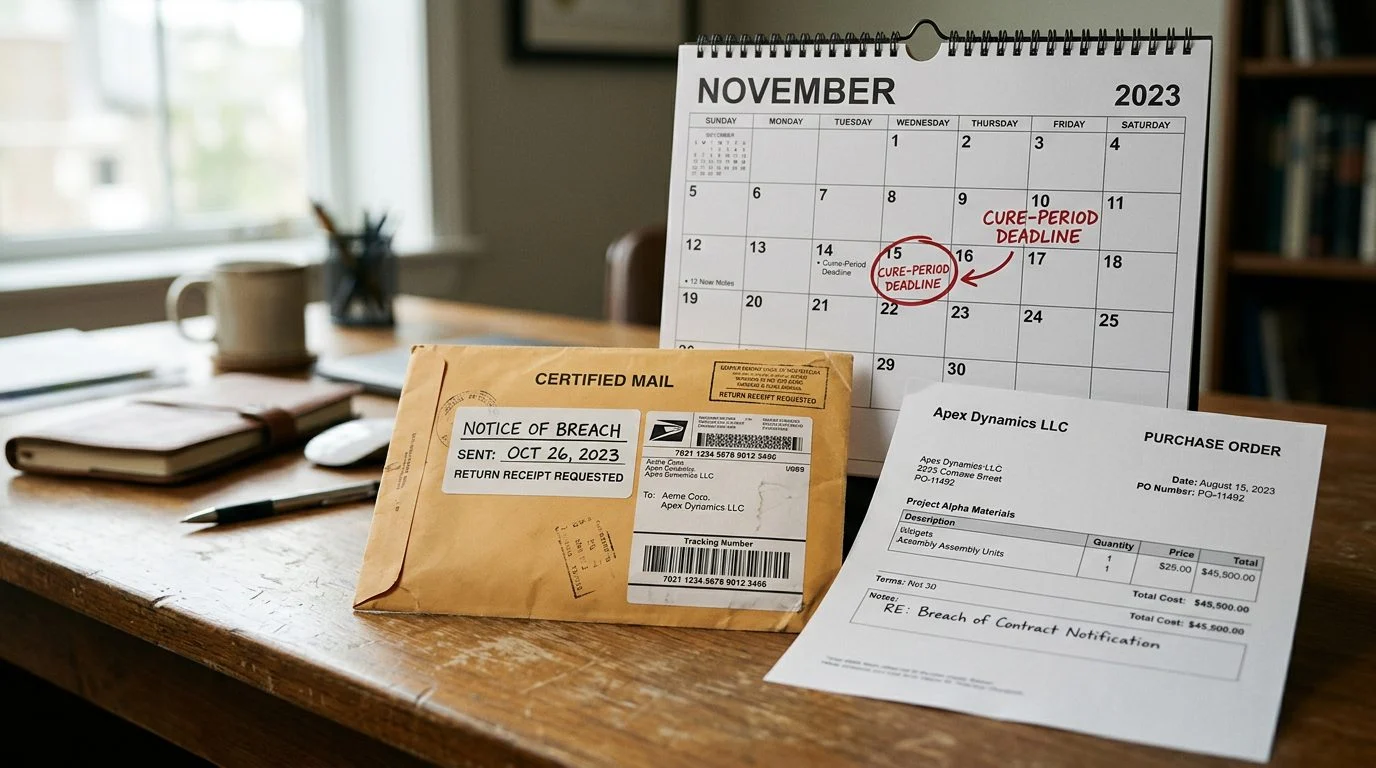
A breach of contract lawsuit asks a court to enforce a deal when the other side fails to do what it promised. This page explains what counts, how long you have to file, what you can recover, and what a case looks like for a business in Tampa and Hillsborough County.
What a Breach of Contract Lawsuit Is and When It Fits
A breach of contract lawsuit fits when one party fails to do what the contract requires, and that failure harms the other party.
Common business examples include:
- An unpaid invoice for goods or services already delivered.
- A missed delivery or completion date that costs your business money.
- A supply or distribution agreement that one side stops following.
- A general contractor that does not pay a subcontractor under a construction subcontract.
Florida’s sale-of-goods rules add a few details. Under Fla. Stat. § 672.709, a seller may recover the price of goods the buyer accepted when the buyer fails to pay as the price comes due. Under Fla. Stat. § 672.201, a contract for goods priced at $500 or more generally needs a signed record to be enforced.
Not every breach ends in court. Many disputes start with a written demand letter that describes the breach, the amount owed or remedy sought, and a response deadline.
If a signed contract has gone unpaid or unperformed, you may have a claim worth reviewing, and our team can talk through your options and deadlines with you. Talk it through with our team — we can walk you through how a situation like yours is usually handled and what your options are.
How Long You Have to File in Florida
For most written contracts, Florida gives five years to file suit. These periods come from Fla. Stat. § 95.11. A few points matter:
- Filing periods under Fla. Stat. § 95.11 apply to actions other than for recovery of real property, and a contract cannot shorten them (see § 95.03). Fla. Stat. § 95.03 makes a clause that sets a shorter filing period void.
- When the clock starts depends on the facts. Track when the other side first failed to perform.
- Construction claims follow different timing. Under § 95.11, an action on the design, planning, or construction of an improvement to real property generally runs from whichever is earliest: the date a temporary certificate of occupancy, a certificate of occupancy, or a certificate of completion is issued, or the date construction was abandoned if not completed. Latent defects run from when the defect is discovered or should have been discovered with due diligence, but in any event the action must be commenced within 7 years after the earliest of the certificate dates or the date of abandonment of construction if not completed.
- Under Fla. Stat. § 95.11(6)(e), except for actions governed by s. 255.05(10), s. 337.18(1), or s. 713.23(1)(e), an action to enforce any claim against a payment bond where the bond’s principal is a contractor, subcontractor, or sub-subcontractor as defined in s. 713.01, for private work as well as public work, runs from the last furnishing of labor, services, or materials, or from the last furnishing by the contractor if the contractor is the principal on a bond on the same construction project, whichever is later. This does not apply to actions governed by s. 255.05(10), s. 337.18(1), or s. 713.23(1)(e). The statute lists exceptions, so check the bond and project dates.
- An action for specific performance, an order forcing the other side to perform, generally must be brought within one year.
Don’t wait on the calendar alone. Emails, invoices, and witness memories fade over time. Also check whether the contract requires notice or a dispute step before suit. Skipping that step can hurt your position.
What a Breach of Contract Lawsuit Can Recover
The amount turns on the contract and the proof.
- Examples include the unpaid balance or the cost to fix work that does not match the contract.
- Lost profits: some cases seek profits lost because of the breach.
- Specific performance: in limited situations, a court can order the other side to perform.
- Attorney’s fees: Florida follows the general rule. Under Price v. Tyler, each party generally bears its own attorneys’ fees unless a contract or statute provides otherwise.
Check your contract’s fee clause. If it lets a party recover fees for enforcing the deal, Fla. Stat. § 57.105(7) may let the court award fees to the other side when it prevails. That rule covers contracts entered on or after October 1, 1988.
Collection also matters. Recovery can turn on whether the other side can pay a judgment.
Defenses to Expect and How They Are Tested
The other side usually answers by challenging the contract, the breach, or the timing. Common defenses include:
- The statute of limitations.
A contract term can also be challenged. Under Basulto v. Hialeah Automotive, a Florida court must find both procedural and substantive unconscionability, weighed together, before refusing to enforce a term.
Adding a fraud or other tort claim does not always help. Under Frutafino v. Dole Chile, a Florida appeals court held that a plaintiff generally cannot recover in tort for a contract dispute unless the tort is independent of the breach.
Defenses get tested through document requests, written questions, and depositions. Expect a counterclaim, too. The other side may say you breached first, so review both sides’ performance early.
The contract’s arbitration clause can decide where the case is heard. A written arbitration agreement is generally enforceable under Fla. Stat. § 682.02 and, for a maritime transaction or a contract evidencing a transaction involving commerce, under the federal arbitration statute, 9 U.S.C. § 2. If a party moves to compel arbitration, Fla. Stat. § 682.03 requires the court, on just terms, to stay the related court claim until it renders a final decision under that statute.
Florida law also limits venue. Under Fla. Stat. § 47.011, actions must be brought in the county where the defendant resides, where the cause of action accrued, or where the property in litigation is located. This section does not apply to actions against nonresidents.
How a Business Contract Case Proceeds: Step by Step
A typical case moves from document review to a demand, then to filing or arbitration, then to discovery and resolution.
- Document review. Our team reviews the contract, amendments, purchase orders, invoices, payment records, and emails. This step checks the key elements and deadlines.
- Demand letter. A written demand states the breach, the amount owed or remedy sought, and a response date.
- Filing or arbitration. If the dispute does not resolve, a complaint is filed in the proper Florida court, or arbitration begins under the contract.
- Discovery. Both sides exchange documents, answer written questions, and take depositions. Timing varies with complexity.
- Mediation, settlement, or trial. Under Fla. Stat. § 44.102, a court must refer a filed civil action for monetary damages to mediation when one party asks, provided that party is willing and able to pay the mediation costs or the costs can be equitably divided between the parties, subject to listed exceptions. Fla. Stat. § 44.102 reads: “(2) A court, under rules adopted by the Supreme Court: (a) Must, upon request of one party, refer to mediation any filed civil action for monetary damages, provided the requesting party is willing and able to pay the costs of the mediation or the costs can be equitably divided between the parties, unless: 1.” Settlement talks are protected: under Fla. Stat. § 90.408, evidence of an offer to compromise a claim disputed as to validity or amount, and of relevant conduct or statements made in compromise negotiations, generally cannot be used to prove liability or absence of liability, or the value of a claim.
Each stage is reviewed with you before key decisions are made.
Why Tampa Bay Business Owners Work With Ayala Law PA
Ayala Law PA focuses its practice on business litigation. That includes commercial and contract disputes, shareholder and partnership disputes, construction litigation, real estate litigation, and international trade litigation.
The firm handles these matters in Florida courts and in arbitration. It serves businesses in Tampa, Hillsborough County, Brandon, Riverview, Plant City, Temple Terrace, and the wider Tampa Bay area.
The firm’s office is in Tampa, at 1646 W Snow Ave. Eduardo A. Maura is the lawyer responsible for this page. Our team includes assistants and office staff who help organize documents and track dates.
No firm can promise a result. Outcomes depend on the contract language, the evidence, and the court or arbitrator involved. A matter may be referred to another lawyer or firm when that fits the case.
Not sure what your next step is?
Talk it through with our team — we can walk you through how a situation like yours is usually handled and what your options are.
Fees and Costs: What You May Owe
Fee terms are discussed with you before you engage the firm. Beyond attorney fees, a client may owe case costs, such as:
- Court filing fees
- Service of process fees
- Deposition and transcript costs
- Fees for outside witnesses
Your contract’s fee clause also matters. It can decide who pays attorney’s fees if a dispute ends in court.
Frequently Asked Questions
Do I need a written contract to sue for breach?
Not always.
Can I sue a partner or shareholder for breaching our agreement?
Possibly. Those disputes can fall under shareholder or partnership litigation, which the firm also handles.
What if our contract has an arbitration clause?
The clause may send the dispute to arbitration instead of court. The exact wording of the clause controls.
How long does a breach of contract case take?
Timing varies with the complexity of the dispute, the number of parties, and whether the case settles early.
Should I stop performing under the contract?
Whether to keep performing, pause work, or send notice turns on the contract’s terms. Review those terms before you act.
If a signed contract has gone unpaid or unperformed, you may have a claim worth reviewing before a deadline runs. Contact Ayala Law PA through our contact page or call (305) 570-2208 to talk through your situation.



