
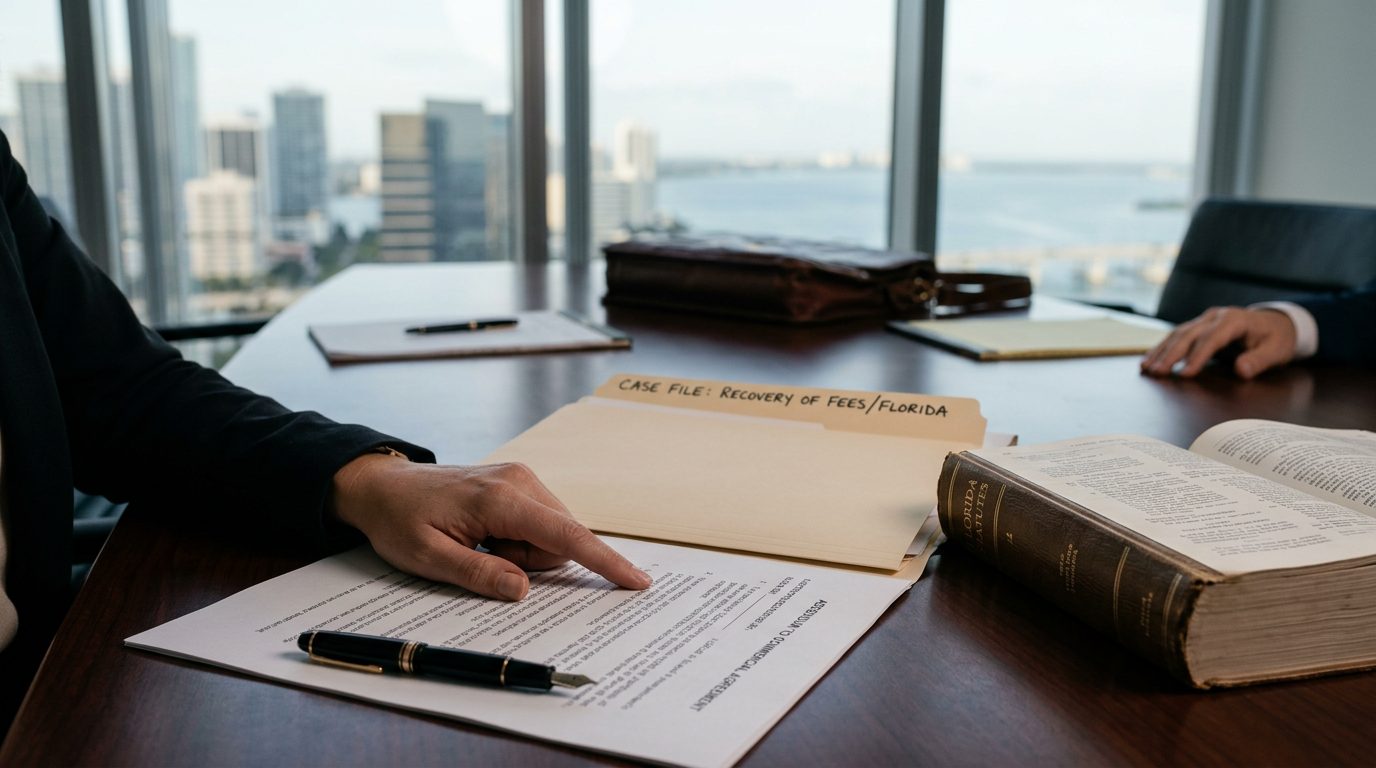
So, can I recover attorney fees in a Florida contract dispute? Sometimes, yes. Each route has its own conditions, and mistakes with the paperwork can cost a claim. This guide explains each route in plain terms. For the wider picture, read our Florida contract disputes guide.
Florida’s Default Rule: Each Side Pays Its Own Lawyer
Fee recovery is the exception, and it needs a basis. Many business owners assume a win brings fees back with it. It often does not. Consider a subcontractor that wins the core claim for unpaid work, but the contract has no fee clause. Without a statute or a sanction, that subcontractor may still have to pay its own lawyer. That is why the fee question belongs at the contract stage, before a dispute starts.
Not sure what your next step is?
Talk it through with our team — we can walk you through how a situation like yours is usually handled and what your options are.

Recovering Fees Through a Prevailing-Party Clause
A prevailing-party clause says the winner of a dispute over the agreement can recover its attorney fees. It is a common contract route. Check whether the clause covers only enforcement actions or every claim tied to the agreement. Some clauses favor only one side. The clause’s wording also controls which fees and costs can be claimed. For how damages work in these cases, see breach of contract damages in Florida. Whether the deal was in writing matters too, and our page on whether a business deal needs to be in writing covers that point.
Statutory Exceptions, Including Construction Lien Claims
Some statutes let a court award fees even when the contract says nothing about them. Each statute has its own scope, so check whether one fits your claim in addition to the contract. A statutory right is separate from a contract clause, and it has its own conditions. Construction disputes add another layer. Contractors and subcontractors should read the chapter’s text before assuming any fee right applies to a lien claim. (See Florida construction industry licensing.)
Section 57.105 Sanctions and the Reciprocity Rule
Section 57.105 lets a court award fees when a party knew or should have known that a claim or defense lacked support in the material facts or existing law. The court can do this at any time during the case. The fees are payable in equal amounts by the losing party and the losing party’s attorney. Fla. Stat. § 57.105 also sets a safe-harbor step. A party that wants sanctions must serve its motion first. The motion may not be filed with the court unless the challenged paper is not withdrawn or corrected within 21 days after service. Section 57.105(7) adds a reciprocity rule. If a contract lets one party recover fees for enforcing it, the court may let the other side recover fees when that side prevails, whether as plaintiff or defendant. That rule applies to contracts entered into on or after October 1, 1988. Sanctions are not automatic. They turn on how each claim and defense was pursued.
How Courts Decide the Amount of Fees
Whether fees are owed and how much they come to are separate questions. Florida law sets a strong presumption that a lodestar fee is sufficient and reasonable. (Florida Supreme Court opinions.) That presumption can be overcome only in a rare and exceptional circumstance, with evidence that competent counsel could not otherwise be retained. Fla. Stat. § 57.104 also requires the court to consider the time and labor of legal assistants who gave meaningful, nonclerical support under an attorney’s supervision. In a claim under the Florida Deceptive and Unfair Trade Practices Act, Fla. Stat. § 501.2105(2) governs attorney fee awards, and a prevailing party’s attorney files a sworn affidavit of time spent on the case and costs incurred for all the motions, hearings, and appeals with the trial judge who presided over the civil case. Keep invoices, time entries, and task descriptions in a form a judge can review. Every business dispute turns on its own facts, so the details of each claim matter. The court sets the award, and it may be less than the full legal bill.
Deadlines, Offers of Judgment, and Arbitration
Some fee routes have firm deadlines, so track them early. In a civil action for damages, a written offer of judgment that is not accepted within 30 days can shift fees. Under Florida law, a defendant’s offer can shift fees if the plaintiff’s judgment is at least 25 percent less than the offer. A plaintiff’s demand can do the same if the judgment is at least 25 percent greater. The offer must be in writing, state that it is made under the statute, name both parties, and state its total amount. Under § 768.79(7), the offeror must make its motion within 30 days after judgment or after a voluntary or involuntary dismissal. Arbitration works differently. Under Fla. Stat. § 682.02, an arbitration agreement in a record is valid, enforceable, and irrevocable, except on grounds that exist to revoke a contract. Under Fla. Stat. § 682.03, a court must stay court claims that are subject to arbitration until it decides a motion to compel arbitration. Deadlines in these statutes are specific, so calendar them as soon as a case begins. Identify your fee basis early, because pleadings and contract wording shape what you can request later.
Not sure what your next step is?
Talk it through with our team — we can walk you through how a situation like yours is usually handled and what your options are.
Reviewing Your Contract and Next Steps
Start with the contract itself. Look for a prevailing-party clause, a one-sided fee clause, and an arbitration clause. Also check notice requirements and any steps that must come before suit, such as mediation before a lawsuit. Note whether the fee terms run in both directions. Bring copies of the contract, any amendments, and key notices to the first conversation. The outcome depends on the contract language and the facts of the case, and no result can be promised in advance. Ayala Law PA focuses on business litigation, including contract disputes, shareholder disputes, construction litigation, real estate litigation, and international trade litigation. Eduardo A. Maura is the responsible lawyer for this page. Clients in Tampa, Hillsborough County, Brandon, Riverview, Plant City, and Temple Terrace are served from the firm’s only office, in Tampa, Florida.
Can I recover attorney fees in a Florida contract dispute without a fee clause?
Possibly, if a statute or a court sanction applies. A contract clause is the other common route, and it needs the clause to exist.
Does a one-sided attorney fee clause work both ways in Florida?
It can, for contracts entered into on or after October 1, 1988. Under Section 57.105(7), the court may let the other side recover fees if it prevails.
How long does a party have to ask for fees after an offer of judgment case ends?
Under § 768.79(7), the offeror’s motion must be made within 30 days after judgment or dismissal. Track that date closely.
If your company is in a contract dispute and you’re unsure whether its legal fees can be recovered, call Ayala Law PA at (305) 570-2208 or use our contact page to have the fee wording reviewed.



