
Short Answer: Yes, Often, but the Route Turns on Your Contract and Facts
Yes, you can often sue a contractor for bad work in Florida. Whether a claim succeeds turns on the contract, the type of defect, any notice steps, and the filing deadlines.
Think of these as gates you pass in order. Check the contract first, then the clock, then the notice and mediation steps, and last the court where a case would be filed.
A lawsuit is one path among several. Many disputes start with a review of the documents and a written demand to the contractor. This page explains the general framework. It is not advice on your specific project.
You may be a homeowner, a property manager or a business owner paying for rework, delays or a stalled job. You may also be asking for a family member or a business partner. In that case, dates and records matter even more.
If a contractor's work has failed and repair bills keep arriving, our team can talk through your contract, your deadlines and your options with you. Talk it through with our team — we can walk you through how a situation like yours is usually handled and what your options are.

What Counts as Bad Work Under Florida Law
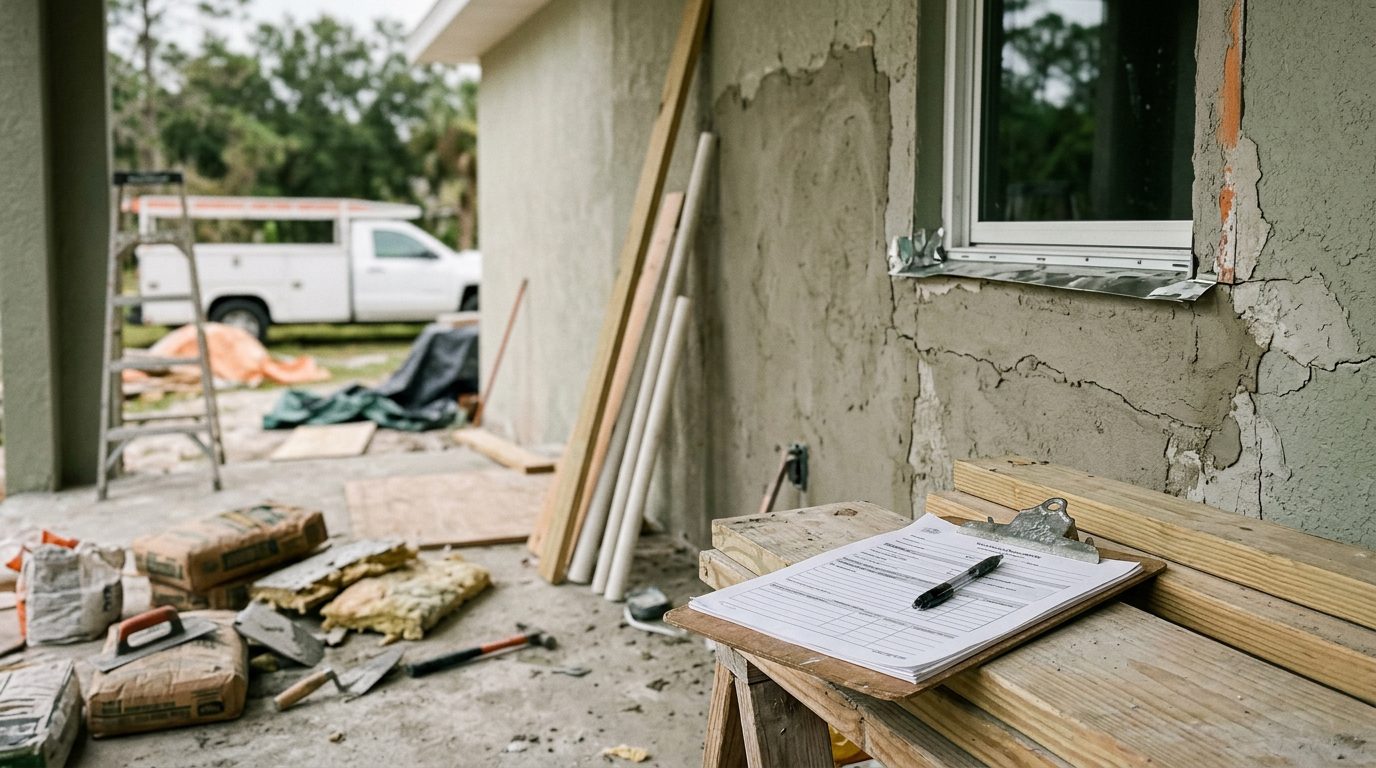
Bad work is construction that falls short of what the contract or the law requires. It can mean poor workmanship, work that departs from the plans, incomplete work, or the wrong materials. Naming the problem correctly helps you pick the right claim.
Breach of contract is the most common claim when a written agreement sets the scope, schedule or quality standard. If the contractor did not deliver what the contract promised, the contract is where your case starts. Negligence may fit when a defect damages other property, such as water damage inside a house caused by a roof installed wrong.
Common examples include roofing installed without proper flashing, leaks after a roof replacement, framing or tile not built to plan, and punch-list items left unfinished. The same facts can support more than one theory. Each theory can carry its own deadline and notice rules.
Florida courts also police how a claim is framed. A plaintiff generally cannot recover in tort for what is really a contract dispute, unless the tort is independent of the breach. See Frutafino v. Dole Chile. Where an express contract covers the same subject, claims from that relationship generally won’t support unjust enrichment. See Williams v. Johnson.
Florida’s Pre-Suit Notice Step for Construction Defects
Notice puts the contractor on record about the problem.
Before you send anything, gather your records. List each defect, the date you first noticed it, where it sits in the property, and what you saw. Keep the list factual and free of guesses about cause.
Notice steps and filing deadlines can run at the same time, so don’t wait to start. Write down when the work began and ended, when you paid, and when you first saw each problem. Those dates help sort out which clock applies. The exact notice requirements depend on the property and the claim, so review them against your own facts.
Deadlines: Statute of Limitations vs. Outer Limit
For claims founded on construction of an improvement to real property, the time runs from the earliest certificate or abandonment date, except that for a latent defect it runs from when the defect is discovered or should have been discovered with the exercise of due diligence, and in any event the action must be commenced within 7 years after the earliest certificate or abandonment date. The clock starts at the earliest of several certificate dates or the date work was abandoned. Under Florida Statutes § 95.11, the trigger is the temporary certificate of occupancy, certificate of occupancy, certificate of completion, or abandonment, whichever comes first.
Hidden defects follow a different start date. For a latent defect, the four years runs from when you discovered it or should have discovered it with due diligence. Even then, the suit must be started within seven years after that certificate, completion or abandonment date, whichever is earliest.
Repairs don’t reset the clock in every case. For work within the scope of a permit and certificate, fixing completed work, under warranty or otherwise, does not extend the deadline. This matters when a contractor returns for a fix.
Under Florida Statutes § 95.03, a contract term that sets a shorter period than the statute is void.
A cause of action starts when its last element occurs, under Florida Statutes § 95.031. Contract claims and construction defect claims may run on different clocks, so review each claim on its own. Write down your key dates now, because they often decide which deadline applies.
Who Can Be Sued: Contractors, Subcontractors and Independent Contractors
The general contractor is usually the first party to name, but not always the only one. An independent contractor can be sued like any other party to a contract. Who signed the contract and who did the work usually points to the right defendant.
Lien claims are a different tool. An unpaid subcontractor or supplier may use lien rights under Florida construction lien law. A lien concerns payment and property. A bad-work claim concerns the quality of what was built.
A licensing complaint is a separate process from a lawsuit, and the two can move on different timelines. The Florida Department of Business and Professional Regulation covers contractor licensing and license verification. Confirm the exact company name on the contract, because the right defendant can turn on it.
Steps to Take Before Filing: Evidence, Written Demand and Mediation
Start by gathering proof, because the paper trail carries most bad-work claims. Save the signed contract, change orders, invoices, payment records, permits, inspection reports, dated photos and videos, and every written message with the contractor.
A third-party witness can help explain the work. A building inspector or roofing professional can describe what the work looks like and what should have been done. Their written report can sit beside your photos in the file.
Don’t erase the evidence. Photograph and measure each defect before you repair it. If repairs must start right away, keep the removed parts or photograph them first.
Next, send a written demand. A clear letter lists each defect, states the repair or payment you want, and sets a reasonable response deadline. Keep the tone factual, because a plain letter is easier to use later.
If a lawsuit follows, mediation may come early. On one party’s request, a court must refer a filed civil action for money damages to mediation, unless an exception applies. Exceptions include small claims cases, actions filed to collect a debt, and cases where the parties have agreed to binding arbitration, and the requesting party must be willing and able to pay the mediation costs or the costs must be divisible between the parties. See Florida Statutes § 44.102. Mediation communications are generally confidential under Florida Statutes § 44.405.
Not sure what your next step is?
Talk it through with our team — we can walk you through how a situation like yours is usually handled and what your options are.
Frequently Asked Questions About Suing a Contractor in Florida
What is litigation in construction?
It is the court process for resolving disputes over construction contracts, workmanship and defects. It can include filing, discovery, mediation and trial.
How do I file a complaint against a licensed contractor in Florida?
A licensing complaint and a civil lawsuit are separate steps. Under Florida Statutes § 47.011, a suit goes in the county where the defendant resides, where the claim arose, or where the property is located, but this rule does not apply to actions against nonresidents.
Can an independent contractor be sued?
Yes, a contractor who did the work under a contract, or who caused damage, can generally be a defendant. The contract terms and the deadlines still apply.
Can I sue a roofing contractor for leaks?
Roof claims follow the same framework as other construction claims. The contract scope, any warranty, and your documentation of the leak often matter most.
What notice must I give before suing?
Construction defect claims depend heavily on the facts of each project, so the steps that apply can vary from one matter to the next. The notice section above lists what to gather before you send anything.
How Ayala Law PA Handles Construction and Contract Disputes in the Tampa Bay Area
Ayala Law PA focuses on business litigation, commercial and contract disputes, shareholder and partnership disputes, construction litigation, real estate litigation and international trade litigation in Florida courts and arbitration. Eduardo A. Maura is the responsible lawyer for this page. The firm represents businesses and property owners in Tampa, Hillsborough County, Brandon, Riverview, Plant City and Temple Terrace.
The firm’s office is at 1646 W Snow Ave, Tampa, Florida. The firm represents businesses and entrepreneurs in the Tampa Bay area and Hillsborough County from its Tampa office.
Some matters may be referred to another lawyer or firm where appropriate. Each matter is different, and no result can be promised.
Talk With Our Team About Your Project
If a contractor’s work has failed and repair bills keep arriving, the deadlines and notice questions can feel urgent. You may be carrying that decision for a business, a rental property or a family member.
If you’re asking whether you can sue a contractor for bad work in Florida, call (305) 570-2208 or request a case evaluation. Ayala Law PA does not offer free consultations, so ask about fees when you call.



