
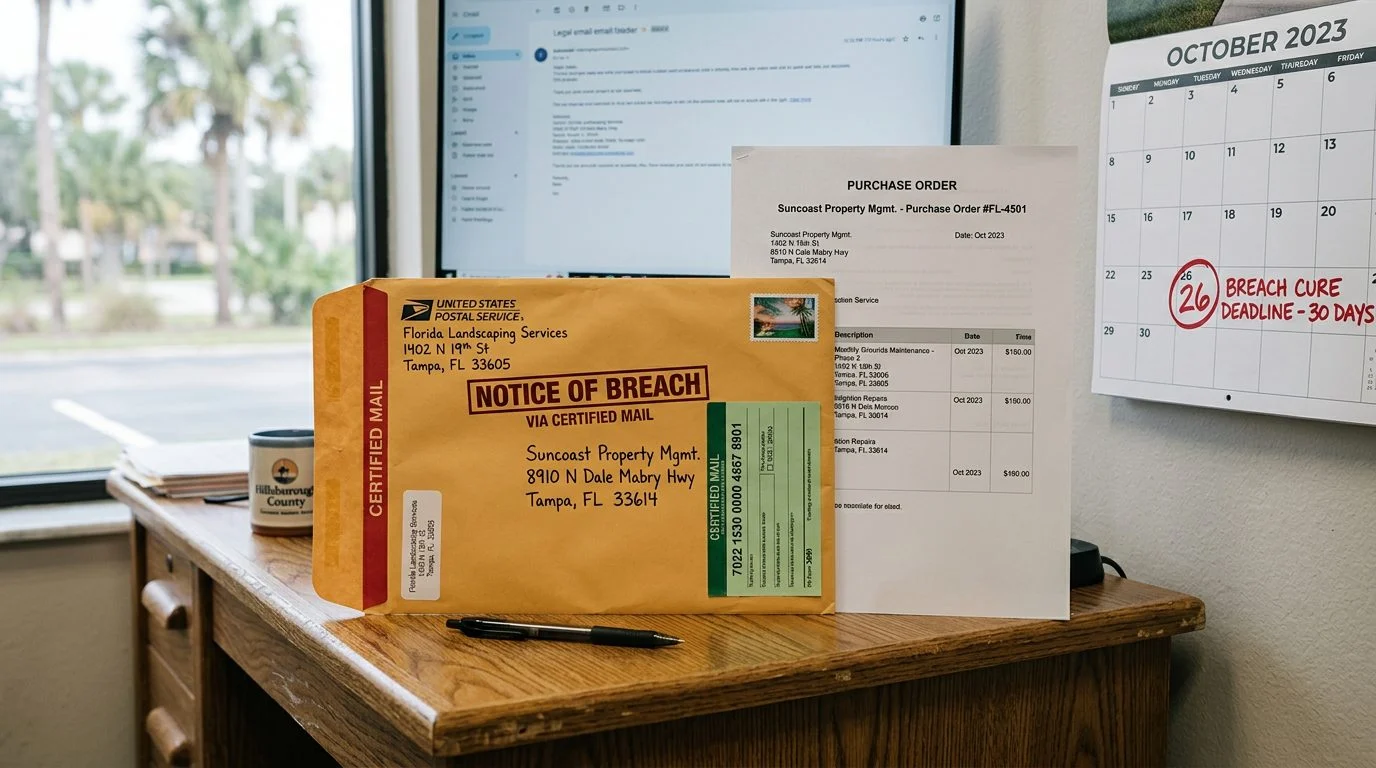
Short Answer: Can You Pause Your Work When the Other Side Stops Paying?
Sometimes, yes. In many Florida contract disputes, a party may stop its own work after the other side commits a serious breach. Whether you can stop performing a contract during a dispute in Florida turns on three questions. Was the breach material? Does the contract allow a pause or require notice first? Has the other side shown it will not perform? Timing and paperwork can matter as much as the decision itself.
This guide explains how courts sort out breach, when a pause is generally supported, where a pause backfires, and what to document first.
Not sure what your next step is?
Talk it through with our team — we can walk you through how a situation like yours is usually handled and what your options are.
How Florida Courts Decide Who Is the Breaching Party
Disputes over a contract often turn on questions about whether the agreement was valid and what happened under it. A material breach goes to the heart of the deal. It can help to look at how much of the deal the failure actually affected.
It rarely gives that side a reason to walk away from the whole contract.
Order of events matters. If you are the first party to fail in a serious way, the other side may not have to keep performing. If the other side failed first, your duty to keep going may be excused. The order of events can matter as much as how each side felt about it.
A contractor who halts all work over a disputed invoice may find the customer’s position looks stronger. Decide early whether the breach is serious enough to justify a stop. Don’t wait until the crew has already left the site.
When a Pause Is Generally Supported by a Material Breach
A pause is generally easier to defend when the other side has committed a serious breach. Three situations come up most often.
First, nonpayment. Both the amount unpaid and the payment terms in the contract are worth reviewing.
Second, anticipatory repudiation. A customer who says it won’t pay the balance and stops ordering materials may be sending that signal. Once the signal is clear, a court may treat the other side as having breached before any deadline arrives.
Third, adequate assurance. If you have reasonable grounds to doubt the other side will perform, you can ask in writing for assurance by a set date. If the other side refuses or stays silent, that can support a pause. Keep the request reasonable and in writing.
Document the breach before you act.
Where a Pause Turns Into Your Own Breach
Four traps stand out.
The first is a minor or disputed amount. Stopping all work over a small invoice the customer contests can look like an overreaction. The other side may then argue that you breached first.
The second is notice and cure. Many contracts require written notice and a window to fix the problem before remedies apply. Skipping that step can weaken your position, even when the other side really did fail to pay. Read the clause before you act.
The third is the contract’s own suspension or termination clause. If the contract describes how and when work may stop, it is worth reading that section closely. A pause that ignores the clause is hard to defend.
The fourth is timing. A pause that starts before the other side’s breach, or that conveniently follows a drop in the job’s profit, invites the argument that the pause was a pretext. Where you can, limit the pause to the work tied to the unpaid amount. Stopping only that portion is usually easier to explain than halting the whole contract.
Steps to Take Before You Stop Work
Before you stop, read the contract, document the breach, and send written notice. Then decide whether to pause. Take these steps in order.
- Read the contract for payment terms, notice requirements, cure periods, suspension rights, and any dispute resolution clause.
- Build a dated record. Save invoices, delivery logs, emails, change orders, and any statement showing the other side won’t perform.
- Send written notice. Identify the breach, cite the contract section, set a cure deadline, and reserve your right to suspend or terminate.
- If the contract allows, ask in writing for adequate assurance of performance by a reasonable date.
- Total the amounts owed and the costs of delay, so the damages picture is clear if the matter goes to court.
- On construction work, check lien rights early. Construction lien rights under Chapter 713, Florida Statutes, carry their own deadlines, and the time limits for certain related actions appear in Fla. Stat. § 95.11.
How a Contract Dispute Moves Toward Litigation in Florida
A contract dispute usually moves from notice to negotiation, then to any required mediation or arbitration, and then to a lawsuit if needed. Each stage has its own timing.
Florida sets time limits for suing in Fla. Stat. § 95.11. Under Fla. Stat. § 95.03, a contract term that sets a shorter time to sue is void.
Florida also uses offers of judgment.
Fee rules are a default. Under Price v. Tyler, the Florida Supreme Court explained that each party generally pays its own attorney’s fees unless a contract or statute provides otherwise.
Don’t count on a quasi-contract claim as a backup. In Williams v. Johnson, a Florida appeals court said that where an express contract covers the same subject, claims arising from that relationship won’t support unjust enrichment.
Not sure what your next step is?
Talk it through with our team — we can walk you through how a situation like yours is usually handled and what your options are.
Talk With Ayala Law PA About Your Paused Contract
Before you pause a contract, the contract terms and the breach facts should be checked together. Doing that first protects your position.
This page is the responsibility of Eduardo A. Maura of Ayala Law PA. The firm’s bona fide office is at 1646 W Snow Ave in Tampa, Florida. The firm focuses on business litigation, commercial litigation, contract disputes, shareholder disputes, construction litigation, real estate litigation, and international trade litigation. Its practice covers businesses in Tampa, Hillsborough County, Brandon, Riverview, Plant City, Temple Terrace, the Tampa Bay area, and Florida.
Common Questions
Can I stop work if my customer hasn’t paid an invoice?
Sometimes. A substantial unpaid amount under the contract’s payment terms can support a pause, but notice steps still matter.
Who pays attorney’s fees in a Florida contract dispute?
Each side generally pays its own fees unless a contract or statute says otherwise.
Can a Florida contract shorten the time to file a lawsuit?
No. Under Fla. Stat. § 95.03, a contract term that sets a shorter period to sue is void.
If a customer has stopped paying and you’re weighing whether to pull crews or halt a job, call (813) 414-5715 or send a request through our contact page. Bring the contract, the invoices, and any notices you have sent or received. We can talk through what to say before you stop.



