

How Long Does a Business Contract Lawsuit Take in Hillsborough County?
A business contract lawsuit in Florida has no fixed length. The timing depends on how far the case goes and which stages it reaches. A dispute that settles after a demand letter moves through far fewer stages than one that reaches discovery, motions, and trial.
This page walks through each stage in order. It ties each stage to the Florida rule or statute that governs it, so you can see where the time goes.
Where the case is filed matters too. Under Fla. Stat. § 47.011, an action must be brought only in the county where the defendant resides, where the cause of action accrued, or where the property in litigation is located. This section does not apply to actions against nonresidents. For many Hillsborough County businesses, the county where the defendant lives or where the claim arose may be the proper place to file.
Some contracts send disputes to arbitration instead of court. That choice changes the path, and we cover it below.
If a customer or vendor has stopped paying under your contract, you may have a claim to weigh, and our team can walk you through the deadlines and next steps. Talk it through with our team — we can walk you through how a situation like yours is usually handled and what your options are.
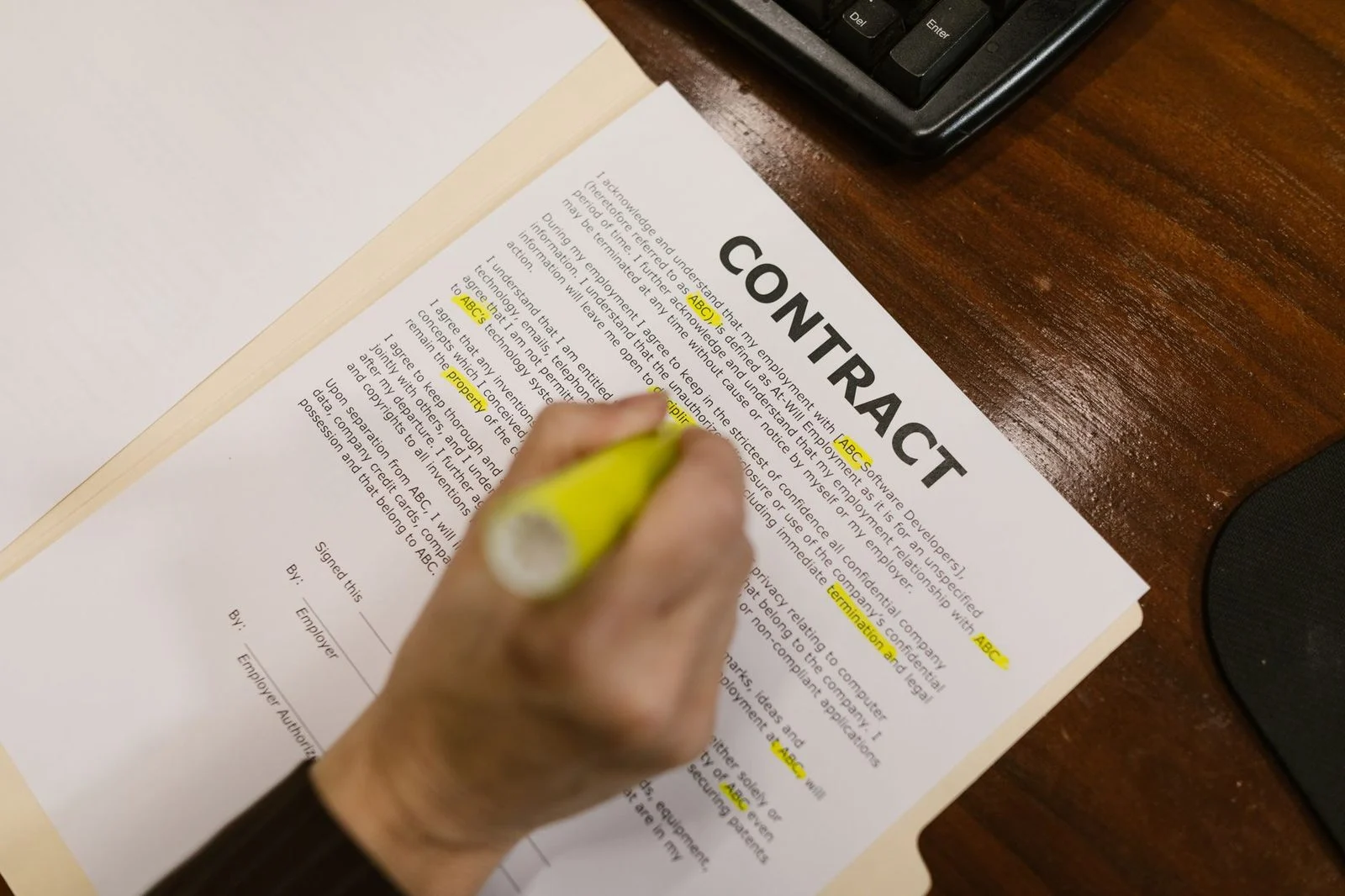
Before You File: Demand Letters, Contract Notice Terms, and Evaluation
Most disputes start with a written demand. A demand letter states the breach, the payment or performance you want, and a deadline to respond. Many disputes narrow or resolve at this stage, before anyone files suit.
Read the contract for notice terms before you send anything. Some agreements require written notice to a specific address, a set delivery method, or a cure period before suit. Missing one can delay the case.
Check for an arbitration clause too. Under Fla. Stat. § 682.02, a written agreement to arbitrate is valid, enforceable, and irrevocable, except on grounds that exist for revoking a contract. If you or the other side asks the court to order arbitration, Fla. Stat. § 682.03 requires the court, on just terms, to stay the court case that involves the arbitrable claim until the court renders a final decision under this section.
Gather your documents now. Pull the signed contract, any amendments, purchase orders, invoices, payment records, and emails or letters about the work. Organized records make every later stage faster.
Is the Claim Still Timely Under Florida Law?
Florida generally gives five years to sue on a written contract and four years on an oral contract, but a claim founded on the design, planning, or construction of an improvement to real property has a four-year period that usually runs from the earliest certificate of occupancy or completion, or abandonment, subject to a latent-defect discovery rule and a 7-year outer limit. The time limits come from Fla. Stat. § 95.11.
The clock starts when the cause of action accrues. Under Fla. Stat. § 95.031, a cause of action accrues when the last element of the claim occurs. For an unpaid invoice, identify the date the payment was due and not made. For a failure to perform, identify the date the performance failed.
A contract cannot shorten the window. Under Fla. Stat. § 95.03, any contract provision that sets a shorter time to sue than the statute allows is void.
Some events pause the clock. Fla. Stat. § 95.051 lists tolling events. They include a pending arbitral proceeding about the same dispute and a partial payment on a written obligation. Work out the accrual date early instead of waiting for talks to end.
Filing, Service, and the Defendant’s Response
Filing starts the case, but formal service makes it real. The defendant then has a set period to respond, and that response sets the next stage.
The response can take several forms. A defendant may file an answer, which admits or denies each allegation, and list defenses. The defendant may also file a counterclaim against you or a motion to dismiss. Each step can add time. A motion to dismiss that removes claims can reshape the rest of the case.
Defendants often challenge the contract itself. Florida law requires an offer, an acceptance, consideration, and enough detail on the essential terms. In St. Joe Corp. v. McIver, the Florida Supreme Court held that even an oral contract must meet these basic requirements. If the parties never agreed on the essential terms, the contract claim can become the main fight.
Case Management and Discovery
Discovery is often the stage that takes the most time in a contract case. This is where both sides exchange facts. Expect written questions called interrogatories, requests for documents, and depositions, which are sworn statements taken outside the courtroom. Attorneys may also send subpoenas to third parties, such as a bank or a vendor that holds records.
Three things drive the length. They are the volume of documents, the number of witnesses, and disputes over what must be produced. A dispute over a few invoices and one signed contract moves faster than a case with years of email, several vendors, and many people who saw the work.
The court sets deadlines as the case moves forward. Both sides need steady progress. Keep your emails, texts, invoices, and change orders in one place so you can answer requests quickly.
Mediation, Settlement, and Offers of Judgment
Florida courts often send contract damage cases to mediation, and many settle there. Under Fla. Stat. § 44.102, a court must refer a filed civil action for money damages to mediation when one party asks, provided that party is willing and able to pay or the costs can be equitably divided, unless an exception applies, such as a landlord and tenant dispute without a personal injury claim, an action filed to collect a debt, a medical malpractice claim, or a case governed by the Florida Small Claims Rules. This applies if the requesting party is willing and able to pay the mediation costs or the costs can be equitably divided between the parties.
Exceptions matter. The referral rule does not cover an action filed to collect a debt, which is why unpaid invoice suits can follow a different route. It also does not apply when the parties have agreed to binding arbitration.
Mediation has a defined start and end. Under Fla. Stat. § 44.404, court-ordered mediation begins when the court issues the order.
Offers of judgment carry real money. Under Fla. Stat. § 768.79, if a defendant files an offer of judgment that the plaintiff does not accept within 30 days, the defendant is entitled to recover reasonable costs and attorney’s fees incurred from the date of filing of the offer if the judgment is one of no liability or the judgment obtained by the plaintiff is at least 25 percent less than such offer. The same statute works in reverse for a plaintiff’s demand. Settlement talks are also protected. Under Fla. Stat. § 90.408, an offer to compromise a disputed claim, as well as any relevant conduct or statements made in negotiations concerning a compromise, is inadmissible to prove liability or absence of liability for that claim or its value.
Not sure what your next step is?
Talk it through with our team — we can walk you through how a situation like yours is usually handled and what your options are.
Summary Judgment, Trial, and Final Judgment
If the judge resolves the key contract question, the case can end sooner. If the key facts are still disputed, the case goes on.
Trial timing depends on the court’s calendar and on how much remains disputed. A case with one clear contract question moves differently from one with several claims, counterclaims, and disputed damages.
A final judgment states who wins and what is owed. It can cover damages, costs, and interest. Under Fla. Stat. § 55.03, the Chief Financial Officer sets the judgment interest rate each quarter. The rate stated on a judgment accrues until it is paid. An appeal after final judgment adds more time on top of that.
Factors That Make a Business Contract Case Shorter or Longer
The biggest drivers are the number of parties, the number of documents, and the number of disputed issues. Each added party, claim, or defense adds discovery and motion work.
Defenses add issues. A force majeure defense or a claim of fraud in the inducement each adds questions to litigate. Our supporting pages on those topics go into more detail.
Tort framing has limits. In Frutafino, S.A.S. v. Dole Chile, S.A., the Third District stated that a plaintiff may not recover in tort for a contract dispute unless the tort is independent of the breach. Quoting Greater N.Y. Corp. v. Cenvill Miami Beach Corp., a Florida Third District Court of Appeal decision repeats the rule: “It is well established that a meeting of the minds of the parties on all essential elements is a prerequisite to the existence of an enforceable contract, and where it appears that the parties are continuing to negotiate as to essential terms of an agreement, there can be no meeting of the minds.”
When no contract governs, the claim may be unjust enrichment. In Pincus v. American Traffic Solutions, Inc., the Florida Supreme Court stated the elements. The plaintiff must show a benefit conferred, the defendant’s appreciation of it, and retention under circumstances that make keeping it without payment inequitable.
Collection can take extra time. A judgment only helps if the other side can pay. Collection steps after judgment add their own timeline. Whether any of this changes your case depends on the facts.

Deciding Whether to Sue Over a Breached Contract
Deciding whether to sue often starts with a stopped payment or missed performance. A customer stops paying an invoice. A contractor walks off a job. A vendor fails to deliver.
Before you decide, pin down four things. Know the signed terms, the date the claim arose, any notice or arbitration clause, and what the other side can realistically pay. These answers shape the timeline more than any general estimate.
How long do I have to sue on a contract in Florida?
Can a contract clause shorten the deadline?
No. Under Fla. Stat. § 95.03, a contract clause that sets a shorter time to sue than the statute allows is void.
Does arbitration pause the deadline?
A pending arbitral proceeding about the same dispute can toll the limitations period under Fla. Stat. § 95.051.
Can a court send a contract case to mediation?
Yes, when one party asks and the costs can be paid or split, unless an exception applies. A case filed only to collect a debt is excluded under Fla. Stat. § 44.102.
If a customer or vendor has stopped paying under your contract, you may have a claim to weigh. Call Ayala Law PA at (305) 570-2208 or send a message through our contact page to talk through the contract, the deadlines, and the likely stages. Eduardo A. Maura is the responsible lawyer for this page. The firm’s office is at 1646 W Snow Ave in Tampa, Florida, and it represents businesses in Hillsborough County and the Tampa Bay area.



