
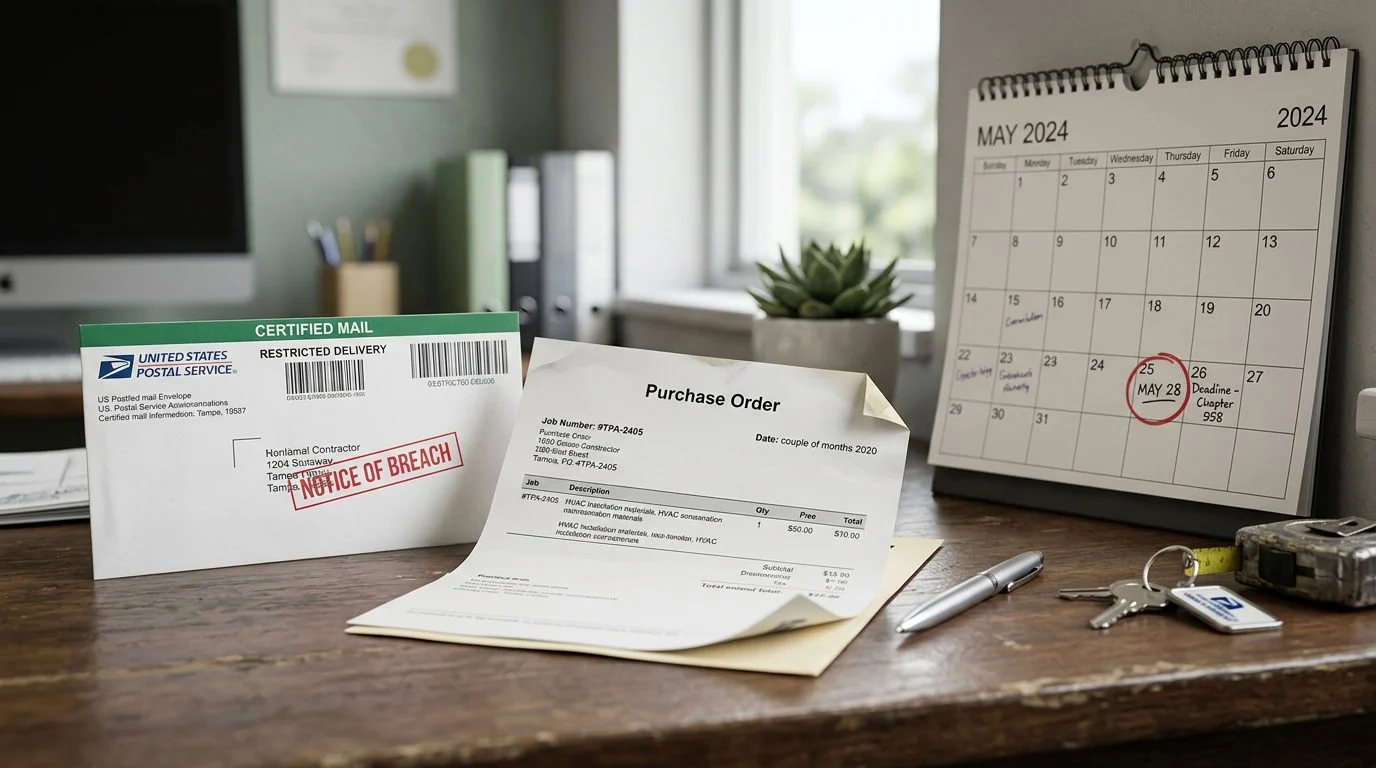
Getting a Chapter 558 notice as a Tampa contractor is stressful, especially if the job is still open or the owner has moved on. A Chapter 558 notice is a pre-suit notice about alleged construction defects. It is not a lawsuit, but it starts a timeline you need to track from day one.
This guide explains what the notice is, what it should say, which deadlines matter, and what to do in the first two weeks.
What Is a Chapter 558 Notice and Who Receives It?
A Chapter 558 notice is a written notice that a property owner or other claimant sends before filing a construction defect lawsuit. It tells the builder what problems are claimed, so the builder can look at them before any suit is filed. Contractors and subcontractors are common recipients. One notice can name more than one party.
Who gets a notice depends on who owns the property, who built or managed the work, and who the claimant names. The notice describes a claim. It does not decide who is at fault. A notice on one project does not, by itself, establish that anyone is responsible. Treat it as the start of a review, not a finding.
Not sure what your next step is?
Talk it through with our team — we can walk you through how a situation like yours is usually handled and what your options are.
What Should the Notice Say?
A useful notice names the property, describes each alleged defect, and gives enough detail to find it on site. Check these items as soon as it arrives:
- The project name and property address
- Each defect claimed, with its location
- Who sent the notice and who it names
- The date and method of delivery
A vague notice is harder to answer. Compare each claimed defect with your project file, including the contract, plans, permits, and inspection records. Write down the date and method of delivery the day it arrives. Timing questions are much easier to answer when that date is on record.
Which Deadlines Should a Tampa Contractor Track?
The main outer deadline comes from Florida’s limitations statute, and its clock can start before the notice ever arrives.
construction defect claims against contractors fall under a different provision, § 95.11(3)(b), which generally requires an action founded on the design, planning, or construction of an improvement to real property to be commenced within four years, running from the earliest of the date the authority having jurisdiction issues a temporary certificate of occupancy, a certificate of occupancy, or a certificate of completion, or the date of abandonment of construction if not completed; for latent defects, the time runs from when the defect is discovered or should have been discovered with due diligence, and in any event the action must be commenced within seven years of that same date. Under § 95.031, a cause of action accrues when its last element occurs.
A few more points matter:
- Under § 95.03, a contract clause that shortens the filing period below the statute is void.
Put every date on one sheet. Include the service date, any response dates from the notice, the inspection window, and the certificate dates. Review that sheet early, not after a suit is served.
What Are the First Response Steps?
Start by protecting the record. Then document the claimed condition before anyone changes it. These steps work best in order:
- Log the service date. Keep the notice, the envelope, and any delivery records.
- Calendar every date the notice sets. Don’t let one pass by default.
- Preserve the project file: contracts, change orders, daily logs, inspection reports, photos, permits, and correspondence.
- Notify your insurance carrier and any subcontractor or supplier whose work may be involved, as early as practical.
- Compare each claimed defect with your records before making any statement or repair.
- Plan the inspection. Decide who attends, what gets documented, and what gets shared.
- Draft a written response that addresses each alleged defect, including any repair or settlement offer.
Keep the response factual. Stick to what the records show, and avoid guessing about causes.
What Mistakes Cost Contractors the Most?
The costly mistakes usually happen early and informally, before the file is reviewed. Watch for these:
- Making repairs before the condition is documented and inspection is offered. Repairs can make it harder to show what the original work looked like.
- Sending texts or emails that admit fault or describe the defect casually.
- Assuming a subcontractor or supplier will handle the notice without written coordination.
- Assuming a repair restarts the clock. Where the work was done under a duly issued building permit and the local authority has issued a temporary certificate of occupancy, a certificate of occupancy or a certificate of completion, later repairs or replacements within the scope of that permit and certificate generally do not restart or extend the limitations period under § 95.11(3)(b), Florida Statutes.
- Letting the notice sit while you wait for the owner to call back.
When Can an Unresolved Notice Become a Lawsuit or Arbitration?
An unresolved notice can lead to a lawsuit in Florida courts, or to arbitration if the contract requires it. The first question is where a suit could be filed. Under § 47.011, actions go in the county where the defendant resides, where the cause of action accrued, or where the property in litigation is located; this section does not apply to actions against nonresidents. For a Tampa project, that may mean Hillsborough County.
If your contract has an arbitration clause, § 682.02 makes a written agreement to arbitrate generally valid and enforceable. The court decides whether that agreement exists. Under § 682.03, a court may not refuse arbitration just because the claim lacks merit.
Mediation may come first. On one party’s request, a court must refer a filed civil action for money damages to mediation under § 44.102, provided the requesting party is willing and able to pay the mediation costs or the costs can be equitably divided between the parties, unless a listed exception applies.
Other parties can get pulled in. Construction lien disputes in Florida are governed by statute, so the paperwork and timeline on each project can matter a great deal. Plan for each path early, since the forum shapes the next steps.
Not sure what your next step is?
Talk it through with our team — we can walk you through how a situation like yours is usually handled and what your options are.
Why Ayala Law PA for This Work?
Ayala Law PA is a business litigation firm in Tampa. The firm focuses on construction litigation, along with commercial and contract disputes, shareholder and partnership disputes, real estate litigation, and international trade disputes in Florida courts and arbitration.
The firm’s only office is at 1646 W Snow Ave, Tampa, FL 33606. It serves Tampa, Hillsborough County, and the Tampa Bay area from that office. Eduardo A. Maura is the lawyer responsible for this page. Our team includes assistants and office staff.
Frequently Asked Questions About Chapter 558 Notices
Does a Chapter 558 notice mean I’m being sued?
No. It is a pre-suit notice, but it can lead to a lawsuit if the claim is not resolved.
Do I have to accept a repair offer?
The decision is yours, and it should rest on your project records. Under § 90.408, evidence of an offer to compromise a disputed claim, as well as any relevant conduct or statements made in negotiations concerning a compromise, is inadmissible to prove liability or absence of liability for the claim or its value.
Can I repair the defect before responding?
You can, but document the condition and offer inspection first. Repairs can make it harder to show what the original work looked like.
Does this apply to subcontractors and suppliers?
Other parties in the chain may face claims too. Coordinate responses in writing so everyone works from the same facts.
What if I no longer own or manage the project?
That depends on the facts of the project and the contract.
How are fees handled?
Questions about fees are welcome when you contact our office at (813) 414-5715.
Next Step: Talk Through Your Notice Dates
If a Chapter 558 notice has reached you about work you built or managed, you don’t have to sort out the dates alone. Call (813) 414-5715 or use the contact form to request a case evaluation. Bring the notice, the service date, your project file, and any emails or texts about the job, since they may matter later.



