
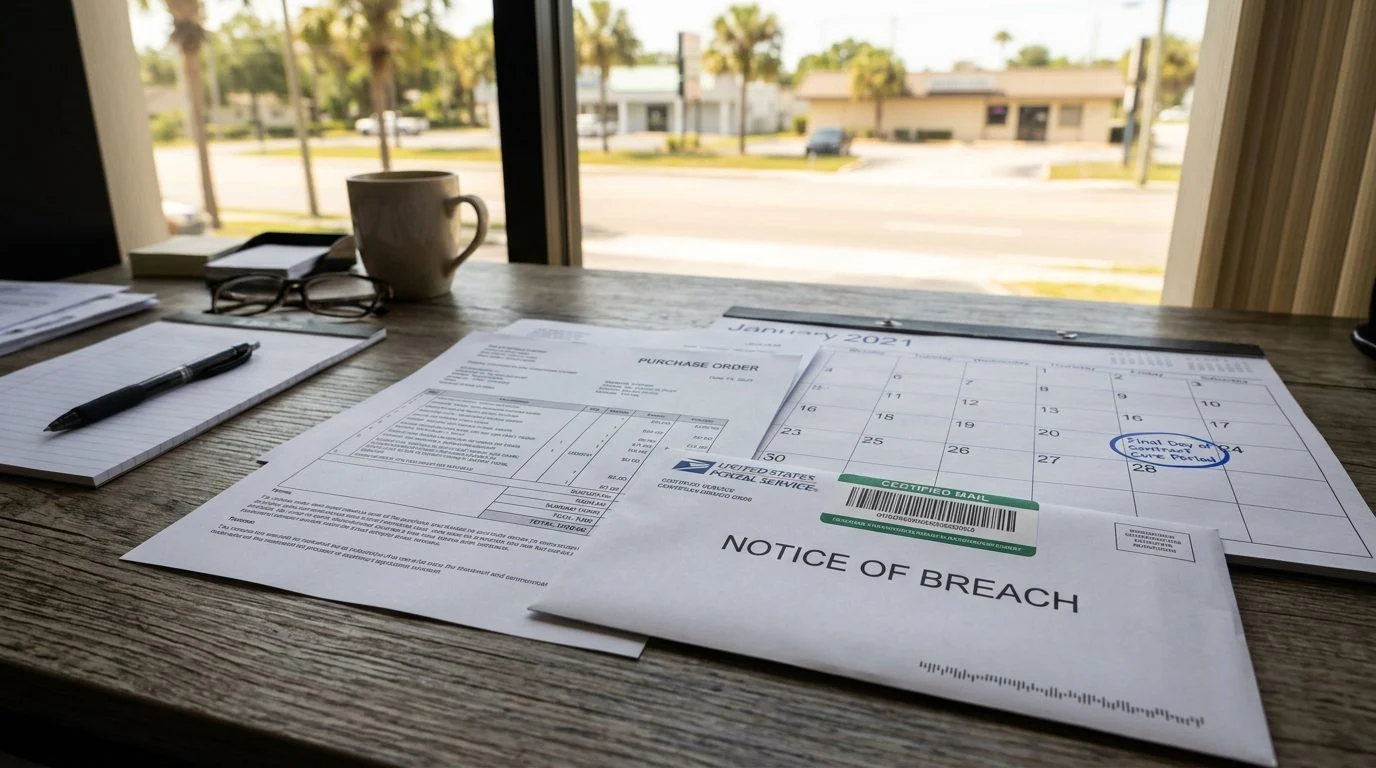
Someone has sent you a termination notice, or you’re deciding whether to end a business agreement yourself. Either way, the real question is whether the contract allows the exit, and how to end it without a lawsuit.
Most termination disputes turn on the contract’s own words and on whether each required step was followed. When the exit is supported, many disputes resolve through talks, mediation or a negotiated release. When it isn’t, the party that ends the deal can become the party in breach.
What a Commercial Contract Termination Dispute Is and Who It Affects
A commercial contract termination dispute is a disagreement over whether a business agreement can be ended, or was validly ended, and on what terms. The fight is usually about the exit itself: the reason, the notice, the timing, or who still owes what after the deal stops.
These disputes reach many kinds of agreements. Owners and managers run into them with vendor, distribution, licensing, service and supply contracts. Partners and counterparties face them when they receive a termination notice they did not expect.
The stakes are practical. A termination handled poorly can lead to a breach claim, withheld payments, lost deposits or unpaid invoices. It can also strain a business relationship that still has value.
Many people come to this question for someone else. A co-owner, a family member who runs the company or a manager may hand you the file. The steps below apply whether you make the decision or help someone who does.
If you're holding a termination notice or weighing whether to exit a deal, our team can review the agreement with you and explain your options. Talk it through with our team — we can walk you through how a situation like yours is usually handled and what your options are.
Lawful Grounds for Ending a Business Agreement
The grounds below come up most often in Tampa-area business disputes.
- Material breach. A material breach is a failure that goes to the heart of the deal, not a small slip. In a Florida appellate decision, the court explained that a party’s “failure to perform some minor part of his contractual duty cannot be classified as a material or vital breach” (Covelli Family, L.P. opinion).
- Required steps. In the Covelli Family, L.P. opinion, the court explained: “As a general rule, conditions precedent are not favored, and courts will not construe provisions to be such, unless required to do so by plain, unambiguous language or by necessary implication.”
- Termination for convenience. Some agreements let a party end the deal without a breach, after a set notice period. Check whether yours has this right, and follow the notice period exactly.
- Expiration or mutual agreement. A contract may end when its term runs out, the work is finished, or both sides agree in writing to stop.
- Notice and cure. Many contracts give the other side a set window to fix a problem. Ending the deal before that window closes can make your termination the problem.
- Anticipatory repudiation. For sale-of-goods contracts, a clear refusal to perform a future duty, where the loss of that performance will substantially impair the value of the contract to the other party, can let the other side wait a commercially reasonable time or pursue a remedy for breach (Fla. Stat. § 672.610).
A termination the contract doesn’t allow can itself be treated as a breach by the party that ends the deal.
Steps to Take Before You Send or Answer a Termination Notice
Before any notice goes out, read the full agreement and confirm exactly how the contract requires notice to be given. Small details here often decide the dispute.
- Read the whole agreement. Check the definitions, notice addresses, dispute-resolution, governing-law and survival clauses. The survival clause shows which duties continue after the deal ends.
- Confirm the notice method. Some contracts require certified mail or delivery to a specific address. Whether an electronic signature or electronic record is enforceable depends on the facts of each agreement. That still doesn’t make every text or email a valid notice.
- Gather the record. Collect performance reports, invoices, emails, delivery logs and any waivers or amendments. Course of performance can help show what the parties meant (Fla. Stat. § 671.205).
- Keep messages short and factual. Avoid messages that admit fault, threaten termination or agree to new terms before the position is reviewed.
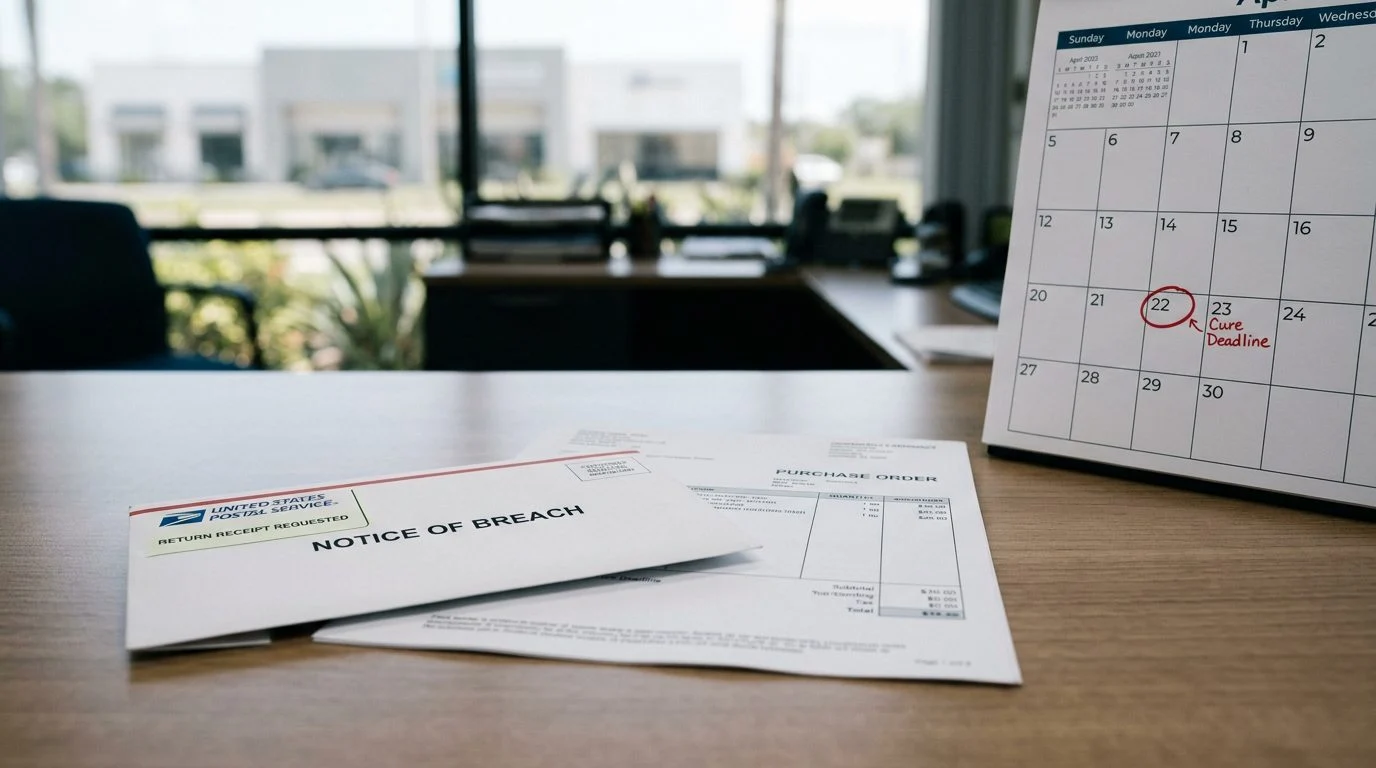
- Calendar every deadline. Track cure periods, payment dates and any required mediation or arbitration step.
- Watch what you keep accepting. Ratification occurs when a party entitled to rescind fails to do so after discovering the facts that warrant it (Flaherty v. Flaherty). Undoing a deal for a mistake also has strict limits (Waterside at Boynton Homeowners’ Ass’n).
Negotiated Exits Compared With Formal Dispute Routes
A negotiated exit ends a termination dispute by agreement, while formal routes rely on mediation, arbitration or a court. Most parties try the negotiated route first, and the right path depends on the contract language and the facts of the relationship.
- Mutual termination agreement. The written deal can settle final payments, return of property, transfer of customers or work, releases and confidentiality.
- Mediation. On request, a Florida court must refer most civil actions for monetary damages to mediation. Fla. Stat. § 44.102 reads: “(2) A court, under rules adopted by the Supreme Court: (a) Must, upon request of one party, refer to mediation any filed civil action for monetary damages, provided the requesting party is willing and able to pay the costs of the mediation or the costs can be equitably divided between the parties, unless: 1.” The request must come from a party able to pay, or the costs must be equitably divided.
- Arbitration. A written agreement to arbitrate is valid, enforceable and irrevocable, except on grounds that exist for revoking any contract. The court decides whether an agreement to arbitrate exists (Fla. Stat. § 682.02).
- Circuit court. Actions must be brought in the county where the defendant resides, where the cause of action accrued, or where the property in litigation is located, but this rule does not apply to actions against nonresidents (Fla. Stat. § 47.011).
How a Termination Matter Moves Through Our Office
Our work starts with the contract, then moves to options, and only then to a filing if talks fail. Each step is designed to keep your position clear before you act.
- Intake. We talk through the agreement, the notice you received or the exit you’re planning, and your business goals.
- Document review. We check the contract and your records against its termination, notice and cure clauses.
- Options. We outline negotiated and formal routes, along with the risks each one carries.
- Notice or response. We draft or review termination, cure or response letters.
- Resolution. We negotiate exit terms, or use mediation or arbitration if the contract or a court calls for it.
- Litigation if needed. We file or defend a claim in Florida courts or arbitration.
Timelines vary with the contract, the other party’s response and the forum. Ayala Law PA handles these matters from its Tampa office.
Why Work With Ayala Law PA on a Termination Dispute
Ayala Law PA focuses on business and contract disputes, and its Tampa office serves Hillsborough County and the Tampa Bay area. The firm’s practice covers business and commercial litigation, contract disputes, shareholder and partnership disputes, construction litigation, real estate litigation and international trade litigation.
Eduardo A. Maura is the responsible lawyer for this page. Our lawyers and support staff handle intake, document organization and scheduling, so each matter has a clear point of contact.
Our approach begins with the agreement itself, then the options, rather than with a promise about how a dispute will end. Each termination dispute turns on its own contract and facts, so we don’t predict results.
Not sure what your next step is?
Talk it through with our team — we can walk you through how a situation like yours is usually handled and what your options are.
Common Questions About Ending a Business Contract
Most of these answers turn on the contract’s own words, so start there.
Can a text or email end a commercial contract?
Florida law also says a contract isn’t denied effect just because electronic records were used.
Can a seller back out of a real estate contract in Florida?
A seller’s exit from a purchase contract turns on the written terms, any contingencies and the notice steps the contract lists. Start with those three items before responding.
What is tortious interference with a business relationship?
It can arise alongside a termination dispute when a third party is involved.
What if the other side won’t negotiate?
If the contract requires mediation or arbitration, that step usually comes first. In a filed civil action, a party may ask the court to order mediation, and the court must refer the case to mediation on request if the requesting party is willing and able to pay the costs of the mediation or the costs can be equitably divided between the parties, subject to statutory exceptions; otherwise a case may move toward a court in a county the venue rules allow.
Should you keep doing business during a dispute?
Perform only as the contract requires, and watch what you accept. Continuing to accept benefits after learning the facts can affect your right to undo the deal.
Next Steps: Talk Through Your Termination Situation
If you’re holding a termination notice or weighing an exit, you may feel pressure to act quickly. You may also be handling the matter for a company or a family member, unsure whether the contract lets you end it.
Bring the agreement, the termination notice or your planned exit, and the key dates to a conversation. Then request a case evaluation or call (813) 414-5715. The Tampa office is at 1646 W Snow Ave, Tampa, FL 33606, and Eduardo A. Maura is the responsible lawyer for this page.



