
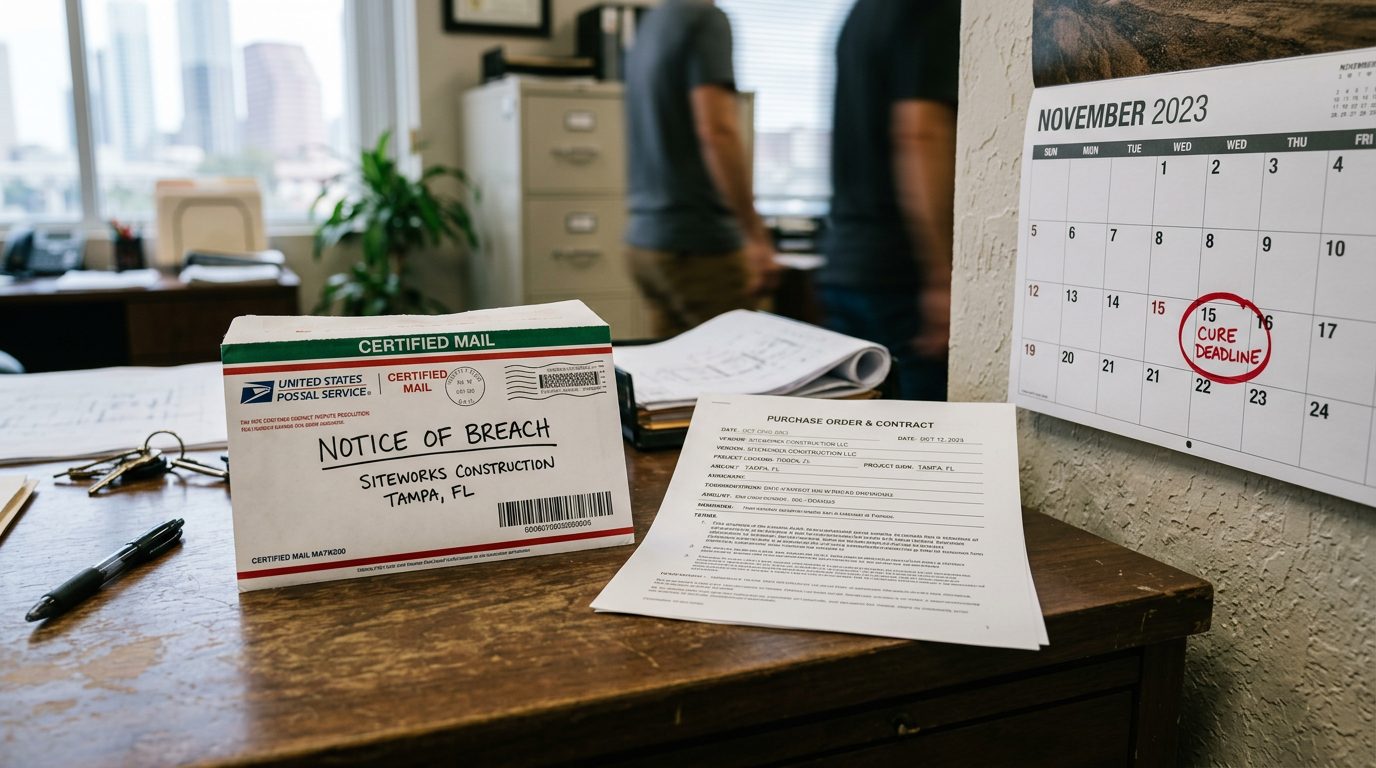
Construction contract dispute resolution is how the parties settle a disagreement that comes from a construction contract. The usual paths are negotiation, mediation, arbitration and court litigation. The dispute clause in your contract often decides which path applies, so check it first.
This page is for contractors, subcontractors, suppliers, owners and developers in Tampa, Hillsborough County and the wider Tampa Bay area. It explains each path, the steps involved and the deadlines that can narrow your options early.
What Construction Contract Dispute Resolution Covers and Who It Serves
Construction contract dispute resolution covers every way a construction disagreement gets settled, from talks between the parties to a court judgment. It applies to private and commercial projects.
The people it serves include general contractors, subcontractors, material suppliers, owners and developers. Each one can end up on either side of a payment, scope or lien dispute.
Ayala Law PA focuses on construction litigation within its business litigation practice. That practice also covers commercial litigation, contract disputes, shareholder disputes and real estate litigation. The work happens in Florida courts and arbitration.
Not sure what your next step is?
Talk it through with our team — we can walk you through how a situation like yours is usually handled and what your options are.
Common Construction Disputes the Firm Handles
Most construction disputes involve money, scope, schedule, liens or fraud. The firm’s construction litigation work covers these categories:
- Unpaid invoices and withheld progress payments between owners, contractors and subcontractors.
- Pay-when-paid and pay-if-paid clauses, which tie a payment to the owner’s own payment. Whether one holds up turns on its wording and Florida law.
- Scope disagreements, disputed change orders and claims for extra work the written contract doesn’t mention.
- Delay claims and disputes over defective or incomplete work.
- Construction liens and lien foreclosure are part of the construction litigation our team handles for businesses in Florida courts.
- Construction contract fraud, such as misstatements in bids, contract terms or payment applications.
Match your situation to one of these categories. That tells you which records to pull first.
Dispute Resolution Paths: Negotiation, Mediation, Arbitration and Litigation
The four main paths are negotiation, mediation, arbitration and court litigation. Each one works differently.
Negotiation is usually the first step. A written demand states the amount in dispute and the contract term that supports it.
Mediation uses a neutral mediator to help the parties reach a settlement. When one party asks, and that party is willing and able to pay the mediation costs or the costs can be equitably divided between the parties, a Florida court must refer most money-damages cases to mediation, unless an exception applies, such as an agreement to binding arbitration. See Fla. Stat. § 44.102.
Arbitration puts the dispute before a neutral arbitrator who hears evidence and issues a binding award. See § 682.02. Arbitrator and forum fees add to the cost. Under § 682.02, the court decides whether an agreement to arbitrate exists or a controversy is subject to it. The orders that can be appealed are listed in § 682.20. See § 682.20.
Court litigation happens in public, under court rules. Florida law generally requires a suit to be filed where the defendant lives, where the claim arose, or where the disputed property sits, with an exception for nonresidents. See § 47.011.
Check the dispute clause before you pick a path. It often sets the forum.
How the Process Works: Steps and Typical Timeline
A typical matter moves from document review to a written demand. From there it goes to mediation or negotiation, and then to arbitration or court if the dispute stays open.
- Intake and document review. Bring the contract, change orders, payment applications, lien notices, correspondence and the project schedule.
- Clause and deadline check. Identify the dispute clause, any notice requirements and the time limits that apply to your claim.
- Written demand and negotiation. The demand states the amount, the basis for the claim and the response you want.
- Arbitration or court filing. If the matter stays open, a demand or complaint starts the formal case. Discovery and a hearing or trial follow.
- Resolution. The matter ends by settlement, award or judgment. Payment or lien release steps may follow.
The length of each stage varies from one matter to the next. The sequence of steps matters more than any set calendar, so plan around the steps.
Deadlines and Steps to Protect Your Position
Deadlines to file suit are set by statute. For actions founded on the design, planning, or construction of an improvement to real property, Fla. Stat. § 95.11(3)(b) provides a four-year period that runs from the date the authority having jurisdiction issues a temporary certificate of occupancy, a certificate of occupancy, or a certificate of completion, or the date of abandonment of construction if not completed, whichever date is earliest. When the action involves a latent defect, the time runs from when the defect is discovered or should have been discovered with the exercise of due diligence. In any event, the action must be commenced within 7 years after that same earliest date.
- The seven-year limit. For actions about the design or construction of an improvement to real property, the action must be commenced within 7 years after the earliest of a temporary certificate of occupancy, a certificate of occupancy, a certificate of completion or the date construction was abandoned. See § 95.11.
- Latent defects. For a hidden defect, the time generally runs from when it was or should have been discovered. Even so, the action must be filed within seven years of the earliest certificate or abandonment date. See § 95.11.
- See § 95.03.
- Lien steps. Notice and enforcement requirements can affect a construction dispute, so reviewing your situation early is worthwhile.
To protect your position now:
- Keep signed contracts, change order requests, daily logs, photos, emails, texts, payment applications and lien waivers.
- Follow the notice steps in your contract. Record the date and delivery method of each notice.
- Review the contract before you walk off a job or stop communicating with the other side.
Why Work With Ayala Law PA on a Construction Contract Dispute
Ayala Law PA focuses on business litigation, including construction litigation, from its only office in Tampa, Florida. Construction work sits inside that business litigation focus, alongside lien foreclosure and construction contract fraud.
The firm serves businesses and entrepreneurs in Tampa, Hillsborough County, Brandon, Riverview, Plant City, Temple Terrace and the Tampa Bay area. The firm’s office is at 1646 W Snow Ave in Tampa, Florida. Businesses in Tampa and Hillsborough County can contact the firm to discuss a matter.
Eduardo A. Maura is the responsible lawyer for this page. Our team handles intake and gathers the contract and project records you bring in. That way the dispute clause and deadlines get reviewed early.
Not sure what your next step is?
Talk it through with our team — we can walk you through how a situation like yours is usually handled and what your options are.
Common Questions About Construction Dispute Resolution
Who usually wins in arbitration?
No one can predict that. The result turns on the contract wording, the records and the decision-maker in each case.
Can I keep working during a dispute?
Your contract’s suspension and termination terms control this. Review them before you stop work.
Do I have to arbitrate if my contract says so?
Florida courts generally enforce a valid arbitration agreement. A court may not refuse to order arbitration just because the claim lacks merit. See § 682.03.
Is mediation required?
Not in every case. A Florida court must refer most money-damages cases to mediation when a party asks, provided the requesting party is willing and able to pay the mediation costs or the costs can be equitably divided between the parties, unless an exception applies. Contracts may also call for mediation before a claim is filed.
Can a contract term be thrown out as unfair?
A Florida court can refuse to enforce an unconscionable term. It must find both unfair dealing in how the deal was made and unfair terms. See Basulto v. Hialeah Automotive.
Does an illegal contract term hold up?
A contract that violates the constitution or a statute is void. Florida courts will not enforce it. See Taboada v. Duarte.
What does a case evaluation cost?
Case evaluations carry a fee, and the firm explains its fee arrangement when you make contact.
Talk With Our Team About Your Construction Dispute
If a payment has stopped or a lien notice has landed on your project, your contract and records are the place to start. You may be reading this for a company or a job you didn’t choose to be part of. Ayala Law PA can review the contract, the deadlines and your dispute options with you. Reach out through the contact page to request a case evaluation.



