
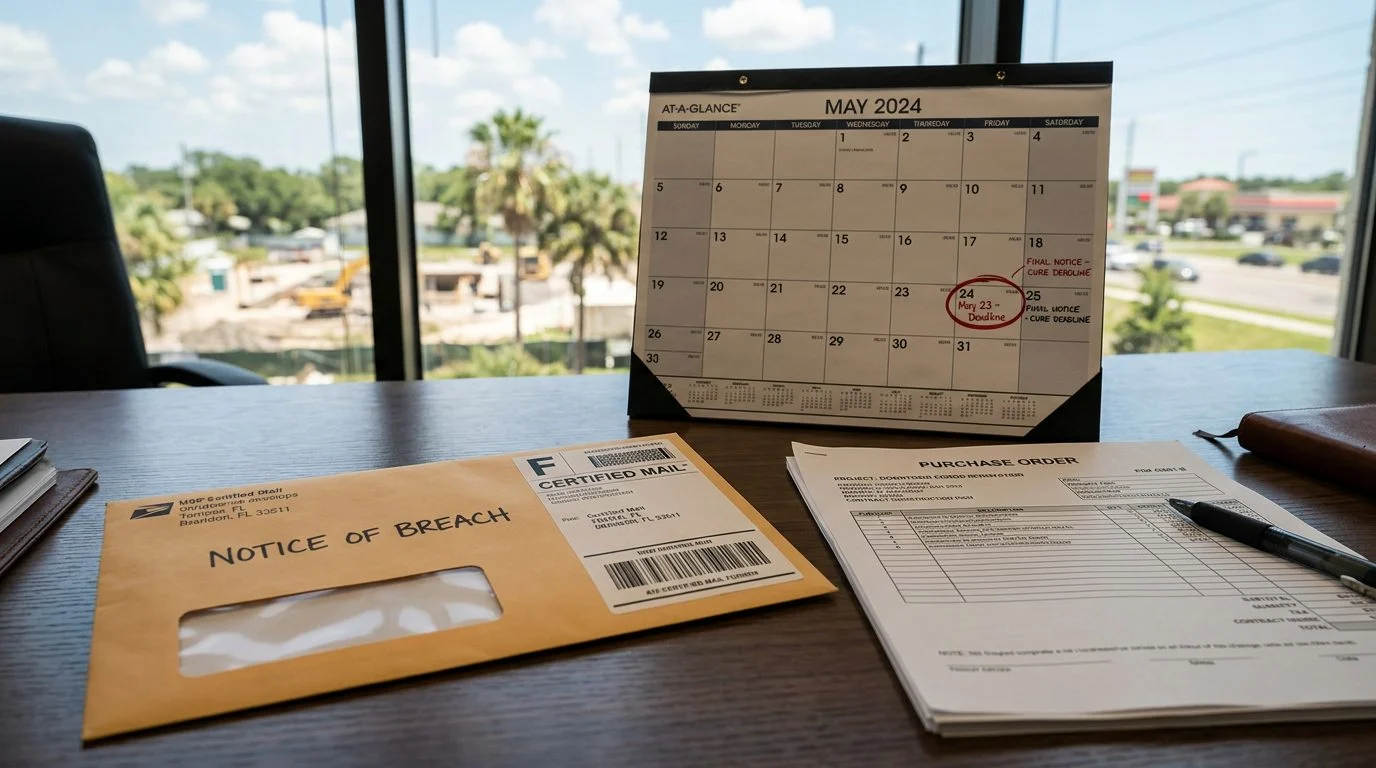
A construction payment withholding dispute in Tampa can stall a job and your cash flow at the same time. If someone is holding back money you earned, the first question is whether the reason is legitimate.
Florida law requires payment of undisputed amounts under the contract, and a real, bona fide dispute is treated differently. Short deadlines apply to liens and notices, so reviewing the facts early keeps more of your options open.
What Payment Withholding Means in a Florida Construction Contract
Payment withholding is when an owner, contractor or other party keeps back all or part of an amount already earned under a construction contract. A late payment is different, because withholding usually comes with a stated reason, such as a defect, a back-charge or a pay-when-paid clause.
Florida’s construction payment statute says a person who receives payment for improving real property must pay the undisputed amounts owed for labor, services or materials, in accordance with the contract terms (Fla. Stat. § 713.346).
This page is for subcontractors, suppliers, general contractors and property owners on projects in Tampa, Brandon, Riverview, Plant City, Temple Terrace and across Hillsborough County. Chapter 713 of the Florida Statutes governs construction liens, and the contract’s own words still decide much of what is due.
Not sure what your next step is?
Talk it through with our team — we can walk you through how a situation like yours is usually handled and what your options are.
Common Reasons Payments Get Withheld on Tampa-Area Projects
Most withholding fights trace back to a few recurring reasons. Knowing which one applies tells you what proof matters most.
- Pay-when-paid language. Some subcontracts pay you only after the upper-tier party is paid. Florida courts do not favor reading a contract step as a condition precedent unless plain language or necessary implication requires it.
- Retainage. A contractor may hold back a share of each payment until completion. Disputes often center on when it is due and whether the work is finished.
- Unsigned change orders. Extra work done on a verbal promise is hard to prove. Signed change orders and written approvals carry the weight.
- Back-charges. An owner or contractor may offset costs for alleged defects, delay or cleanup.
- Stalled approvals. A payment application approved and later reversed leaves a gap in the record.
- Money that stops upstream. When a contractor runs short or a lender stops draws, subcontractors and suppliers often wait last.
The common mistake is waiting for the other side to come around. Silence doesn’t protect your position, and the paper trail thins with every week that passes.
Your Options When a Payment Is Withheld
You can send a written demand, protect lien rights, sue for breach of contract or pursue a bond claim. The right choice depends on where you sit on the project.
- Written demand. A clear letter names the unpaid amount, the contract term you rely on and the records that back it up.
- Construction lien. A subcontractor or supplier not in privity with the owner generally must serve a notice to owner before starting work, or not later than 45 days after starting, but in any event before the owner disburses the final payment. Failing to serve it can be a complete defense to enforcement of the lien.
- Verified complaint. When undisputed amounts stay unpaid 30 days after they became due or after payment is received, whichever is later, the unpaid party can use the procedure in Fla. Stat. § 713.346. Remedies can include an accounting and a temporary injunction. They do not apply to the extent of a bona fide dispute over any part of the contract price, or if the unpaid party committed a material breach of the contract that would relieve the other side of its obligations.
- Arbitration or court. Written arbitration agreements are generally enforceable under Florida law. Fla. Stat. § 682.02 reads: “(1) An agreement contained in a record to submit to arbitration any existing or subsequent controversy arising between the parties to the agreement is valid, enforceable, and irrevocable except upon a ground that exists at law or in equity for the revocation of a contract.”
In a lien enforcement action, the prevailing party is entitled to recover a reasonable attorney’s fee (Fla. Stat. § 713.29).
How the Process Works and the Deadlines That Matter
A payment dispute usually moves through intake, document review, notice, negotiation and, if needed, a filing. The lien and notice clocks often start before the fight is over, so they come first.
- Intake. You describe the project, the parties and the amount in dispute.
- Document review. The contract, payment applications, change orders, lien waivers, emails and daily logs get checked against each other.
- Notices and demands. Notices go out, and lien deadlines are tracked.
- Negotiation or mediation. Many disputes resolve here, where the contract provides for it.
- Filing. If the matter doesn’t resolve, a suit or lien foreclosure action goes to the proper Florida court.
Key clocks: a claim of lien generally must be recorded no later than 90 days after final furnishing (§ 713.08(5)). A lien doesn’t continue longer than one year after recording unless an enforcement action starts (§ 713.22(1)). A licensed contractor generally must pay a subcontractor within 45 days after getting paid, or on the contract terms, absent a bona fide dispute; a contractor who knowingly or willfully violates this rule is subject to disciplinary proceedings (§ 489.1295). Timelines vary with the case and the court calendar.
Why Work With Ayala Law PA on a Tampa Payment Dispute
Ayala Law PA serves Tampa and Hillsborough County clients from its office at 1646 W Snow Ave, Tampa, FL 33606. Clients in Brandon, Riverview, Plant City and Temple Terrace are served from that same Tampa office.
The firm focuses on construction litigation, including contractor and subcontractor disputes, lien foreclosure and construction contract fraud. It also handles business and commercial litigation, contract disputes, shareholder and partnership disputes, real estate litigation and international trade litigation in Florida courts and arbitration.
Eduardo A. Maura is the responsible lawyer for this page. Our lawyers and support staff organize documents and track deadlines, which matters when a payment dispute turns on dates.
A withholding fight often sits inside a wider business relationship. The firm reviews the contract, any bond, any arbitration clause and the fee provisions together. Results depend on the facts of each matter, and no outcome can be promised in advance.
Questions People Ask About Withheld Construction Payments
The first step is usually a written demand and a complete paper file. Here are the questions readers ask most.
What can I do if a contractor doesn’t want to pay me?
Send a written demand that lists the unpaid amount and the contract terms behind it. Then protect your lien rights and gather your contract, invoices and approvals.
How long does a contractor have to pay a subcontractor in Florida?
A licensed contractor generally must pay within 45 days after getting paid, or on the contract terms, unless there’s a bona fide dispute over the amount. The contract and payment history decide the details.
Can I file a lien if the owner says the work was defective?
Possibly. The lien, the notice requirements and the defect claim need to be reviewed together, and a construction defect action requires written notice at least 60 days before filing, or at least 120 days before filing an action involving an association representing more than 20 parcels (§ 558.004).
Does an arbitration clause stop me from going to court?
Florida law generally enforces written arbitration agreements, so the dispute clause in your contract matters. Whether it covers your claim depends on its wording.
How much does it cost to file a lawsuit against a contractor?
Court filing fees and other case costs vary by court and case. The firm discusses its fee arrangement with you directly.
Not sure what your next step is?
Talk it through with our team — we can walk you through how a situation like yours is usually handled and what your options are.
Talk With Ayala Law PA About Your Withheld Payment
A stalled job and tight cash flow are stressful, and your paperwork may be scattered across emails and job files. Start by gathering the contract, payment applications, change orders, lien waivers and key correspondence. To talk through your situation, call (813) 414-5715 or request a case evaluation.



