
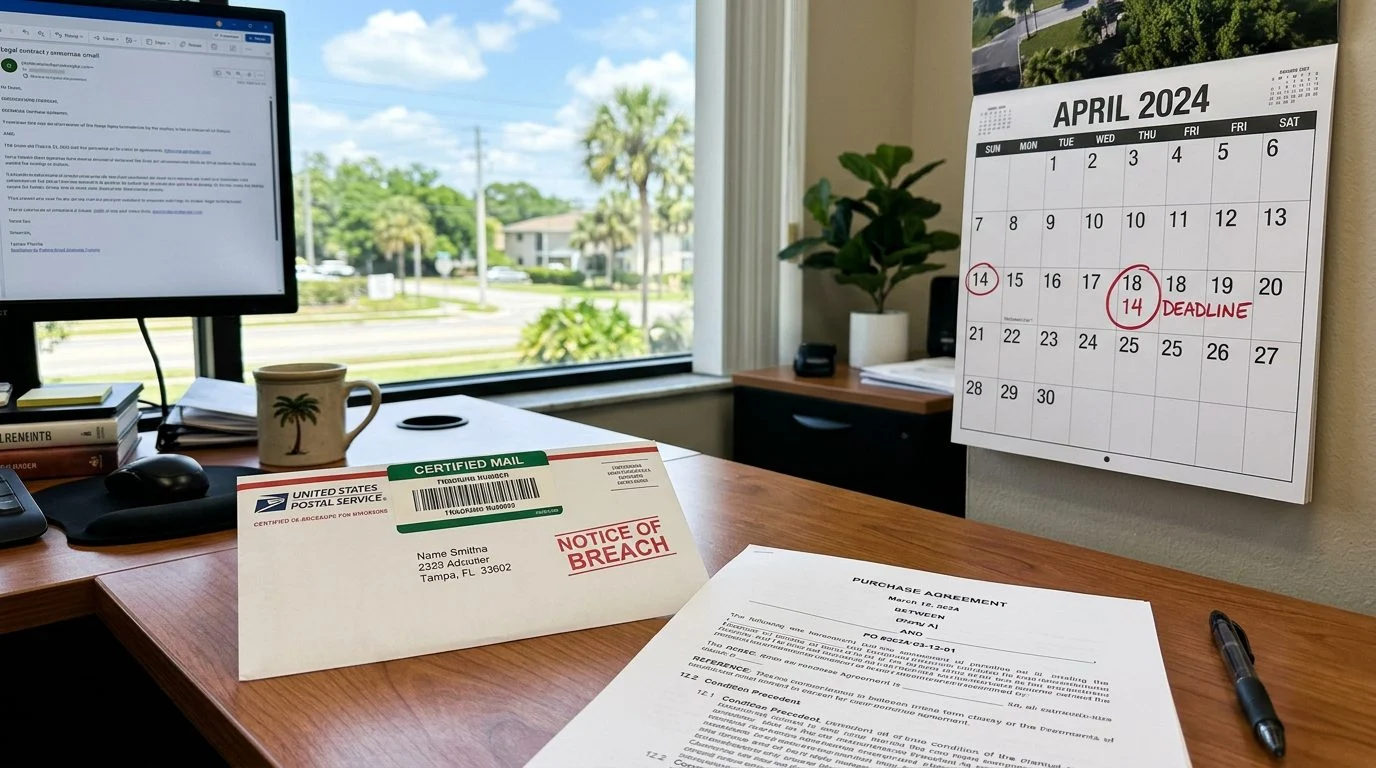
Your counterparty stopped paying, or never delivered, and now says the contract never required it to. That argument often turns on a condition precedent.
In plain terms, a condition precedent is an event that must happen before one party has to perform. If that event never happens, the other party’s duty may never start. Florida courts read the contract’s words to decide whether a clause is a true condition and what it means in practice.
What Does Condition Precedent Mean in a Florida Contract?
A condition precedent is an event, such as a payment, a delivery, or an approval, that must occur before a duty to perform begins. It is something that happens, not something a party promises to do.
Florida contracts still need the basic parts of a deal. The Florida Supreme Court has said an oral contract must meet the basic requirements of contract law, including offer, acceptance, consideration, and enough detail in its essential terms (St. Joe Corp. v. McIver). A condition sits inside those terms. It controls when a promise becomes due.
Take a supplier agreement. The supplier agrees to ship an order, but shipment is due only after the buyer makes its first deposit. The deposit is the condition. Until it is made, the supplier’s duty to ship has not started.
If a counterparty says a required payment or delivery never happened, so its duty never started, you may have a claim worth reviewing. Call (305) 570-2208 or reach out through the contact page. Talk it through with our team — we can walk you through how a situation like yours is usually handled and what your options are.
How Does a Condition Precedent Differ From a Promise?
A promise is something a party must do. A condition precedent is something that must happen first.
Compare two clauses. In the first, the buyer pays a deposit before the seller must deliver. The deposit is a condition precedent. In the second, the seller delivers first, and the buyer’s payment is a promise that becomes due afterward.
A condition subsequent works the other way. It is an event that ends a duty that already exists. The difference matters because it can shift who must prove what in a dispute.
The wording usually controls, not the title. A heading that says “Conditions” may not settle the question, and a clause without that label can still be a condition. How a court reads a particular clause depends on the facts.
What Are Common Conditions Precedent in Business Deals?
Most business conditions fall into four groups: payment, delivery and acceptance, approval, and financing or inspection.
Payment conditions require a deposit or first installment before work or shipment starts. A contractor may agree to begin a job only after the owner’s first payment is made.
Delivery and acceptance conditions require goods to arrive in the agreed condition and be accepted. Under Florida’s sale-of-goods law, Fla. Stat. § 672.606 says acceptance occurs when a buyer, after a reasonable chance to inspect, says the goods conform or keeps them despite a defect; it also occurs when the buyer fails to make an effective rejection, but not until it has had a reasonable chance to inspect, or when the buyer does any act inconsistent with the seller’s ownership, unless that act is wrongful against the seller and the seller has not ratified it.
Approval conditions require a landlord’s, lender’s, or government’s sign-off. In construction, the issuance of a permit can be the trigger for the next phase of work.
Financing and inspection conditions are common in real estate purchase contracts. A buyer may agree to close only if a loan is approved or an inspection is completed by a set date. The same principle applies to business deals.
Conditions can also appear in a purchase order, a subcontract, or a side letter. Read every document that touches the deal.
How Do Florida Courts Decide Whether a Condition Applies?
Courts start with the written words. Terms such as “if,” “provided that,” “subject to,” “upon,” and “contingent on” often signal a condition.
Courts also read the whole contract. One clause can change how another reads, so a single phrase rarely settles the question.
Conduct can matter too. If one side accepted late performance, or signaled it would not hold the other side to a deadline, a court may weigh that.
Unclear wording leads to fights. When a clause could be read two ways, each side argues for its reading, and the evidence decides which reading wins.
What Happens When a Required Payment or Delivery Never Happens?
The other side may not owe performance yet, and the dispute shifts to why the condition failed.
Several rules shape that fight.
Condition versus breach. A condition that never happened differs from a breach, where a party fails a duty it already owes. The remedies and defenses can differ, so identify the problem early.
Some statutes apply to the whole deal. Agreements that cannot be performed within one year must be in a signed writing under Fla. Stat. § 725.01. Fla. Stat. § 725.01 reads: “unless the agreement or promise upon which such action shall be brought, or some note or memorandum thereof shall be in writing and signed by the party to be charged therewith or by some other person by her or him thereunto lawfully authorized.” Contracts for goods priced at $500 or more generally need a signed record under Fla. Stat. § 672.201.
But where an express contract covers the same subject, claims arising from that relationship generally will not support an unjust enrichment claim (Williams v. Johnson).
Time limits to sue also apply. See Fla. Stat. § 95.11. A contract clause that sets a shorter period than the statute allows is void under Fla. Stat. § 95.03.
How Do Conditions Work in Florida Real Estate and Construction Deals?
In a real estate purchase, a financing or inspection condition usually has a deadline. Missing that deadline can decide whether the deal goes forward.
A buyer may argue the contract ended when a financing or inspection condition was not satisfied in time. Notice rules are often central, so read the clause closely.
In construction, a payment condition can control when work continues. A draw request or a signed lien waiver may be a condition to the next payment. The contract’s wording decides much of what each side can do.
One limit applies here. Promissory estoppel generally cannot be used to enforce an oral promise that Florida law requires to be in a signed writing (DK Arena, Inc. v. EB Acquisitions I, LLC).
Ayala Law PA handles contract, construction, and real estate disputes in Florida courts and arbitration.
Not sure what your next step is?
Talk it through with our team — we can walk you through how a situation like yours is usually handled and what your options are.
What Should a Business Do When a Counterparty Says a Condition Was Never Met?
Start by gathering the full paper trail. Pull the signed contract, every amendment, all notices, payment records, delivery receipts, and emails that mention the condition.
Timing often matters as much as wording. A deadline for meeting a condition, or for giving notice, can decide the dispute. For goods that were accepted, a buyer must notify the seller of breach within a reasonable time after discovering or should have discovered the breach, or it will be barred from any remedy (Fla. Stat. § 672.607).
Write down dates as they happen. Keep copies of what you sent and what you received.
What happens if a condition precedent is not met?
The duty that depends on that condition generally does not start yet. Other claims may still exist, based on the contract’s wording.
Can a party waive a condition in Florida?
Is a condition precedent the same as a condition subsequent?
No. A condition precedent must happen before a duty starts. A condition subsequent ends a duty that already exists.
Eduardo A. Maura is responsible for this page. Ayala Law PA’s office is at 1646 W Snow Ave in Tampa, Florida, and the firm represents businesses in Tampa and Hillsborough County. The firm handles business contract disputes for clients in Tampa and Hillsborough County.
If a counterparty says a required payment or delivery never happened, so its duty never started, you may have a claim worth reviewing. Call (305) 570-2208 or send your details through the contact page.



