
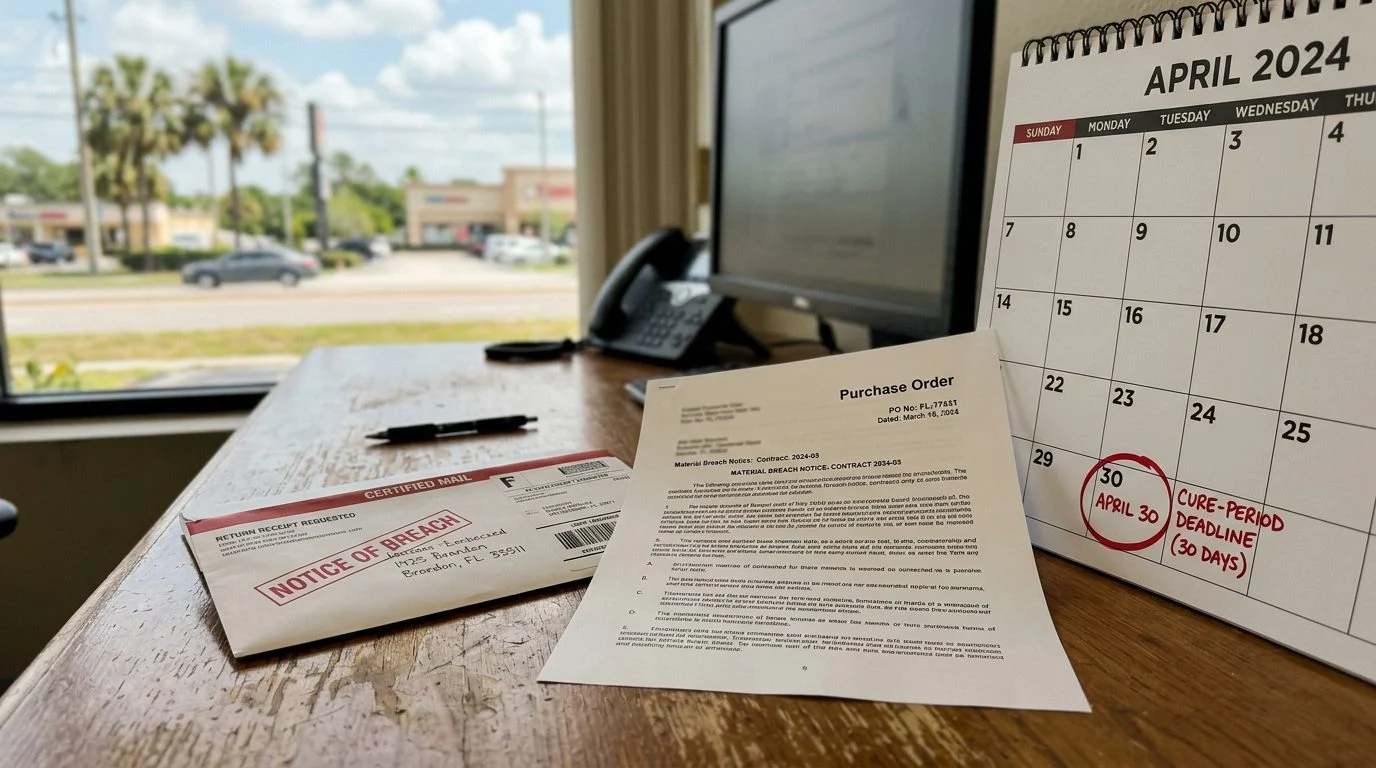
Yes, you may be able to cancel a business contract for material breach in Florida, but only when the breach is serious and you follow the contract’s own steps. A minor problem usually does not let you walk away. This guide explains the questions that decide the answer, so you can review your situation before you stop work or stop payment.
What Counts as a Material Breach Under Florida Law
A material breach is a failure that defeats the main reason the parties made the deal. It takes away a core benefit you bargained for, not just a small piece of the agreement.
Courts usually weigh several things.
A breach is not automatically material just because a deadline slipped or a term was technically broken. A two-day delay in a six-month project may be minor. Failing to deliver the equipment the whole project depends on is much more likely to be material.
If a business partner or supplier has stopped performing and you're unsure whether you can walk away, our team is ready to talk through your contract with you. Talk it through with our team — we can walk you through how a situation like yours is usually handled and what your options are.
Minor, Material, Fundamental, and Anticipatory Breach Compared
The four types of breach are minor, material, fundamental, and anticipatory. Each one leads to different options, so sorting your facts matters.
- Minor (partial) breach: The other side missed part of its duty.
- Material breach: The failure goes to the heart of the deal. You may generally pause your own performance and, if the breach is serious, end the contract. You can still pursue damages.
- Fundamental (total) breach: The other side failed to perform at all, or so completely that the contract’s purpose is lost. This is often the clearest case for ending the deal.
- Anticipatory breach: The other side clearly says, by words or conduct, that it will not perform when the time comes. You may be able to treat the contract as breached before the deadline arrives.
Write down what the other side did or failed to do. Then match those facts to one category. The label matters less than the facts behind it.
Start With the Contract: Termination, Notice, and Cure Provisions
The contract’s own termination and notice terms usually control first. Read the default definition, the termination clause, the notice method, and any cure period. A cure period is a window the contract gives the other side to fix the problem after you send notice.
Check these details closely:
- The notice address and delivery method. Many contracts require notice by certified mail or to a named person. A notice sent to the wrong place may not count.
- Whether notice must come before termination takes effect. Some clauses require written notice and a waiting period.
- Whether the termination clause is narrower than general law. An express clause may allow cancellation only for listed events.
A contract cannot cut the time to sue below the limit set by law. Under Fla. Stat. § 95.03, a contract provision that sets a shorter period to bring a claim than the statute of limitations is void.
For a broader look at Florida contract disputes, read our Florida contract disputes guide for Tampa-area businesses.
Cancelling the Right Way, and When Cancelling Becomes the Breach
Cancelling is safest when the breach is material and you follow the contract’s steps exactly. Before cancelling a contract, it helps to review its terms and any notice requirements, since how a cancellation is handled can affect what happens next.
Timing matters too. If you keep accepting performance after you learn of the breach, the other side may argue you chose to keep the deal. Florida courts have described a related idea for voidable contracts. In Flaherty v. Flaherty, the court explained that ratification occurs when a party who can rescind a voidable contract fails to do so after learning the facts that justify rescission.
For a sale of goods, timing rules are strict. Under Fla. Stat. § 672.607, a buyer that has accepted goods must notify the seller of a breach within a reasonable time after discovering it or after it should have discovered it, or it can be barred from any remedy.
You generally have two paths. You can terminate and seek damages, or you can keep the contract alive and sue for the breach. The paths carry different consequences, so choose deliberately. If the contract sends disputes to arbitration, Fla. Stat. § 682.02 makes a written arbitration agreement valid and enforceable, except on grounds that exist to revoke any contract.
Keep your steps simple. Put the notice in writing, state the basis, follow the delivery method, and keep copies. If you’re considering passing your obligations to someone else instead of ending them, see our guide on assigning a business contract without consent.
Does a Three-Day Rule Let You Cancel a Business Contract?
Do not assume a three-day window applies to your business contract. Start with the contract itself and look for any cancellation or review period written into it. Some agreements set their own timing, so the contract’s wording is worth reviewing closely.
Next, build a clear timeline. Note the date you signed, the date each delivery or payment was due, and the date each side last acted. Save every written notice, email, and text that shows what happened and when.
Also check what the other side has said. A statement that it will not perform, or a missed deadline it confirms in writing, can change how the timing looks. Keep those messages in their original form so the dates can be checked later.
Damages and Remedies When the Other Side Breached
Contract damages are one form of remedy when a contract is breached.
Some losses are harder to recover. Consequential damages are losses that follow indirectly from the breach, such as lost profits on a later job. Courts decide that question case by case.
Attorney’s fees work differently. Fees are usually recoverable only when the contract or a statute provides for them. Under Fla. Stat. § 57.105, if a contract allows fees to a party that must act to enforce it, the court may also allow fees to the other side when that side wins, whether it was the plaintiff or the defendant, but only for contracts entered into on or after October 1, 1988. Review the fee clause before you act.
If your contract sets a fixed amount for a breach, that clause changes the remedy picture. Read our guide on liquidated damages clauses before relying on any number in the contract.
Not sure what your next step is?
Talk it through with our team — we can walk you through how a situation like yours is usually handled and what your options are.
Proving the Breach and Preserving Your Records
Your strongest proof is usually the signed contract plus a dated record of what each side did. The records you need most are the signed contract and any amendments, the performance schedule, invoices, payment records, emails and texts, meeting notes, and written notices or cure requests.
Build a timeline that matches each duty in the contract with what actually happened. Keep originals, and do not edit, delete, or re-date documents. Changing or discarding records can create serious problems if the dispute goes to court or arbitration.
Note any statements from the other side that show it did not intend to perform. Florida law recognizes that a promise of future action can support a fraud claim if the promisor had no intention of performing, or a positive intention not to perform. The Fourth District discussed this point in Frutafino, S.A.S. v. Dole Chile, S.A..
Be careful with settlement talks. Under Fla. Stat. § 90.408, an offer to compromise a disputed claim, as well as relevant conduct or statements made in negotiations about a compromise, generally cannot be used to prove liability or the value of the claim.
When a Contract May Be Void Rather Than Terminated
A void contract never had legal effect. A voidable contract can be undone by the party entitled to undo it. The same facts can raise both a breach question and a validity question, so the framing matters.
Some contracts must be in writing. Under Fla. Stat. § 725.01, an agreement that cannot be performed within one year of its making cannot be enforced unless it, or a note of it, is in writing and signed by the party to be charged.
Mistake works in a narrow way. In Waterside at Boynton Homeowners’ Ass’n v. Southern Homes of Palm Beach, LLC, the Fourth District explained that rescission for a mutual mistake requires a mistake that is mutual and concerns a fact of the essence of the contract.
Fraud can also matter, as explained above. Each of these grounds turns on its own record, so gather the facts early.
Frequently Asked Questions
Can I cancel a business contract for material breach Florida courts would support?
You may be able to if the breach is material and you follow the contract’s notice and cure steps. Ending a deal without a valid basis can expose you to a claim.
What are the four types of breach?
They are minor, material, fundamental, and anticipatory breach. Each one leads to different options.
Is there a three-day rule for cancelling a contract?
Do not assume one for a business contract. Check the agreement for any cancellation period it gives.
What can void a contract?
Missing writings required by statute, mistake, duress, and fraud can each affect validity. Each case is judged on its own record.
Talk Through Your Contract With Ayala Law PA Before You Stop Performing
The safest next step is to review the contract and the facts before you stop performing. That is a hard position when a partner, supplier, or contractor has stopped delivering or paying. You may be worried that stopping your own work will expose your company to a claim.
Ayala Law PA focuses on business litigation. The firm handles commercial and contract disputes, shareholder and partnership disputes, construction litigation, real estate litigation, and international trade litigation in Florida courts and arbitration. The firm serves businesses in Tampa, Hillsborough County, and the wider Tampa Bay area from its Tampa office at 1646 W Snow Ave, Tampa, Florida.
Consultations are not offered on a no-fee basis, so ask about fee terms when you reach out.
If you’re weighing whether you can end a contract over a breach, call (813) 414-5715 or request a case evaluation to talk through your facts.
This page is the responsibility of Eduardo A. Maura, Ayala Law PA, whose office is at 1646 W Snow Ave, Tampa, Florida.



