
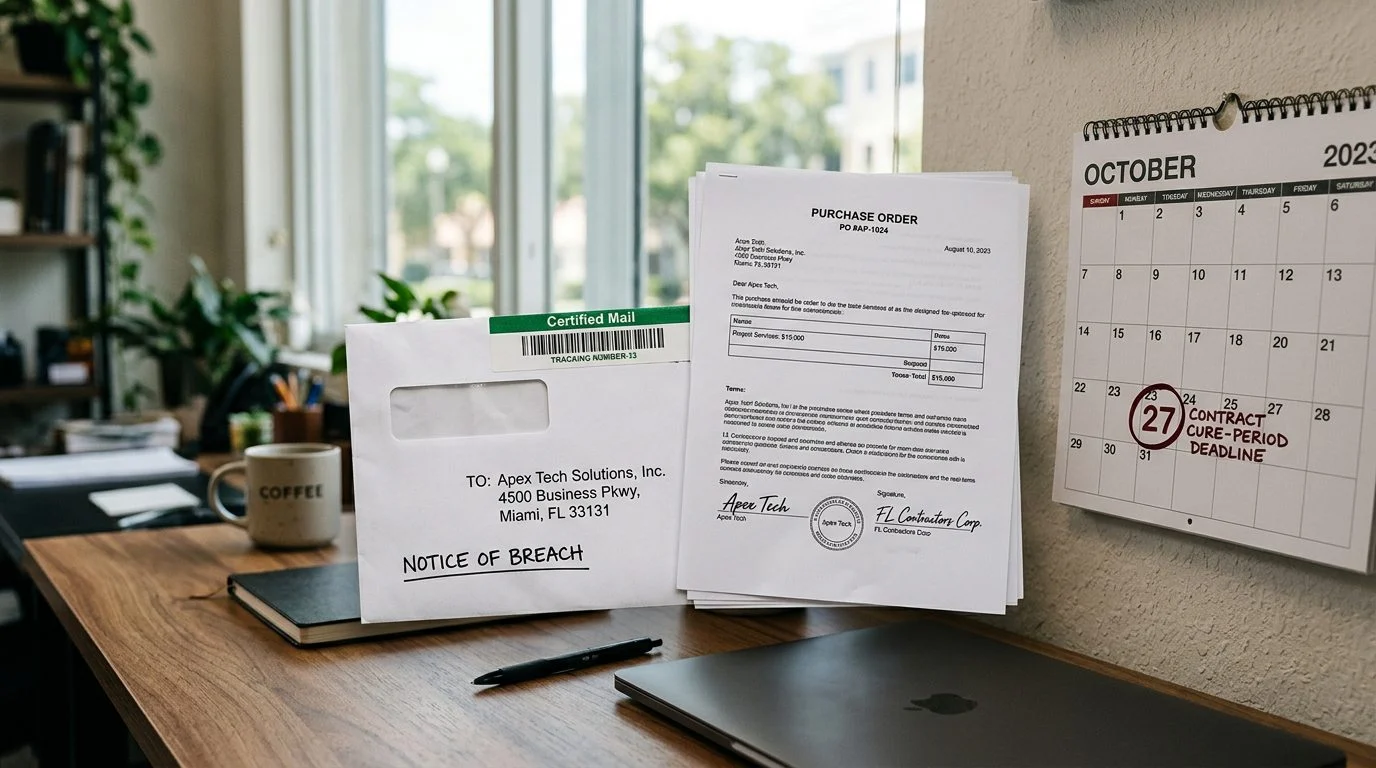
The Short Answer: Sometimes, but the Wording and Evidence Decide It
Yes, sometimes. Changes to a contract can appear in later emails, texts, signed amendments or the parties’ conduct, and how those materials are viewed depends on the facts of each dispute.
Contract modification by email Florida disputes usually come down to one question: did both sides agree to the same specific change? Many owners assume a quick email settles it. Sometimes it does. Often the other side says the change never took effect.
This page is general information for business owners. It does not decide any particular dispute. Eduardo A. Maura is the responsible lawyer for this page. The firm’s only office is in Tampa, Florida, at 1646 W Snow Ave, and it represents businesses in the Tampa Bay area. The firm handles business litigation, commercial litigation, contract disputes, shareholder disputes, construction litigation, real estate litigation and international trade litigation for businesses in Tampa, Hillsborough County and the Tampa Bay area.
Not sure what your next step is?
Talk it through with our team — we can walk you through how a situation like yours is usually handled and what your options are.
What a No-Oral-Modification Clause Does and Does Not Do
A no-oral-modification clause says changes must be in writing and signed by the parties. Many commercial contracts include one. Its purpose is to prevent fights over what someone said on a call or in a meeting.
The clause doesn’t always end the discussion. If both sides sign a written change, that signed record is the clearest way to meet a writing requirement.
Clauses differ. Some require a signature. Others only require a writing. That difference matters when you review an email chain. A message ending in a typed name may or may not satisfy the clause, and the wording controls.
Read three clauses together: the amendment clause, the notice clause and the integration clause. The integration clause says the written contract is the full deal. Reading only the amendment clause can miss how the parties meant changes to work.
How Courts Look at Emails, Texts and Signed Writings
Talking about a change is not the same as making one.
For contracts for the sale of goods, Florida law says an offer can be accepted in any manner and by any medium reasonable in the circumstances, unless the offer clearly indicates otherwise (Fla. Stat. § 672.206). That is why an email can matter. It still has to show a real agreement.
Two emails can look alike and carry very different weight. One confirms a change both sides already made. The other proposes a change the other side never answered. The first is usually stronger evidence. The second may show only an idea.
In a contract modification by email Florida dispute, a court may read the whole chain as one record. It looks at the order, the dates and whether a message points back to the original contract by section or date. A short reply that skips the proposed change may not count as acceptance, and that is a fact question.
Under Florida law, an electronic signature can have the same effect as a written signature, unless other law says otherwise (Fla. Stat. § 668.004). An electronic signature uses letters, characters or symbols with intent to authenticate a writing (Fla. Stat. § 668.003). Whether a typed name or signature block counts turns on those facts.
Text messages and social media posts follow the same logic. What they say, who sent them and how the parties usually talked all matter.
Verbal Changes, Waiver and Conduct
A spoken change to a contract that needs a signed writing is often hard to enforce. Conduct can still matter, though. Several ideas come up often in these disputes.
If the other side relied on that choice, the dispute may turn on it.
Years of accepting late payments can show how both sides understood the deal.
Florida’s sales-of-goods rules say a contract may be made in any manner that shows agreement, including conduct by both parties that recognizes the contract (Fla. Stat. § 672.204). Conduct can help prove a deal exists. It does not automatically prove the terms changed.
Promissory estoppel, a related idea, cannot be used to enforce an oral promise that the statute of frauds requires in a signed writing. The Florida Supreme Court said so in DK Arena, Inc. v. EB Acquisitions I, LLC.
Where an express contract covers the same subject, a claim for unjust enrichment generally will not stand, as the court explained in Williams v. Johnson.
These are arguments that need proof. A general description cannot show how they would apply to your emails and records.

Florida Rules That Can Affect a Contract Change
The statute of frauds requires a signed writing for some agreements. One example is an agreement that cannot be performed within one year of when it was made (Fla. Stat. § 725.01). A change that extends a multi-year deal may raise this question. Without a signed writing, the law generally bars a suit on that agreement.
For contracts for the sale of goods, Florida requires a signed record when the price is $500 or more (Fla. Stat. § 672.201). A contract that misses this rule can still be enforced in limited cases. One case is when the other side admits in court that a contract was made, and then only up to the quantity admitted.
Between merchants, a written confirmation of the contract that is sufficient against the sender and received within a reasonable time can satisfy the writing rule against the receiver, if the receiver has reason to know its contents. Between merchants, the receiver must give notice of objection in a record within 10 days after receiving the confirmation, or the confirmation can satisfy the writing rule against them. That 10-day window is a short deadline to watch.
These rules interact with each other and with the contract’s terms. Which rule applies turns on the type of contract.
Handling Changes So the Record Is Clear
Write the change in specific terms. Name the section being changed, the original contract date and the new price, deadline or scope. Then ask the other side to confirm in writing.
Keep one file for each contract. It should hold every email, text, signed amendment, invoice and note of a call, with dates and names. That file is what you’ll need if a dispute starts.
Don’t rely on a phone call or a casual text to change a payment term. If a call happens, send a short follow-up that restates the change. Ask the other side to reply in writing.
Check authority. Ask whether the person who agreed to the change could bind the company. A title or role can be disputed later, so keep proof of who approved it.
A clear written amendment reduces disputes. It does not replace a review of the contract and the full record.
Not sure what your next step is?
Talk it through with our team — we can walk you through how a situation like yours is usually handled and what your options are.
Related Reading and Next Step
For a broader view, read our Florida contract disputes guide for Tampa area businesses. If the question involves a mistake or misrepresentation, see the set-aside guide. The firm’s Tampa and Hillsborough County pages describe the businesses it serves in those areas.
Frequently Asked Questions
Is a contract modification by email enforceable in Florida?
Sometimes. An email can show a change if it states the new term clearly and both sides agreed to it.
Is a verbal change to a written contract enforceable?
It is often hard to enforce when the contract requires a signed writing. Conduct and waiver can still come up in a dispute.
Do text messages count as a signed writing?
Sometimes. Florida gives an electronic signature the same effect as a written one, unless other law says otherwise.
Does a no-oral-modification clause stop every change?
It doesn’t always end the question.
The firm charges for case evaluations, and this page does not quote a price. If an email or text says your price, deadline or scope changed while your signed contract says otherwise, call (305) 570-2208 or contact us to review the documents.



