

If the buyer has stopped paying an earnout, holdback, or other deferred sale payment, you may have a contract claim. Whether you have one turns on the written purchase agreement, the definitions it uses, and any notice terms. Ayala Law PA focuses on business litigation and contract disputes, including payment disputes that follow a business sale. The firm’s only office is at 1646 W Snow Ave in Tampa, Florida. It represents businesses and entrepreneurs in Hillsborough County and the Tampa Bay area, including Brandon, Riverview, Plant City, and Temple Terrace.
What an Earnout or Purchase Agreement Payment Dispute Is
An earnout is part of the sale price that the buyer pays later, and only if the business hits stated targets. Those targets might be revenue, gross profit, EBITDA (earnings before interest, taxes, depreciation, and amortization), or a milestone.
Other deal terms work the same way. A seller note is a loan from the seller to the buyer. A holdback or escrow sets aside part of the price in a separate account. A working capital adjustment changes the price based on the cash, inventory, and bills on hand at closing.
This page is for two kinds of readers. Sellers who are waiting on money they believe is owed. Buyers who have received a demand they think is unfair. In both cases, the dispute usually turns on the written agreement, its definitions, and the accounting method it requires. For background, see our Florida contract disputes guide.
Not sure what your next step is?
Talk it through with our team — we can walk you through how a situation like yours is usually handled and what your options are.
Why Buyers Withhold or Dispute Earnout and Purchase Price Payments
Buyers usually withhold deferred money for reasons tied to the numbers or to the seller’s conduct after closing. These are common patterns, not predictions about any deal.
- Missed targets. The buyer says the target wasn’t met, using a revenue or profit figure the seller disputes.
- Accounting disagreements. The parties calculate revenue, costs, or add-backs differently under the agreement’s definitions.
- Covenant claims. The buyer says the seller broke a promise, such as running the business in the ordinary course.
- Set-off claims. The buyer says an indemnity claim should reduce what it owes.
- Changes after closing. New ownership changes staffing, pricing, or accounting, which makes the earnout hard to check.
Each pattern turns on the contract language. Read the exact definitions before deciding how strong a claim or defense is.
What Ayala Law PA Handles in Earnout and Purchase Agreement Disputes
The firm handles earnout and purchase agreement payment disputes within its business litigation and contract dispute work. Our team can work with either the seller or the buyer.
- Document review. We read the purchase agreement, earnout schedule, definitions, accounting terms, and any dispute clause.
- Demand letters and negotiation. We send written demands and request the financial records the agreement gives a party the right to see.
- Breach of contract claims. We pursue unpaid earnout, holdback, or purchase price amounts.
- Set-off defense. We respond to indemnity demands that would reduce payments owed.
- Court and arbitration. We file suit in Florida state courts, including Hillsborough County, or pursue arbitration when the agreement requires it.
- Mediation. We take part in mediation and settlement talks when the agreement or the court calls for them.
The firm’s practice areas also include shareholder disputes, construction litigation, real estate litigation, and international trade litigation. This page covers the earnout and payment side only.
How an Earnout Dispute Typically Unfolds, Step by Step
A typical earnout dispute moves from document review to notice, demand, negotiation, and then a filing if talks fail. The timeline varies with the forum, the records, and both sides’ schedules.
- Intake. You share the purchase agreement, amendments, closing statement, and payment history. We identify deadlines and notice requirements.
- Notice and cure. Many agreements require written notice of a claimed breach and a cure period before any lawsuit. We check compliance on both sides.
- Demand and records request. A written demand states the amount claimed, the contract basis, and the records needed to check the math.
- Negotiation or mediation. Talks test the earnout calculation against the contract definitions. In a filed civil action for monetary damages, a party that is willing and able to pay the mediation costs, or whose costs can be equitably divided between the parties, can ask the court to refer it to mediation under Fla. Stat. § 44.102, unless an exception applies. Mediation communications are generally confidential under Fla. Stat. § 44.405.
- Filing. If talks fail, we file a complaint or demand arbitration. Arbitration agreements contained in a written record are valid, enforceable, and irrevocable, except on a ground that exists at law or in equity for revoking a contract, under Fla. Stat. § 682.02.
- Discovery and hearing. Both sides exchange financial records and testimony, then move toward motions, a hearing, or trial.
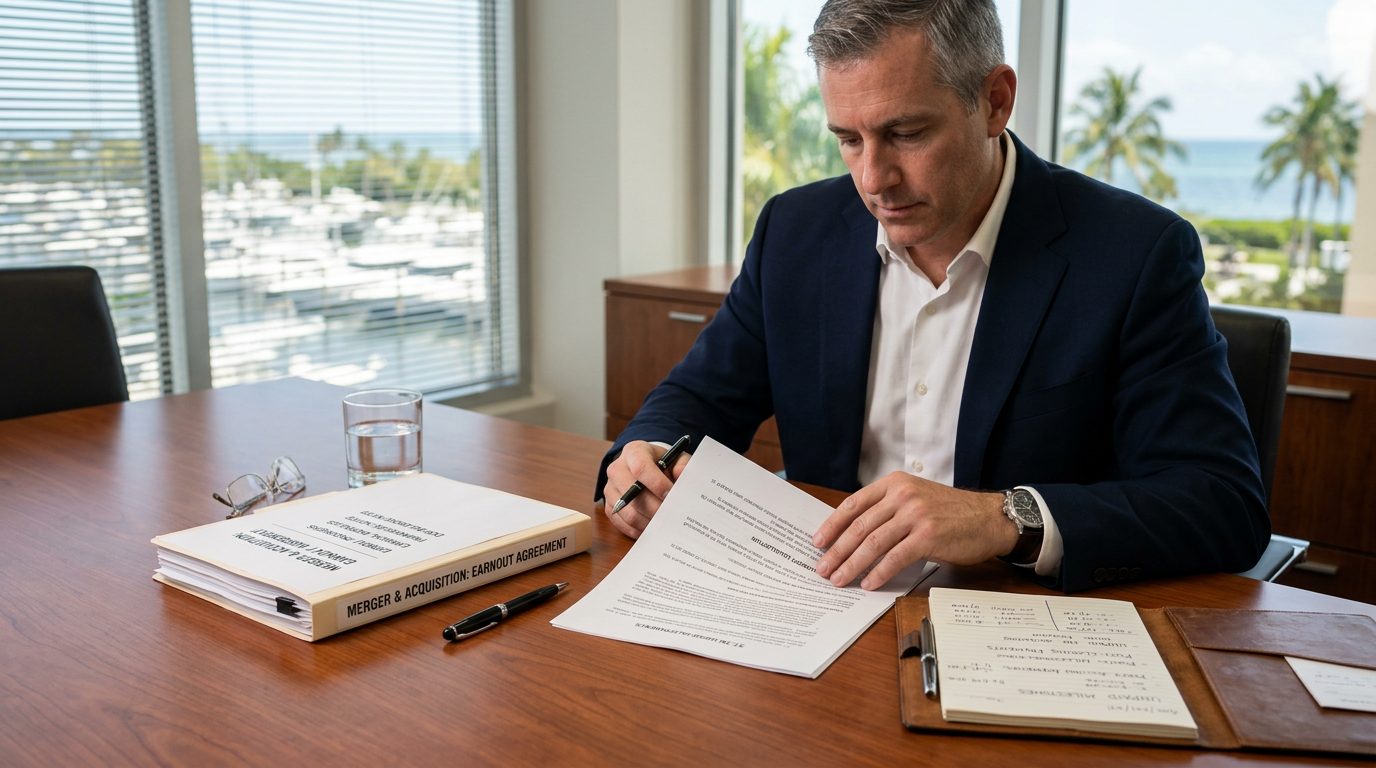
Documents to Gather and the Contract Language That Controls
The purchase agreement and its definitions usually control an earnout dispute. Gather these documents first.
- Core documents: the signed purchase agreement, all amendments, the earnout schedule, the closing statement, and any escrow or holdback agreement.
- Performance records: monthly or quarterly financial statements, tax filings for the earnout period, and the accounting method used.
- Communications: emails and letters about the calculation, operating decisions, and any written notice of breach or set-off.
As you read, ask these questions:
- Does the agreement allow a set-off, and must the buyer give written notice first?
- Which accounting principles and definitions apply, and does the buyer’s math follow them?
- Does the agreement require arbitration, mediation, or a specific court?
The implied covenant of good faith cannot override the contract’s express terms, under QBE Ins. Corp. v. Chalfonte Condo. Apartment Ass’n. Time limits for contract claims are set in Fla. Stat. § 95.11. Claims on written and unwritten contracts fall under different periods. A contract clause that shortens that period is void under Fla. Stat. § 95.03.
Options Before Litigation: Negotiation, Demand Letters, and Mediation
Negotiation and a written demand often come before any lawsuit or arbitration. Narrow disputes over one calculation or one set-off often resolve here.
- Direct negotiation. The parties walk through the numbers together. This is often the fastest route.
- Demand letters. A letter sets out the contract basis, the amount claimed, and the records requested.
- Mediation. A neutral mediator helps each side test its position against the agreement’s terms.
- Standstill agreements. The parties can agree in writing to hold off on filing while they exchange records. The agreement should address any deadlines.
- Settlement offers.
If an arbitration is pending, Fla. Stat. § 95.051 tolls the running of the limitations period for that dispute.
Not sure what your next step is?
Talk it through with our team — we can walk you through how a situation like yours is usually handled and what your options are.
Why Work With Ayala Law PA on a Business Sale Dispute
Ayala Law PA focuses on business litigation. Its work on earnout disputes starts with the agreement’s definitions and the payment records. Eduardo A. Maura is the responsible lawyer for this page. The firm’s lawyers handle matters in Florida courts and arbitration.
The firm’s office is at 1646 W Snow Ave in Tampa, Florida. The firm, whose only office is in Tampa, represents businesses and entrepreneurs in Hillsborough County and across the Tampa Bay area, including Brandon, Riverview, Plant City, and Temple Terrace. Under Fla. Stat. § 47.011, a case may be brought only where the defendant resides, where the claim arose, or where the property in litigation is located. This section does not apply to actions against nonresidents.
One common mistake is waiting too long to read the notice and dispute clauses. Those clauses can set steps that must happen before a lawsuit or arbitration. Our team reviews the documents first and then recommends a path.
Frequently Asked Questions About Earnout Disputes in Florida
Can I sue if the buyer stops paying my earnout?
It may be possible. The agreement’s notice, cure, and dispute terms decide the next step.
Do I have to keep running the business the same way after the sale?
Some agreements include operating covenants for the earnout period. Your contract’s wording controls.
Can a buyer reduce my earnout because of an indemnity claim?
Only if the agreement allows set-off and the buyer followed its notice steps.
Does an earnout dispute have to go to arbitration or court?
Check the dispute clause. Under Fla. Stat. § 682.03, on motion of a person showing an agreement to arbitrate and alleging another person’s refusal to arbitrate, a court can order arbitration when a valid agreement to arbitrate exists. Fla. Stat. § 682.03 reads: “(b) If the refusing party opposes the motion, the court shall proceed summarily to decide the issue and order the parties to arbitrate unless it finds that there is no enforceable agreement to arbitrate.”
How long do I have to sue?
Florida sets limits in Fla. Stat. § 95.11.
How much will this cost?
Fees vary with the matter, and the firm explains how fees work when you reach out.
If a buyer has stopped paying your earnout or cut the amount, reach out through our contact page to talk through your purchase agreement and the payments in dispute.



