
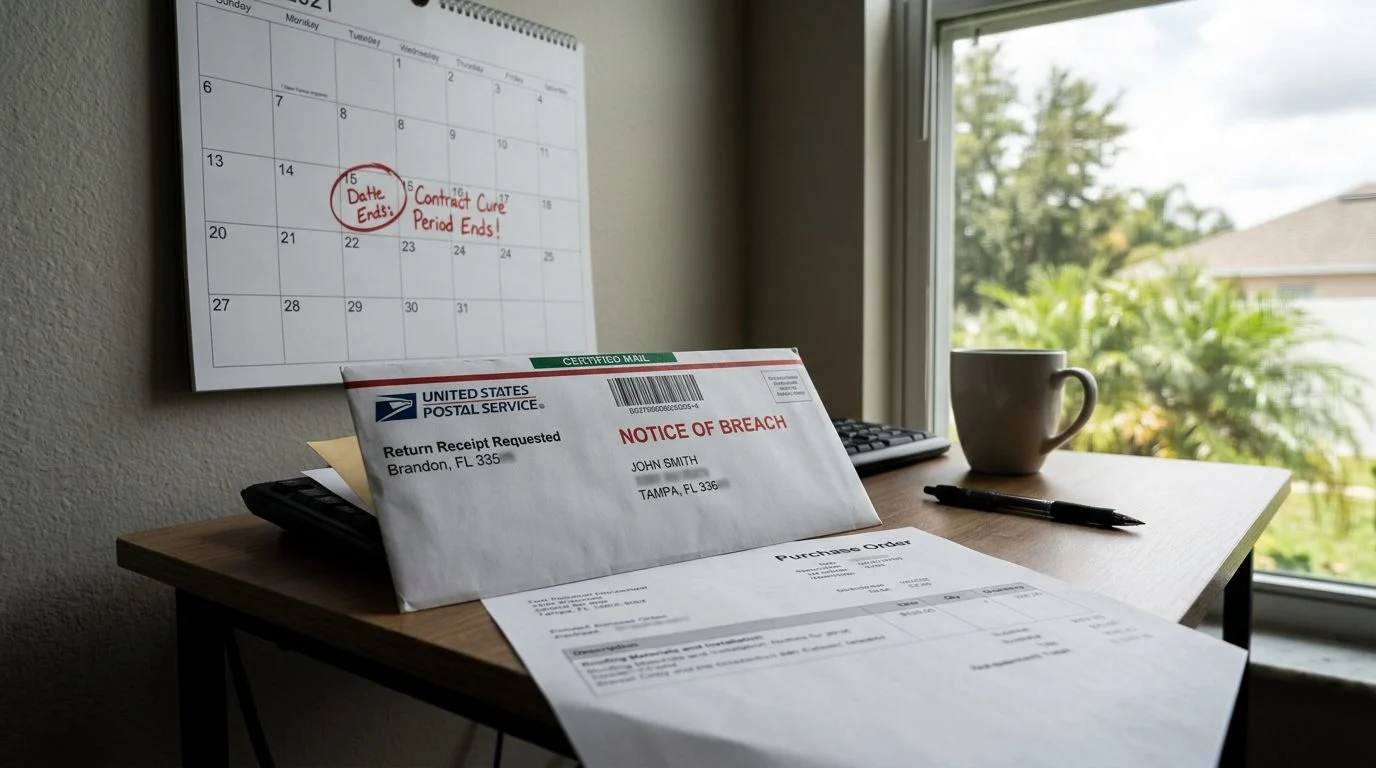
What damages can I recover for breach of contract in Florida? Money losses caused by a breach are a common focus of these disputes. The amount depends on the type of loss, whether you can prove it, and what the contract says. This page walks through the main categories, the proof each one needs, and the limits that often change the final number.
What Damages Mean in a Florida Breach of Contract Claim
Compensatory damages are the core of most breach of contract claims. They aim to cover the loss the breach caused, so your business ends up where it would have been if the deal had been performed. Think of them as a way to repair the harm, not as a punishment for the other side.
Contract disputes often turn on the terms of the agreement and what each side did under it. The firm’s breach of contract lawyer guide covers that framework in full, so this page focuses on the damages piece.
How much you can recover depends on the facts and the terms of your contract. Two deals with the same breach can produce very different numbers. The amount turns on proof and on what the parties agreed.
If your deal involves goods, such as equipment, materials or inventory, the rules sit in Chapter 672 of the Florida Statutes. Those rules add their own notice requirements. For example, if you accepted the goods, you must notify the seller of the breach within a reasonable time after you discover or should have discovered it, or you will be barred from any remedy. See Fla. Stat. § 672.607.
Not sure what your next step is?
Talk it through with our team — we can walk you through how a situation like yours is usually handled and what your options are.
Direct Damages: The Losses That Flow Straight From the Breach
In a supply deal, that often means the gap between the contract price and what you must pay someone else for the same goods.
Here is a simple example. A supplier agrees to deliver 500 steel brackets at $12 each, then fails to deliver. You buy the same brackets elsewhere at $15 each. Your direct loss is $3 per bracket, or $1,500 in total.
Proof matters most here. Keep the signed contract, the purchase order, the replacement quotes, and the invoice from the new supplier. A bid you received before the breach is often stronger evidence than a number you calculate later.
The example is simplified. Real deals often include discounts, delivery charges and other terms. Each one should be documented, because each one can change the math.
Consequential Damages: Foreseeable Losses Beyond the Contract Price
Consequential damages are losses that come from the breach indirectly. A common example is a lost customer order caused by a supplier’s delay that stopped your production line.
These losses are harder to recover than direct losses. A supplier that never heard about your customer’s deadline may argue it could not have expected the loss.
That’s why written communications matter. An email or purchase order that says a shipment must arrive before a fixed event shows the other side knew about the special circumstance. Save those messages and the signed documents that show what each side understood at signing.
Also check whether the contract limits this category. Some contracts waive consequential damages entirely. We cover those terms later on this page.
Incidental Damages: The Costs of Responding to the Breach
Incidental damages are the reasonable costs you pay while responding to a breach. They can include inspecting rejected goods, storing them, shipping them back, or paying a rush fee to get replacement performance.
Two tests keep these costs honest. First, the expense must be reasonable. A rush shipment ordered because a delivery failed fits that test. A payroll cost you would have paid anyway usually does not.
This line trips up many claims. Some businesses add regular wages, rent or overhead to their damages figure. Those are ordinary operating expenses. They are not automatically part of the loss the breach caused.
Keep dated receipts, shipping bills, and a simple log of the extra steps you took. The log should show what happened, when it happened, and why you acted.
Lost Profits: What Must Be Proven
Courts look for hard evidence. That can include contracts with other customers that were lost or delayed, your sales history for similar periods, financial statements, and market data. The stronger the pattern of past performance, the easier it is to show what the breach cost.
Lost profits come in two measures. Lost gross revenue is the money you would have taken in.
Here is an illustration. If you lost $40,000 in sales and avoided $25,000 in costs, your lost net profit is $15,000. Using the gross number without subtracting avoided costs can overstate the loss.
A newer business faces a harder road. Without a track record, there is less history to show what future profits would have looked like. That is a practical point, not a prediction about any case.
Mitigation of Damages: The Duty to Limit Losses
If a supplier misses a delivery and you wait three months to find another source, the other side will argue that part of the loss was your choice.
Timing tells the story. Suppose a supplier misses a delivery on Monday. You get two replacement bids by Wednesday and place an order on Thursday. That quick, documented response supports your damages figure.
If you wait weeks to act, the record looks very different. Keep dated emails and call notes that show each step you took and when you took it.
Not sure what your next step is?
Talk it through with our team — we can walk you through how a situation like yours is usually handled and what your options are.
Damages That Generally Cannot Be Recovered
Attorney’s fees work differently. Often, fees come back only when a contract or a statute provides for them. Under Fla. Stat. § 57.105, if a contract entered into on or after October 1, 1988 lets a party recover fees for enforcing it, the court may allow fees to the other side when that side prevails. The word “may” matters. A fee clause gives a right to ask, not an automatic award.
Settlement offers can also shift costs. A plaintiff can make a similar demand.
Florida’s offer-of-settlement statute, Fla. Stat. § 45.061, keeps a written offer open for 45 days unless it is withdrawn sooner by a writing served on the offeree before the offeree accepts, but the section does not apply to causes of action that accrue after its effective date. An offer neither withdrawn nor accepted in that time is deemed rejected.
Punitive damages are a separate kind of claim.
How Contract Terms Can Limit What You Can Recover
Clear contract terms can narrow what you can recover. Read them before you assume a category of loss is available. Common examples include caps on liability, waivers of consequential damages, and warranty exclusions.
Warranty language matters for goods. Under [Fla. Stat. § 672.316], words such as “as is” or “with all faults” exclude implied warranties unless the circumstances indicate otherwise. Remedies for breach of warranty can also be limited under the chapter’s rules on liquidation or limitation of damages, in sections 672.718 and 672.719.
Liquidated damages clauses set a fixed amount for a breach in advance. Whether a court enforces one turns on how the clause is written and the circumstances around it.
A contract also cannot shorten your time to sue below the statutory period. Under [Fla. Stat. § 95.03], a contract provision that sets a shorter period than the applicable statute of limitations is void. This affects timing, not the amount, but it can decide what you can still pursue.
Interest has a contract angle too. Under [Fla. Stat. § 55.03], the statutory judgment rate does not affect an interest rate set by written contract. The written terms can change how a judgment accrues.
Review the full agreement before you rely on any damages category. Amendments, change orders and purchase orders can add or narrow the rules.
Talking Through Your Contract Dispute With Ayala Law PA
Ayala Law PA represents businesses and entrepreneurs in commercial and contract disputes in Florida courts and arbitration. The firm also handles shareholder and partnership, construction, real estate and international trade litigation.
The firm is based in Tampa at 1646 W Snow Ave. It represents clients in Tampa, Hillsborough County, Brandon, Riverview, Plant City and Temple Terrace from that office. Eduardo A. Maura is the lawyer responsible for this page.
Common Questions
What damages can I recover for breach of contract in Florida?
You can usually seek the losses the breach caused, such as direct, consequential and incidental losses, if you can prove them.
How can a business approach a lost profits claim when it has limited sales history?
Answers depend on the facts and evidence in each case. To discuss your situation, contact Ayala Law PA at (813) 414-5715.
Do I get my attorney’s fees back?
Often only when a contract or statute provides for them. The court decides how the rule applies to your facts.
Can a contract limit my damages?
Yes. Caps, waivers and warranty exclusions can narrow what you can recover.
If a customer failed to pay on a supply agreement or a subcontractor walked off your job, contact Ayala Law PA at (813) 414-5715 to talk through which losses may be part of your claim. You can also send a case evaluation request. Ayala Law PA explains its fee terms for a case evaluation when you call.



