
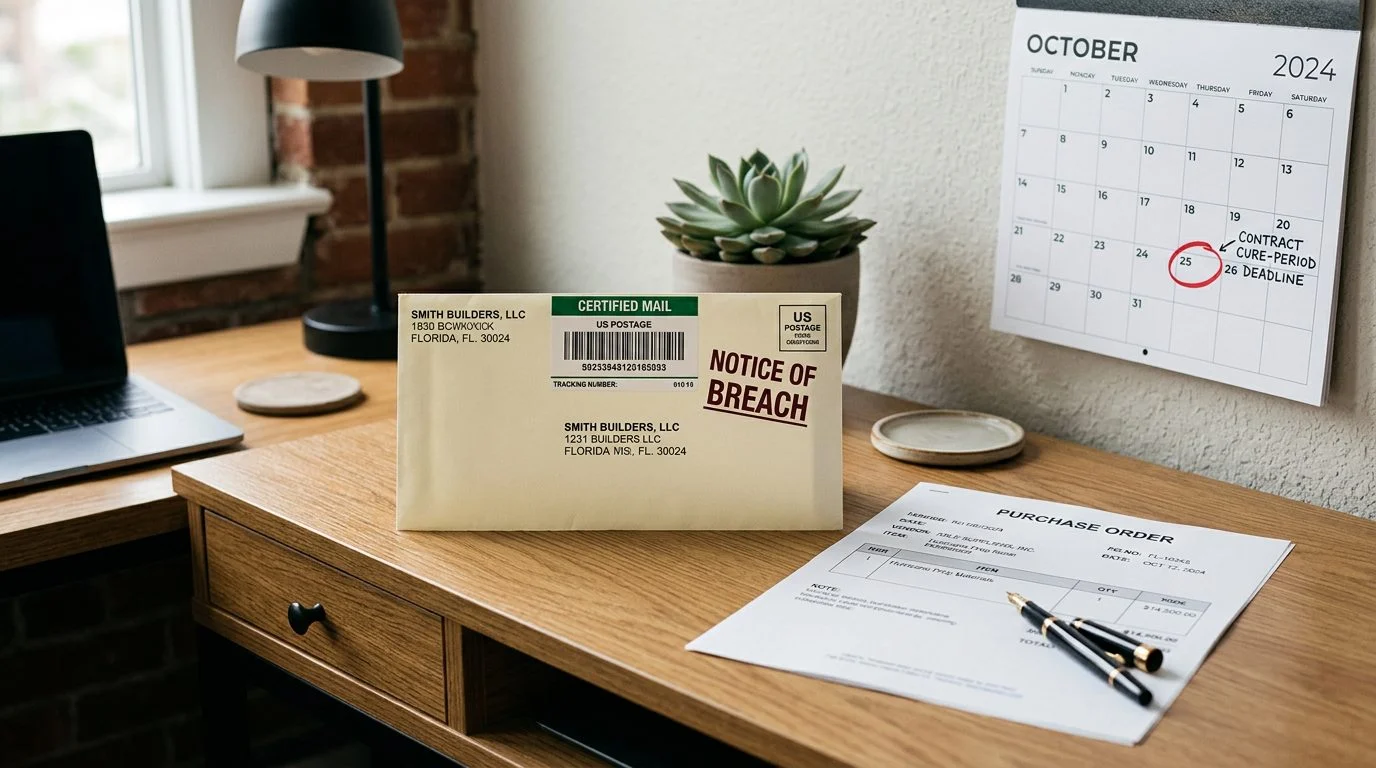
A force majeure clause can excuse a hurricane-related delay, but only when its written words cover the event and the delay it caused. If the clause doesn’t match, a Florida business may still have to perform or face a breach claim. This page explains how a force majeure hurricane contract question usually turns on the wording, and what Tampa Bay owners should check first.
Ayala Law PA focuses on business litigation, contract disputes, construction litigation, real estate litigation and international trade litigation. The firm’s only office is in Tampa, at 1646 W Snow Ave, and it represents businesses in Tampa and throughout Hillsborough County. Eduardo A. Maura is the lawyer responsible for this page.
Why hurricane season makes force majeure a practical question
A force majeure clause is a contract term that can excuse performance when a listed event blocks it. Storm risk is known when a contract is signed, so the clause is a choice the parties made in advance.
Many disputes start the same way. A storm hits, a crew stops, a closing moves or a shipment never arrives. Then the business owner asks whether the contract allows a pause. The answer depends on what the parties wrote before the storm.
This page is for Tampa Bay owners, contractors, subcontractors, property managers and commercial parties facing a stalled job, a missed closing or a supplier that stopped shipping. The governing-law clause is worth reviewing alongside the rest of any agreement.
If a storm has stalled your job, closing or shipment, you don't have to sort out the contract alone. Contact our team to talk through what happened and what your agreement says. Talk it through with our team — we can walk you through how a situation like yours is usually handled and what your options are.
How Florida courts read a force majeure clause
The written clause is the starting point, and its exact words usually decide the question. A clause that names hurricanes is different from one that covers “events beyond reasonable control.” Both still have to fit the facts.
A listed event does not excuse every delay. Rain that slows a crew for a day may not be a hurricane under the clause.
Florida’s Supreme Court has said that even an oral contract needs basic terms: an offer, an acceptance, consideration and sufficiently specific essential terms. St. Joe Corp. v. McIver applies that rule to contracts generally. Vague excuse language often leads to disagreement about what the parties meant.
The triggering event: storm damage, orders and access
A hurricane triggers a clause only when the clause’s trigger matches what happened. Direct damage to the job site is different from a government evacuation order or a curfew. Each one may be treated differently depending on the wording.
Check which storm stage the clause names. Some clauses refer to a watch, a warning or an actual landfall. Others say nothing about timing, which leaves room for argument.
Supplier and shipping problems need the same care. A storm that slows a delivery may or may not qualify, depending on whether the clause covers delivery delays. The link between the storm and the missed delivery has to be shown, not assumed.
Notice, mitigation and documentation duties
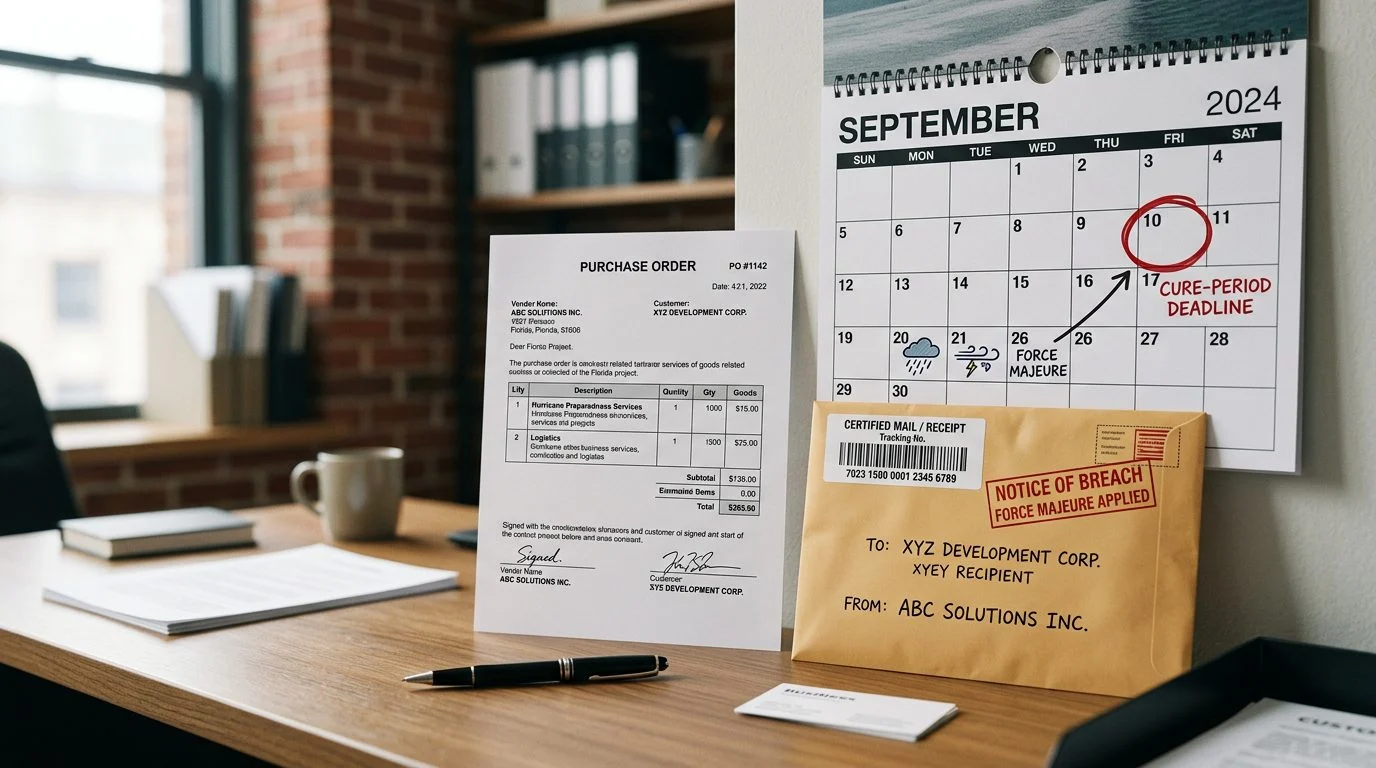
Many clauses require written notice within a set number of days. Missing that deadline can weaken the excuse, even when the storm was real. Read the notice section before you send anything.
Parties are also commonly expected to take reasonable steps to limit delay and cost. Crews can be reassigned, schedules can be reworked and materials can be moved. Doing nothing can hurt your position.
Keep records that show what happened and when. Useful items include:
- Dated photos and videos of the site
- Weather reports and storm alerts
- Permit and inspection records
- Written supplier notices
- Daily logs and crew sign-in sheets
Keep communications with the other party short, factual and dated. Stick to what happened, not opinions about who is at fault.
How construction, real estate and commercial contracts differ
The contract type changes the deadlines and the remedies. A construction schedule, a closing date and a supply agreement each work differently under the same storm.
In construction, a hurricane can affect schedule extensions, weather delay provisions and liquidated damages (agreed daily charges for late work). Florida also has a separate deadline rule for claims over the design or construction of an improvement to real property. That rule runs from a certificate of occupancy, a certificate of completion or abandonment of construction, whichever is earliest. In any event, the action must be started within 7 years after that date.
In real estate, a storm can damage the property, delay inspections or disrupt title work. Whether a closing delay is covered depends on the purchase contract’s closing, storm damage and insurance language.
In commercial and international supply deals, tariff or trade-measure language may appear in a force majeure clause. Higher cost alone is often not enough. Many clauses cover events that block performance, not events that make it more expensive. Doctrines like impossibility and impracticability are separate from the clause and are usually narrower.
For goods, Florida’s sales rules require prompt notice of a breach after accepting a shipment. A buyer who accepts goods must notify the seller within a reasonable time after discovering a breach, or may be barred from any remedy. Under Florida’s sales-of-goods rules, a buyer who has accepted goods must notify the seller of any breach within a reasonable time after discovering or should have discovered it, or be barred from any remedy for that breach.
Common questions: can a business stop performing?
A business that stops work without a clear basis can create its own breach exposure. Pausing while you review the clause is a decision with real risk, so review the clause before you act.
A dispute over a storm excuse is often framed as a breach claim, an anticipatory repudiation (one side saying it won’t perform in the future) or a wrongful termination. The label affects what each side must prove.
Your conduct can also matter. Waiver and course of dealing, meaning how the parties have handled similar issues before, may affect how a clause is applied. The contract wording and the history between the parties both matter here.
Attorney’s fees can be a factor. If a contract allows fees to a party that must enforce it, a court may also allow reasonable fees to the other party if that party wins. Where a contract contains a provision allowing attorney’s fees to a party that must take action to enforce the contract, the court may also allow reasonable attorney’s fees to the other party when that party prevails in any action, whether as plaintiff or defendant, with respect to the contract.
Not sure what your next step is?
Talk it through with our team — we can walk you through how a situation like yours is usually handled and what your options are.
Next steps if a storm has disrupted your contract
Start by rereading the clause before you send any notice. Look for the triggering events, the notice deadline and the remedies. A notice sent in the wrong form or too late can change the outcome.
Preserve your records now. Avoid written statements that admit fault until you have gathered the facts. Short, dated messages work better than long explanations.
Also watch the filing clock. A contract cannot set a shorter time to sue than the statute allows. Fla. Stat. § 95.03 says that any such provision is void.
The answer to a force majeure question depends on the contract language and the facts. No outcome can be promised in advance.
If a storm has stalled your project, closed your deal or stopped your shipment, you can contact Ayala Law PA to talk it through. Our team can review the clause with you and explain the questions that matter most.
Eduardo A. Maura is the responsible lawyer for this page. Clients in Tampa and across Hillsborough County are represented from the firm’s Tampa office at 1646 W Snow Ave, Tampa, FL. Attorney advertising.



