
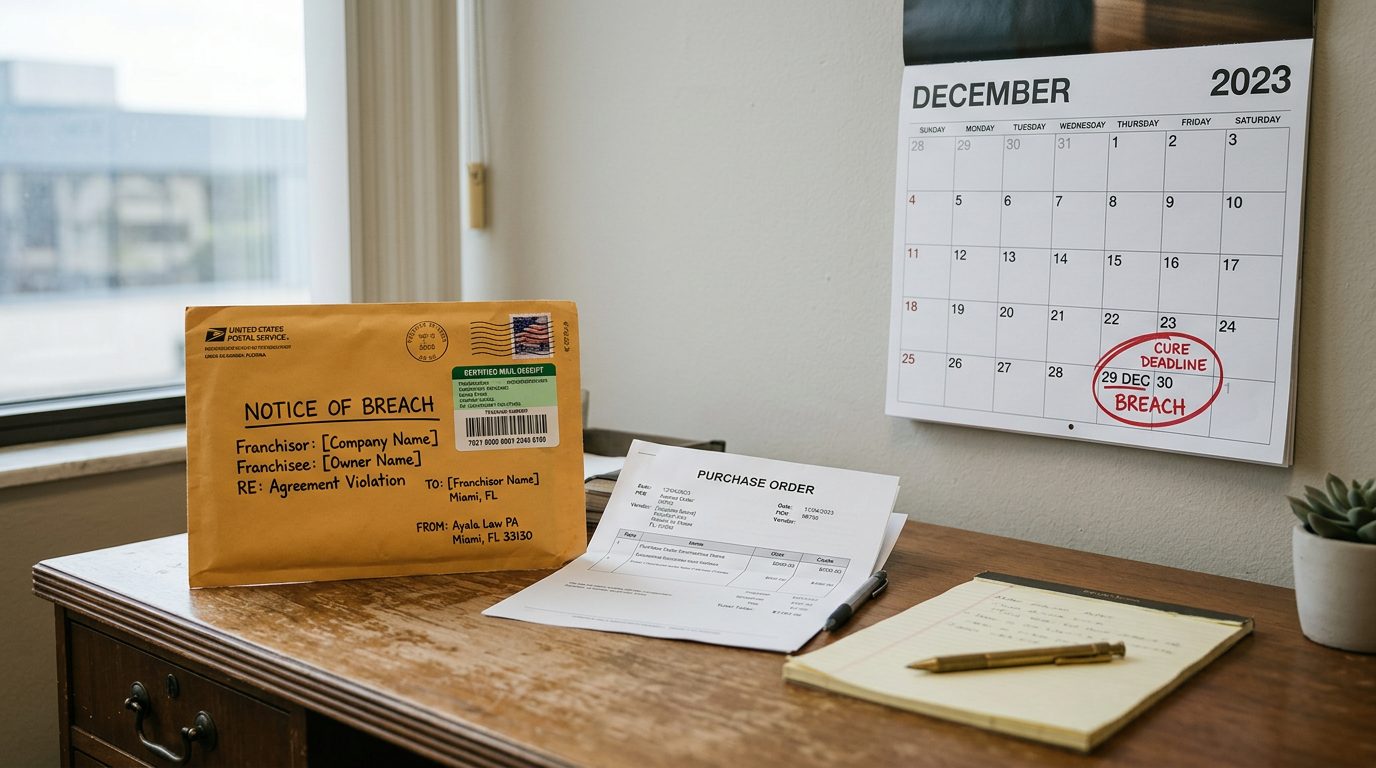
A franchise agreement breach lawsuit in Florida asks a judge or arbitrator to decide whether the franchisor or the franchisee failed to do what the signed contract requires. The written agreement is the starting point. Its notice rules and dispute clauses often decide where and how the case moves. This guide explains common types of breach and some steps that business disputes can involve. Ayala Law PA serves businesses and entrepreneurs in Tampa, Hillsborough County, and the wider Tampa Bay area.
What a franchise agreement dispute covers and who it affects
A franchise agreement dispute is a disagreement over whether one side performed what the signed franchise documents require. The people involved often include the franchisor, the franchisee, multi-unit operators, owners who signed personal obligations, and business partners at the location.
Common franchisor-side breaches include:
- Wrongful termination of the franchise
- Failure to provide promised training or support
- Territory encroachment, where a protected area gets a competing location
- Misapplied fees
- Failure to give the disclosure document on time
Common franchisee-side breaches include:
- Unpaid royalties or advertising fees
- Underreported sales
- Unauthorized use of trademarks or operating systems
- Abandoning the location
- Violating post-termination noncompete or nonsolicitation promises
Timing matters before anyone signs. A franchisor must give its current disclosure document at least 14 calendar days before a prospective franchisee signs a binding agreement or pays anything, unless the transaction is exempted under subpart E, under 16 C.F.R. § 436.2. Start with the written terms. The agreement, its exhibits, and the operations manual usually define what each side owed.
If a termination notice or an unpaid-fee demand has put your business in question, you don't have to work through the agreement alone, so call Ayala Law PA at (305) 570-2208. Talk it through with our team — we can walk you through how a situation like yours is usually handled and what your options are.
What remedies and consequences follow a breach?
The main remedies are money damages, court orders such as injunctions, and attorney’s fee awards. Which ones apply depends on the agreement and the facts.
- Money damages. Damages are money awarded for a loss caused by the breach. Sales reports, royalty statements, and invoices can help document the figures involved in a dispute.
- Injunctions. Under federal trademark law, a court can grant an injunction, according to the principles of equity, to prevent violation of the rights of a registrant of a mark registered in the Patent and Trademark Office. For a registered trademark, federal law gives a rebuttable presumption of irreparable harm once a violation is found, in the case of a permanent injunction, under 15 U.S.C. § 1116.
- Noncompete covenants. Florida enforces a restrictive covenant only if it is in a writing signed by the person bound. It must also be reasonable in time, area, and line of business, and it is unlawful and void unless supported by a legitimate business interest, under Fla. Stat. § 542.335. A temporary injunction requires a proper bond.
- A person who proves a violation of Florida’s franchise misrepresentation section in civil court may recover a judgment for all money invested, the court may also award reasonable attorney’s fees, and it must award the reasonable costs of bringing the action, under Fla. Stat. § 817.416.
- Attorney’s fees. Florida generally makes each side pay its own fees unless a contract or statute provides otherwise, under Price v. Tyler. If the contract allows fees for enforcing it, the court may award fees to the other side when that side prevails, under Fla. Stat. § 57.105.
Florida’s filing deadlines for civil claims are set in Fla. Stat. § 95.11. Notice and cure periods inside the agreement can also run before any lawsuit.
Can you sue a franchise owner, and can a franchisee sue a franchisor?
Yes, a franchisor and a franchisee can each sue the other for breach of the franchise agreement.
- Franchisors may sue over unpaid fees, unauthorized use of marks or confidential materials, or breaches of post-termination duties.
- Related claims, such as misrepresentation in the sale, depend on what the documents and facts show.
Venue follows Florida’s general rule. Actions are brought in the county where the defendant resides, where the cause of action accrued, or where the property in litigation is located, but this rule does not apply to actions against nonresidents, under Fla. Stat. § 47.011.
Many agreements require arbitration. A written arbitration provision in a contract involving commerce is valid and enforceable, except on grounds that exist to revoke any contract, under 9 U.S.C. § 2. If a suit in a federal court of the United States raises an issue referable to arbitration under a written arbitration agreement, a party can ask the court to pause the trial until arbitration has been had under the agreement, if the party asking is not in default in proceeding with that arbitration, under 9 U.S.C. § 3. Owners who signed personal obligations should review those papers too.
How a franchise contract dispute usually moves forward
Most franchise contract disputes follow the same path: review, demand, negotiation, and then mediation, arbitration, or a lawsuit.
- Review the paperwork. Read the full agreement, the disclosure document, any amendments, and the emails and letters behind the dispute. Note the notice, cure, and dispute clauses.
- Preserve evidence. Keep sales reports, royalty statements, texts, emails, and training records.
- Send or answer a written demand. A demand may cure the problem or narrow what is really in dispute.
- A court must refer filed civil money damage cases to mediation when one party asks, provided the requesting party is willing and able to pay the costs or the costs can be equitably divided between the parties, unless a listed exception applies, under Fla. Stat. § 44.102. Exceptions include agreed binding arbitration.
- File suit or demand arbitration. Follow the forum the agreement names. Ask for emergency relief if a location or mark is at immediate risk.
- Litigate or arbitrate. Discovery and motions follow. The case ends in settlement, a judgment, or an award.

How can a business defend a breach of franchise agreement claim?
A defense usually starts with the contract’s own notice, cure, and dispute steps. Check whether the other side followed them.
- Notice and cure. Confirm whether the other side gave the written notice and cure period the agreement requires.
- Prior breach and waiver. Ask whether the other side breached first, or accepted late payments for a long time without objection.
- Good faith claims. Every Florida contract carries an implied duty of good faith. A claim on it can fail if it would contradict express terms or if no claim for breach of an express term goes with it, under QBE Ins. Corp. v. Chalfonte.
- Unfair terms. A court may refuse to enforce a term as unconscionable only if both how the deal was made and how unfair the terms are are present, under Basulto v. Hialeah Automotive.
- Damages. Test the claimed amounts, including lost profits, offsets, and counterclaims.
- Sanctions risk. A court shall award a reasonable attorney’s fee to the prevailing party, paid in equal amounts by the losing party and its attorney, if the court finds they knew or should have known a claim or defense was not supported by the material facts or by then-existing law, under Fla. Stat. § 57.105. There are exceptions. No sanction applies on the law ground for a good faith argument to change the law with a reasonable expectation of success. No sanction applies against an attorney who acted in good faith on the client’s account of the facts. No sanction applies on the law ground against a represented party. A sanctions motion must also be served 21 days before filing, giving time to withdraw or correct the challenged item.
Respond on time. Missing a deadline to answer or to demand arbitration can hurt your position.
Why business owners bring franchise disputes to Ayala Law PA
A franchise agreement dispute is a commercial contract dispute. Ayala Law PA focuses its practice on business litigation and contract disputes.
- The practice also covers commercial litigation, shareholder and partnership disputes, construction litigation, real estate litigation, and international trade litigation.
- Eduardo A. Maura is the lawyer responsible for this page.
- The firm’s only office is at 1646 W Snow Ave, Tampa, Florida. The firm takes on matters for businesses and entrepreneurs located in Tampa, Hillsborough County, Brandon, Riverview, Plant City, Temple Terrace, and the wider Tampa Bay area, in Florida courts and arbitration, with its only office in Tampa.
- Support staff help with scheduling and document organization, and our team tracks the deadlines in each matter.
- The approach is plain-language and business-focused. We explain the agreement, the options, and the deadlines before any filing.
Not sure what your next step is?
Talk it through with our team — we can walk you through how a situation like yours is usually handled and what your options are.
Frequently asked questions about franchise agreement disputes in Florida
Franchise agreement disputes
Each dispute depends on the terms of the agreement and the facts involved. The agreement’s terms decide which apply.
Damages in contract disputes
A contract dispute often centers on what loss a breach caused, and records such as invoices can help show that loss. Each side generally pays its own attorney’s fees unless a contract or statute says otherwise.
How do I defend a breach of contract lawsuit?
Start with the agreement’s notice, cure, and dispute clauses. Then check for prior breach and waiver, test the damages, and respond on time.
Can you sue a franchise owner?
Yes. A franchisor can sue a franchisee for unpaid fees, misuse of marks, or post-termination breaches.
Does the franchise agreement decide where the case is heard?
Often, yes. Forum and arbitration clauses can send a dispute to a court or to an arbitrator.
How long do I have to file?
Florida sets filing deadlines by statute, and the right deadline depends on the claim and the facts.
Talk with Ayala Law PA about your franchise agreement
If a termination notice, an unpaid-fee demand, or a territory conflict has landed on your business, you don’t have to sort out the agreement alone. Before you call, gather the franchise agreement, the disclosure document, any amendments, royalty statements, and key letters or emails. Call (305) 570-2208 or use the contact page to request a case evaluation. Fee arrangements are discussed when you call.



