
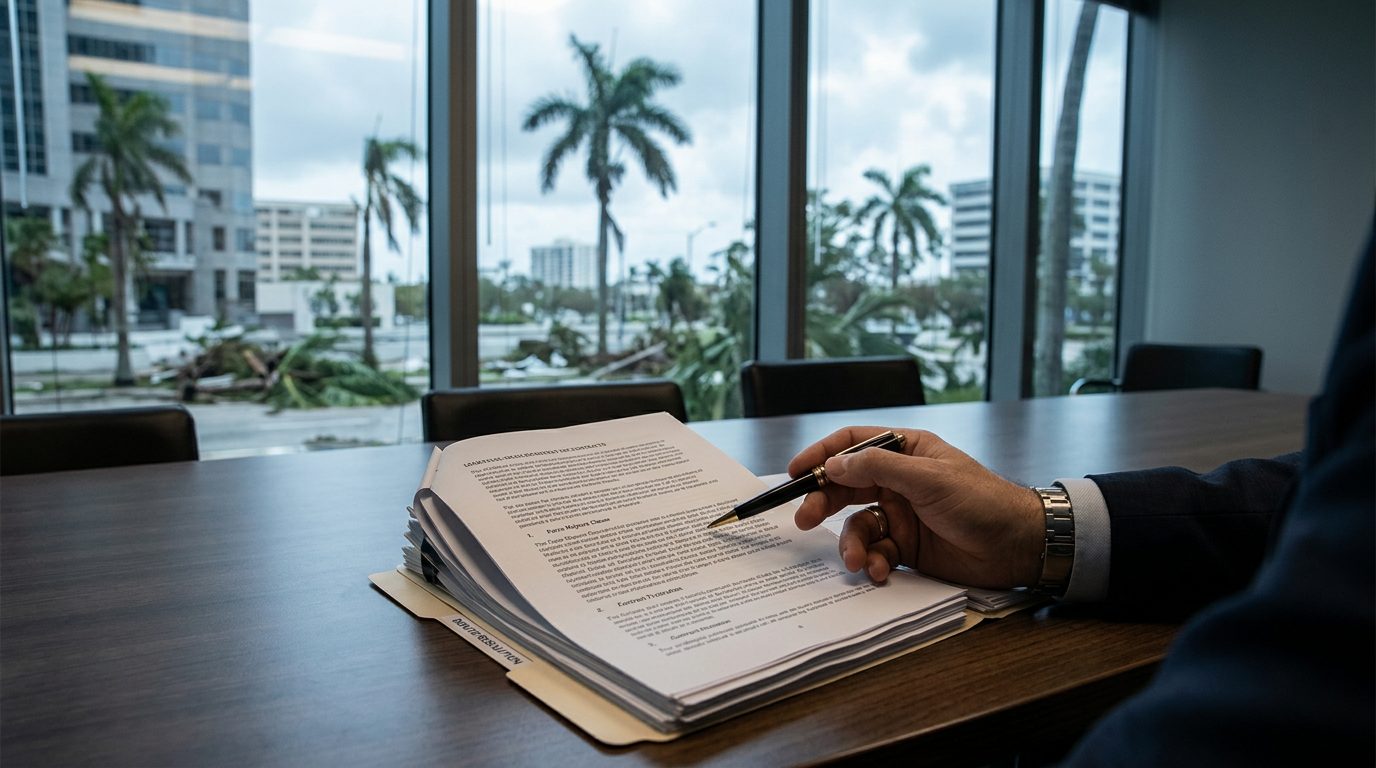
The Short Answer: The Clause Controls, and the Facts Decide
Businesses often review a force majeure clause closely when an unexpected event interrupts performance. Something bad happening is not enough on its own. Whether a given clause excuses a given failure depends on the facts.
A contract’s wording is often the first place to look when a dispute arises. If the clause names the event, sets notice rules, and describes what the party must do, those terms set the test. If the event falls outside the clause, or the party skipped a required step, the clause may not help.
This page walks through the questions a court or arbitrator is likely to ask. It is general information, not legal advice. Ayala Law PA focuses on business litigation, including contract disputes, in Florida courts and arbitration.
If a customer, vendor, contractor, or landlord has cited force majeure to stop paying or delivering, you don't have to sort out the clause and the notice on your own; call us to talk it through. Talk it through with our team — we can walk you through how a situation like yours is usually handled and what your options are.
How Florida Courts Read Force Majeure Clauses as Written
A force majeure clause dispute in Florida usually starts with the words on the page. Read the event list, the definitions, and any language about control or effort before you decide the clause helps or hurts.
Two drafting styles cause most of the argument. A closed list names specific events, such as fire, flood, or a government order. A broad clause uses words like “beyond the reasonable control of the party.” A broad phrase invites a fight over what counts, while a short list leaves less room for one.
Undefined terms cause trouble too. Phrases such as “act of God,” “emergency,” and “government action” can mean different things to each side. If the contract doesn’t define them, expect both sides to argue for the reading that helps them.
The clause must also be part of a valid deal. The Florida Supreme Court has said that even an oral contract needs offer, acceptance, consideration, and essential terms stated clearly enough. St. Joe Corp. v. McIver A clause that is too one-sided can also fail. Under Fla. Stat. § 672.302, if a court finds as a matter of law that a clause was unconscionable at the time the contract was made, it may refuse to enforce the clause, enforce the rest of the contract without it, or limit the clause to avoid an unconscionable result. In Basulto v. Hialeah Automotive, the court said procedural and substantive unfairness must both be present, weighed together.
Questions That Decide Whether the Clause Applies
Start with the event. Did what happened fit the clause’s list or description? Set the clause’s words next to the facts, one by one.
Next, ask whether the event caused the failure. The reason performance stopped is often a central question in these disputes. If demand dropped or the business changed its plans, the clause may not reach the problem. A common mistake is blaming a storm for a cash-flow decision.
Timing matters too. Did the event happen before the performance date, on it, or after? Did it affect the specific obligation in dispute, or only part of the work? A delay on one task doesn’t always excuse the whole contract.
Control matters as well. Many clauses cover only events beyond the affected party’s reasonable control. A choice the party made, such as picking a supplier that later failed, may fall on its side of that line.
Finally, think about proof. The party relying on the clause should be ready to show the event, its timing, and its link to the failure. Dated records make that showing far easier.
Force Majeure Versus Common-Law Excuses
Force majeure is not the only possible excuse. If a contract says nothing about an unexpected event, or its wording does not clearly cover what happened, the parties may disagree about who carries the risk, and that disagreement often becomes the center of the dispute.
A clause follows its own words. Impossibility and frustration are different doctrines, and each raises its own questions about performance and the purpose of a deal. Because the tests differ, a business should review the clause first and then the other doctrines.
This matters when a counterparty sends a notice. The other side may rely on the clause and also hope for a broader excuse. A business that receives a notice should list every excuse the other side might claim and check each one against the contract and the facts.
Notice, Mitigation, and Other Procedural Requirements
Many clauses require prompt written notice of the event and its expected effect. A late or missing notice can cost a party the clause’s protection. Check the notice section for deadlines, delivery methods, and required addresses.
Many clauses also require reasonable efforts to reduce the event’s effect and to resume performance once able. A party that stops all work and does nothing may fail this duty, even when the event was real.
A notice can also be a strategy. A counterparty may send one to shift risk, set up termination, or start a paper record. Compare what the notice says with what the contract requires. Respond in writing, and keep copies of everything you send and receive.
If your business buys goods, Florida’s commercial code adds a separate deadline. Under Fla. Stat. § 672.607, a buyer that has accepted goods must notify the seller of a breach within a reasonable time after it discovers or should have discovered the breach. Otherwise, the buyer may be barred from any remedy.
Hurricanes, Government Orders, and Supply Disruptions
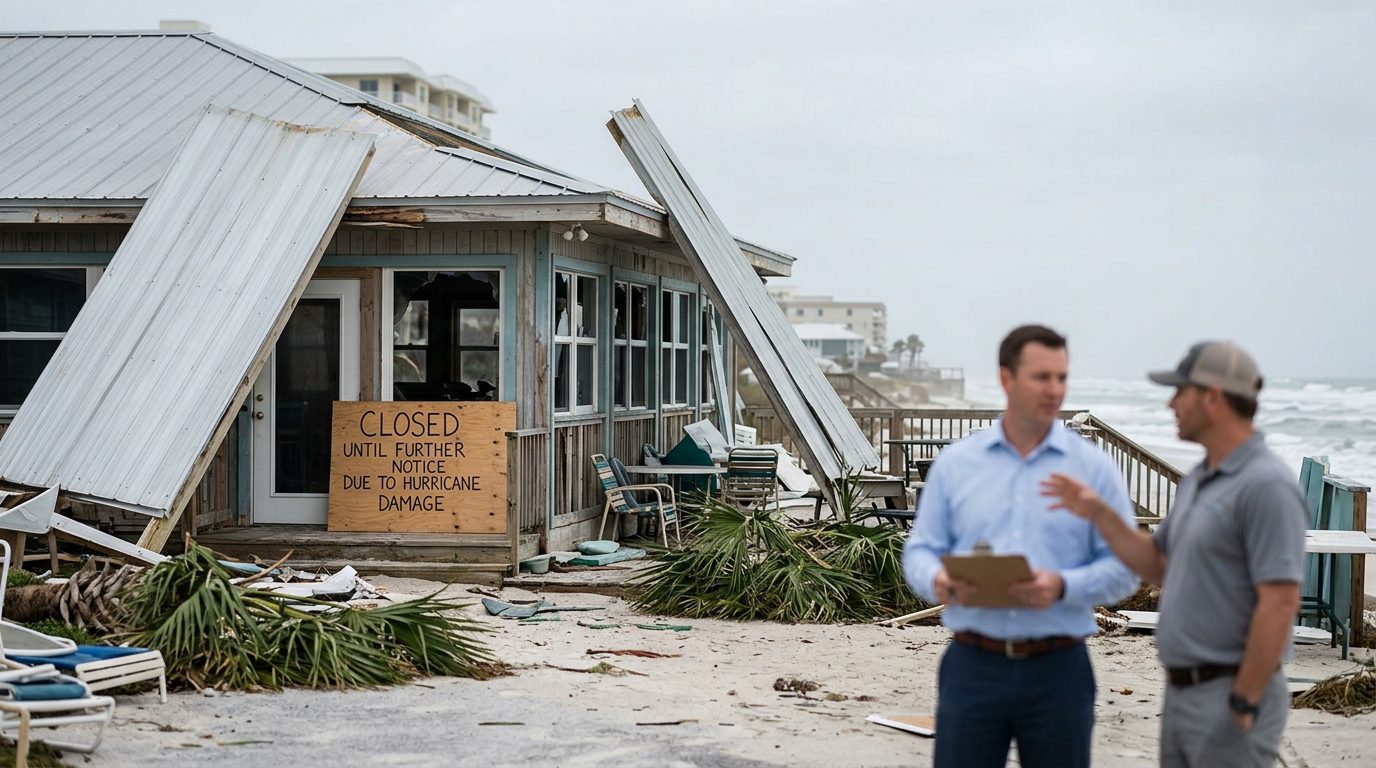
Storms, government orders, and supply interruptions are events that often appear in these clauses. Whether a storm qualifies turns on the wording. A clause that names hurricanes or tropical storms reads differently from one that says “acts of nature” and leaves the rest to argument.
Check whether the clause covers damage to the business, the job site, or the supply route, or only the storm itself. A closed building and a closed supplier are not always the same kind of event under the contract.
Government orders raise their own questions. Check whether the clause covers orders from any government body, and whether the order actually stopped the work. Permitting delays and supplier shortages are often disputed. Ask whether the clause addresses control over the supplier or the permit process.
Event-based disputes turn on each contract’s words and each failure, not on one rule. A pandemic-era clause and a storm clause may read very differently. Hold each claim to the specific language and the specific failure.
Keep dated evidence for every event. Closure notices, damage reports, photos, supplier emails, and permit filings all help show what happened and when.
Not sure what your next step is?
Talk it through with our team — we can walk you through how a situation like yours is usually handled and what your options are.
What a Business Should Do When a Counterparty Invokes the Clause
Start by collecting the complete contract. Include amendments, exhibits, purchase orders, definitions, notice terms, and any dispute resolution section. Use the signed version, not a draft.
Build a dated record. List the event, the notice received, each party’s performance, and every email or call. A clear timeline helps any later claim or defense.
Check the dispute terms next. An arbitration clause can decide where a fight is heard. Under Fla. Stat. § 682.02, a court decides whether an agreement to arbitrate exists and whether a controversy is subject to it. An arbitrator decides certain other questions, such as whether a condition precedent to arbitration has been met.
Venue also matters for court cases. Under Fla. Stat. § 47.011, an action must be brought in the county where the defendant resides, where the cause of action accrued, or where the property in litigation is located. This section does not apply to actions against nonresidents. If the work or delivery happened in Hillsborough County, that county may be where the claim accrued.
Owners have a separate question. Under Fla. Stat. § 605.0304, a company’s debt is solely the company’s debt. A member or manager is not personally liable for it solely by reason of being a member or manager. A personal promise by an owner to pay the company’s debt is a separate commitment, so check whether an owner signed one.
Finally, avoid conceding in writing that the clause applies. Respond with the facts, and reserve your rights until the terms and the facts are reviewed.
Talk Through Your Clause with Ayala Law PA
If a counterparty has cited force majeure to stop paying, delivering, or building, the clause’s wording and the facts decide whether it holds. Ayala Law PA focuses on business and commercial litigation, contract disputes, construction litigation, and real estate litigation. The firm represents businesses in Hillsborough County and the Tampa Bay area in Florida courts and arbitration.
Does a force majeure clause cover an event it doesn’t name?
Only if its wording reaches the event. A broad phrase may reach it, while a short list of named events may not.
Can a court decide whether arbitration applies?
Yes. Under Florida’s arbitration statute, a court decides whether an arbitration agreement exists and whether a controversy falls under it.
Where can a business lawsuit be filed in Florida?
Florida’s venue statute points to the county where the defendant resides, where the claim arose, or where the property is located.
Is an LLC owner personally liable for the company’s breach?
Not solely because they are a member or manager. A separate personal promise by the owner to pay is a different matter.
Eduardo A. Maura is the responsible lawyer for this page. Ayala Law PA’s only office is at 1646 W Snow Ave in Tampa, Florida. If your business has received a force majeure notice and wants to talk through the contract, the notice, and the timeline, call (305) 570-2208 or request a case evaluation.



