
You’re owed money under a business contract, and small claims court looks like the quickest way to collect.
Below, you’ll find the checks to run before you file, the deadlines that apply, and the points where small claims stops working.
Can a Florida Business Use Small Claims Court for a Contract Dispute?
Check those three points first, before you spend time or money on a filing.
Small claims is faster and less formal than a full civil lawsuit. It also offers narrower relief.
Not sure what your next step is?
Talk it through with our team — we can walk you through how a situation like yours is usually handled and what your options are.
Check the Small Claims Dollar Limit
Small claims courts have a dollar cap, and the current figure is the one that counts. Don’t rely on an older article for the number.
Then measure the total the way you’d file it.
Where you file matters too. Under § 47.011, actions must be brought only in the county where the defendant resides, where the cause of action accrued, or where the property in litigation is located, and this rule does not apply to actions against nonresidents. If the defendant is a Florida corporation, § 47.051 adds the county where it keeps an office for its customary business. Check each location against your contract and invoices before you pick a county, whether that’s Hillsborough County or another one.
Is the Claim a Money Claim Small Claims Can Hear?
Small claims cases are built around unpaid invoices, deposits, and contract balances.
Relabeling doesn’t change the claim. Florida’s Third District Court of Appeal has held that a plaintiff generally cannot recover in tort for a contract dispute unless the tort is independent of the breach. In Frutafino v. Dole Chile, the court addressed the common law principle that a plaintiff may not recover in tort for a contract dispute unless the tort is independent of any breach of contract. Where an express contract covers the same subject, Williams v. Johnson explains that claims from that relationship won’t support unjust enrichment.
How Contracts Affect a Potential Lawsuit
The form of your agreement decides what you must prove and which rules apply. A written contract gives you a signed record of the terms.
Goods are different. For a sale of goods priced at $500 or more, § 672.201 says a contract is generally not enforceable by way of action or defense unless there is a record sufficient to indicate that a contract for sale was made and signed by the party against whom enforcement is sought or by that party’s authorized agent or broker, subject to the exceptions in subsection (3). If the other side admits in court that a sale was made, the contract can be enforced, but only for the quantity admitted. This section covers goods, not services.
Identify the right defendant before you file. A member or manager of an LLC is not personally liable for the company’s debts just by holding that role, under § 605.0304. Florida also requires a promise to pay another person’s debt to be in writing and signed before it can be enforced, under § 725.01. Fla. Stat. § 725.01 reads: “unless the agreement or promise upon which such action shall be brought, or some note or memorandum thereof shall be in writing and signed by the party to be charged therewith or by some other person by her or him thereunto lawfully authorized.” Check who signed the contract and in what role.
Review Arbitration, Forum, and Notice Clauses
Florida treats a written arbitration agreement as valid and enforceable, except on grounds that exist for revoking any contract (§ 682.02).
If you file in court and the other side opposes arbitration, the judge decides whether an enforceable agreement exists. The court decides whether an agreement to arbitrate exists, and whether a controversy is subject to it. The court can’t refuse arbitration just because the claim seems weak. Once a party asks the court to order arbitration, the court must, on just terms, stay the court case on the claim alleged to be subject to arbitration until it makes a final decision on that request, and if the court orders arbitration, it must stay the court case on the claim subject to arbitration (§ 682.03).
The other side may argue a clause is unfair. Florida courts refuse to enforce a term only when it is both procedurally and substantively unconscionable, weighed together rather than separately (Basulto v. Hialeah Automotive).
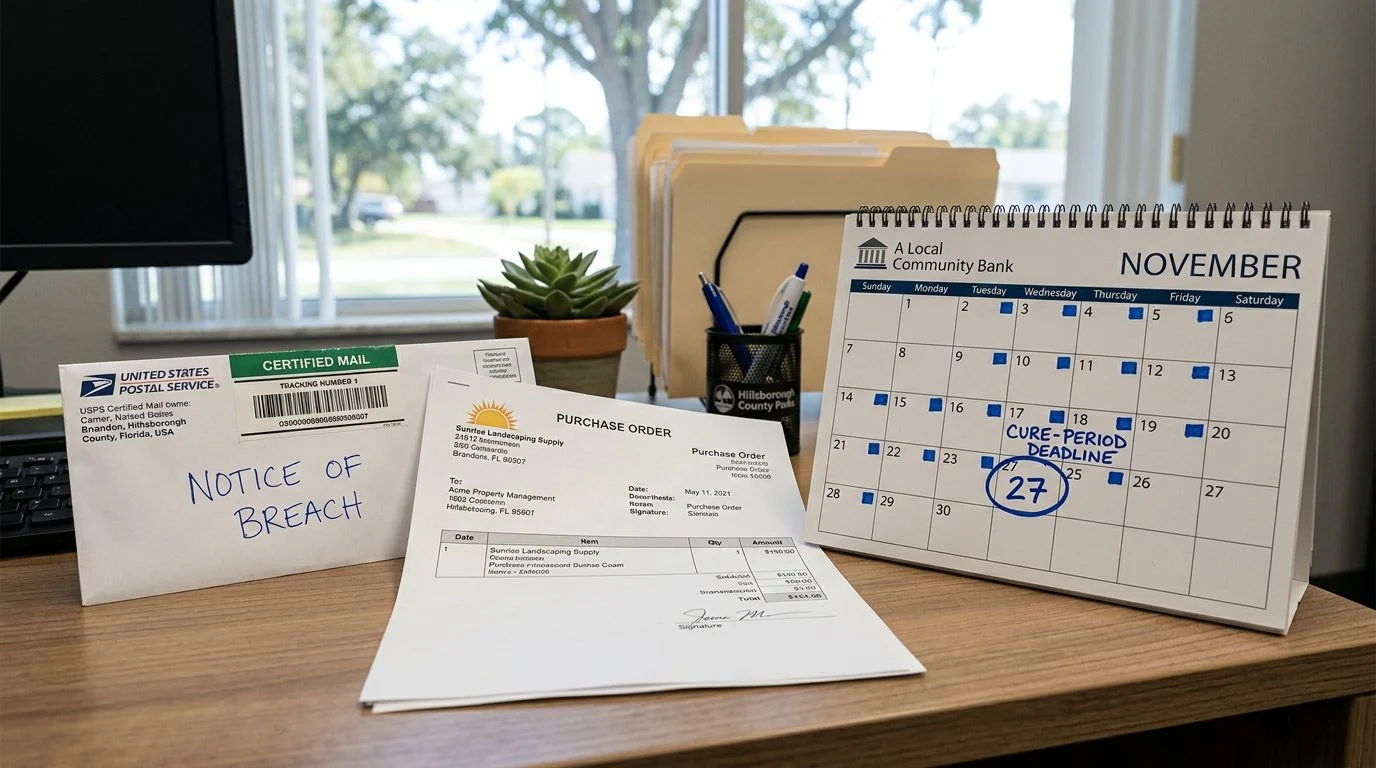
Check the notice-and-cure terms too. Some contracts require written notice and a chance to fix the problem before anyone files suit. Find that section, note the dates, and follow it before you file. A forum clause naming a different place for disputes also changes the venue analysis above.
Check Contract-Claim Filing Deadlines
A Florida business generally has five years to sue on a written contract and four years on an oral contract, under § 95.11. A claim for specific performance has a shorter one-year period under the same statute.
The clock doesn’t start on a date you pick. Under § 95.031, a cause of action accrues when the last element constituting it occurs. Your job now is to pin that point down from your records.
Start a dated timeline today. Include the contract signing, each payment due date, the missed payment or failed delivery, and every written demand. Dates get lost in long email threads, so put them in one document. Those dates are the first thing you’ll need when you decide whether to file. Waiting is the one step you can’t undo.
Not sure what your next step is?
Talk it through with our team — we can walk you through how a situation like yours is usually handled and what your options are.
Gather Contracts, Communications, and Proof of Loss
Before you file, gather the signed contract, every amendment, and the records that show what you’re owed. A useful packet includes the signed agreement and any amendments, purchase orders and invoices, payment records, and written messages about performance, delivery, or rejected work.
Build a one-page damages summary. List each invoice with its date, due date, amount, any payment received, and the remaining balance. A clear table is easier to follow than a folder of loose emails.
If the other side claims the work was defective or late, your records must answer that. Note what you delivered, when, and how the other side responded. Keep copies of everything, and save emails in their original form.
When Small Claims May Not Fit Your Business Dispute
Small claims is a poor fit when the amount is over the cap, you need a court order to act, or the contract sends the dispute to arbitration. Those disputes usually move to county or circuit court, or to arbitration. Each path has its own rules, deadlines, and costs, so plan before you file.
Ayala Law PA focuses on business litigation, commercial litigation, contract disputes, shareholder disputes, construction litigation, real estate litigation, and international trade litigation in Florida courts and arbitration. The firm represents businesses and entrepreneurs in Tampa, Hillsborough County, Brandon, Riverview, Plant City, Temple Terrace, and across the Tampa Bay area. The firm’s office is at 1646 W Snow Ave in Tampa, Florida.
Some matters may be referred to another lawyer or firm if they fall outside what the firm handles.
Key Takeaways and Next Step for Your Contract Dispute
Before you file, check five things: the dollar cap, the money-claim test, the contract’s arbitration, forum, and notice terms, the filing deadline, and your records.
- Dollar cap: Is the whole claim under the current small claims limit?
- Claim type: Is your goal money, rather than a court order?
- Contract terms: Does the contract have an arbitration clause, a forum clause, or notice-and-cure language?
- Deadline: Under Fla. Stat. § 95.11, an action for specific performance of a contract must be commenced within one year, and the section’s other time limits and conditions also apply.
- Evidence: Do you have the contract, the invoices, and a dated timeline?
For a closer look at breach claims, read our breach of contract guide.
Can a business sue in small claims court in Florida?
How long does a business have to sue on a contract?
Generally five years for a written contract and four years for an oral one, under § 95.11.
Does an arbitration clause stop a small claims case?
It can. If the other side opposes arbitration, the court decides whether the agreement is enforceable, and it must order arbitration if one exists (§ 682.03). Fla. Stat. § 682.03 reads: “(b) If the refusing party opposes the motion, the court shall proceed summarily to decide the issue and order the parties to arbitrate unless it finds that there is no enforceable agreement to arbitrate.”
Are an LLC’s owners personally liable for its contracts?
Not just for being owners. Under § 605.0304, a member or manager is not personally liable for company debts solely because of that role.
Deciding whether to file over a breached contract? Call Ayala Law PA at (305) 570-2208 or use our contact page to talk through your contract, invoices, and breach date. Eduardo A. Maura is the lawyer responsible for this page.



