

If a business deal was agreed to only out loud, the deadline to enforce it depends on the kind of claim involved. A deal that was never put in writing can still raise questions about whether it can be enforced, and the answer depends on the type of agreement and the facts involved.
An agreement that cannot be performed within one year from the day it’s made generally must be in a signed writing before it can be enforced.
Short Answer: The One-Year Rule and Oral Business Deals
The one-year rule is one category in Florida’s statute of frauds. Under s. 725.01, Florida Statutes, no action shall be brought upon any agreement that is not to be performed within the space of 1 year from the making thereof, unless the agreement or promise upon which such action shall be brought, or some note or memorandum thereof, is in writing and signed by the party to be charged therewith or by some other person by her or him thereunto lawfully authorized. Fla. Stat. § 725.01 sets out that requirement.
If the agreement, as made, could not be finished within a year, an oral version generally can’t be enforced.
Many owners think every verbal deal is void. The same writing requirement in s. 725.01, Florida Statutes also covers an action to charge the defendant upon any special promise to answer for the debt, default or miscarriage of another person, and an action upon any contract for the sale of lands, tenements or hereditaments, or of any uncertain interest in or concerning them, or for any lease thereof for a period longer than 1 year. In each case, the action may not be brought unless the agreement or promise, or some note or memorandum thereof, is in writing and signed by the party to be charged therewith or by some other person by her or him thereunto lawfully authorized.
Not sure what your next step is?
Talk it through with our team — we can walk you through how a situation like yours is usually handled and what your options are.
The Text of the Rule and Where It Sits in Florida Law
The one-year category sits inside section 725.01, alongside several other categories that need a signed writing. The statute says no action may be brought on such an agreement unless it, or a note or memorandum of it, is in writing and signed by the party to be charged, or by someone lawfully authorized to sign for that party.
It usually comes up after a deal falls apart and one side refuses to perform. The other side then raises the statute as a reason the deal can’t be enforced.
For the wider picture of contract disputes in the Tampa area, see our contract disputes overview.
When the One-Year Provision Applies
The rule applies when the deal, by its terms, cannot be fully performed within one year from the day it was made.
Multi-year deals often fall within the rule. Examples include a three-year supply agreement, a two-year exclusive distribution arrangement, and a multi-year services commitment with no earlier end point. In each one, the agreed timeline runs past the one-year mark.
A common mistake is counting from when work started or judging by how long the relationship actually lasted. The statute looks at the making of the agreement. Pull the timing language from the deal and read it word for word. Some deals mix short and long periods, so read the whole timeline, not only the first year.
When a Deal Can Be Performed Within a Year
A deal that can be fully performed within one year by its own terms generally falls outside the one-year rule.
The rule asks whether the agreement itself could be completed within a year. A short, one-time delivery is a common example of a deal that can be finished quickly.
Essential terms matter too. In a Third District per curiam citation affirmance, the court quoted the rule that it is well established that a meeting of the minds of the parties on all essential elements is a prerequisite to the existence of an enforceable contract, and where it appears that the parties are continuing to negotiate as to essential terms of an agreement, there can be no meeting of the minds. While parties are still negotiating essential terms, there can be no meeting of the minds. A handshake that left key terms open may fail for that reason, before the one-year question even arises. A short term sheet or email can show the terms, so review those records early.
Written Memoranda and Whether a Later Writing Helps
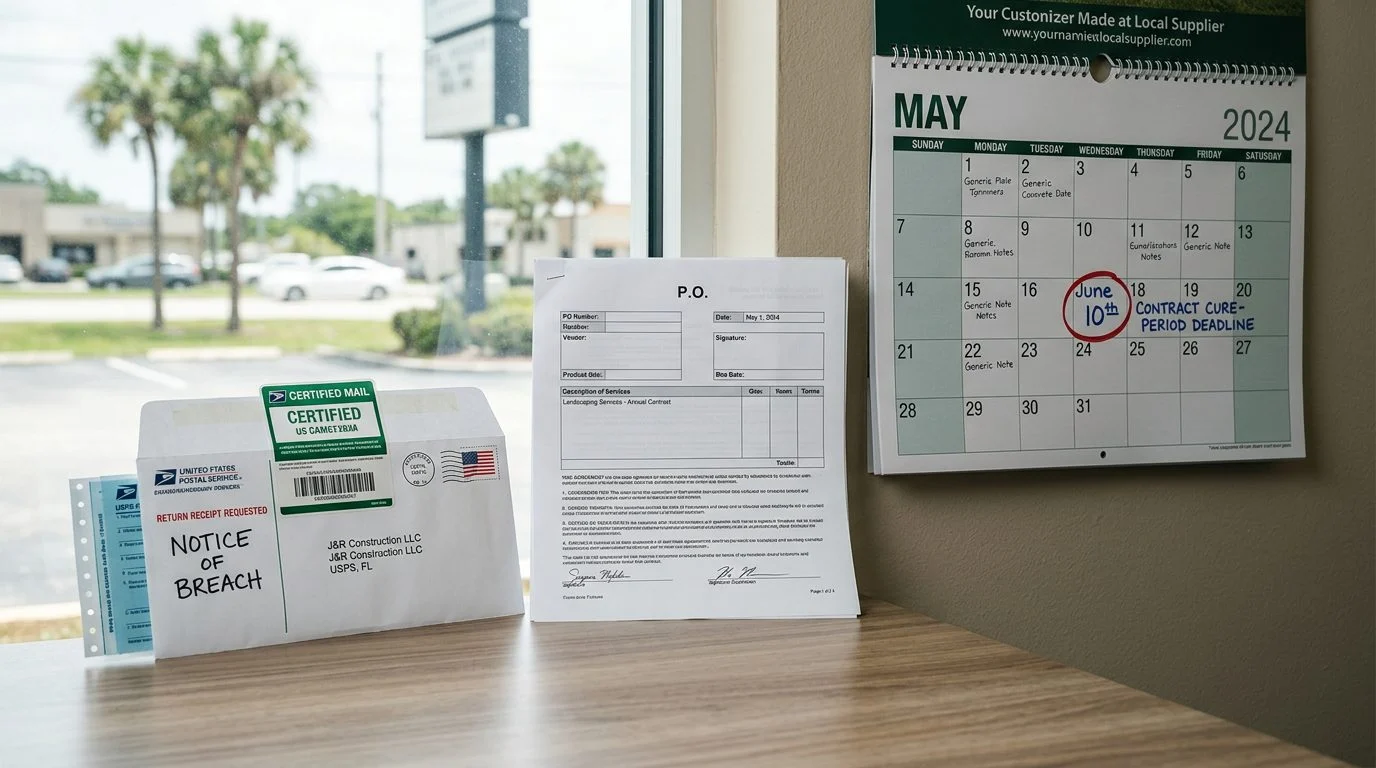
A signed writing that records the agreement can satisfy the statute. Fla. Stat. § 725.01 reads: “unless the agreement or promise upon which such action shall be brought, or some note or memorandum thereof shall be in writing and signed by the party to be charged therewith or by some other person by her or him thereunto lawfully authorized.” The statute accepts a note or memorandum of the deal, so the writing doesn’t have to be a long, formal contract.
The writing must be signed by the party you want to hold to the deal, or by someone lawfully authorized to sign for that party. Check whose signature is on each record, since the statute looks to the party to be charged.
Businesses commonly review emails, text messages, purchase orders, invoices and signed term sheets. Under Fla. Stat. § 668.004, an electronic signature may be used to sign a writing and has the same force and effect as a written signature, unless another law provides otherwise.
A writing made after the handshake still has to meet the signature requirement. Gather every record and note the date each one was sent.
Other Claims, the Goods Rule, and Fraud
When the statute blocks a contract claim, other theories may come up, but Florida courts limit some of them. Promissory estoppel is one. In DK Arena v. EB Acquisitions, the Florida Supreme Court said the doctrine may not be used to circumvent the statute of frauds.
Unjust enrichment has a limit too. Where an express contract covers the same subject matter, claims arising from that relationship cannot support unjust enrichment, according to Williams v. Johnson. For more detail, see our unjust enrichment guide.
Sales of goods follow a separate rule. Under Fla. Stat. § 672.201, except as the section otherwise provides, a contract for goods priced at $500 or more is generally not enforceable unless there is a sufficient record signed by the party against whom enforcement is sought or by that party’s authorized agent or broker. The section has exceptions, including specially manufactured goods, admissions in court, and goods that have been paid for and accepted or received and accepted. Between merchants, a written confirmation can satisfy this rule if it is received within a reasonable time, the receiving party has reason to know its contents, and it is sufficient against the sender, unless that party gives notice of objection to its contents in a record within 10 days after it is received.
Fraud is a separate theory. A promise of future action can be fraudulent if the promisor had no intention of performing it, or a positive intention not to perform, when making it, according to Frutafino v. Dole Chile.
Not sure what your next step is?
Talk it through with our team — we can walk you through how a situation like yours is usually handled and what your options are.
Deadlines to Keep in Mind
Florida sets time limits for filing suit, and the limit depends on the type of claim. Under Fla. Stat. § 95.11, each category of action has its own period, so the label you give a claim matters.
Don’t wait while you sort out which claim fits. Write down the key dates while they’re fresh: when the deal was made, each payment, each delivery, each missed step, and each message about the problem.
Keep the records in one place, in date order. A clear timeline makes it easier to see which terms and events matter.
Next Steps for a Business With a Handshake Agreement
Start by gathering every record of the deal, then map its timing terms against the one-year rule. Here is what to do first.
- Collect emails, texts, invoices, purchase orders, payment records and drafts.
- Note the timing terms as they were stated, including start and end dates.
- Ask whether your claim is an action for specific performance of a contract, since that kind of action must be commenced within one year.
- Review any new written commitment closely before signing, since wording can change terms.
Ayala Law PA focuses on business litigation, commercial litigation, contract disputes, shareholder disputes, construction litigation, real estate litigation and international trade litigation. The firm’s only office is at 1646 W Snow Ave in Tampa, Florida, and it serves businesses in Tampa and Hillsborough County. Eduardo A. Maura is responsible for this page.
If your handshake deal has run past a year and the other side has stopped performing, contact Ayala Law PA to talk through your records and timing terms.



