
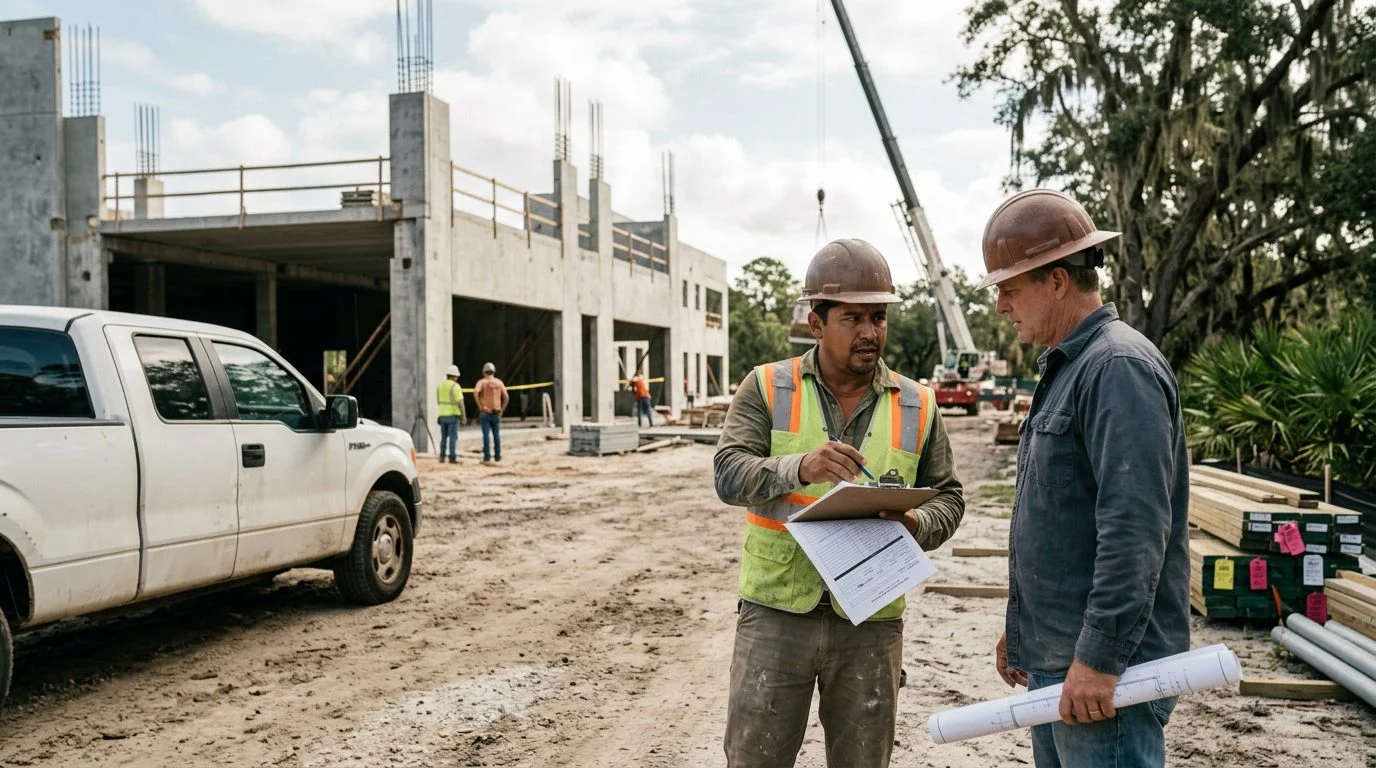
You finished the work, sent the invoices, and the payment still hasn’t come. If you’re a subcontractor not paid in Hillsborough County, Florida law gives you civil tools to pursue what you’re owed.
The three main tools are a construction lien on the property, a claim on a payment bond, and a lawsuit or arbitration. Each one has its own notices and deadlines, so the order you act in matters.
When a Subcontractor Is Not Paid in Hillsborough County
Unpaid subcontractors on Hillsborough County jobs usually face one of a few patterns. The general contractor pays part of an invoice and then stops. Or it disputes change orders for extra work.
Florida law protects more than the subcontractor who signed the contract with the owner. Sub-subcontractors and suppliers who furnish labor or materials to a property can have rights too. Their place in the chain decides which notices they must send and to whom.
Start by mapping the chain. Write down who hired whom, who owns the property, and the first and last dates you worked or delivered. Those dates drive almost every deadline in this area.
This is general information. Each job’s contracts, notices and dates shape which options apply.
If you are still owed money on a Hillsborough County job, you may have a claim, and our team can review your notices and dates with you. Talk it through with our team — we can walk you through how a situation like yours is usually handled and what your options are.
Your Construction Lien Rights Under Florida Law
A construction lien is a claim against the property you improved, and Florida sets short deadlines to create one.
The notice to owner comes first. If you did not contract directly with the owner, you generally must serve a notice to owner. Under Fla. Stat. § 713.06, you serve it before you start work or no later than 45 days after you start, but in any event before the date of the owner’s disbursement of the final payment. Missing that notice is a complete defense to enforcing a lien, so treat it as your first deadline.
Sub-subcontractors and suppliers may also need to send copies to the contractor.
The claim of lien is recorded next. Under Fla. Stat. § 713.08, a claim of lien may be recorded at any time during the progress of the work or thereafter, but not later than 90 days after the final furnishing of labor, services or materials by the lienor. If the original contract is terminated early, the claim may not be recorded after 90 days following the termination or 90 days after final furnishing, whichever occurs first.
- for a claimant not in direct contract with the owner, the date and method of serving the notice to owner Fla. Stat. § 713.08 reads: “(h) If the lien is claimed by a person not in privity with the owner, the date and method of service of the notice to owner.”
A recorded lien does not last forever. Under Fla. Stat. § 713.22, it generally ends one year after recording unless you start an action to enforce it in that year. An owner can shorten that period by recording a notice of contest, which gives you 60 days to sue.
If a deadline lands on a weekend or holiday, Fla. Stat. § 713.011 moves it to the next business day. Count your dates conservatively anyway.
A lien also affects the owner. The City of Cape Coral explains that a property can face a lien even after the owner has paid the contractor.
Payment Bond Claims on Florida Construction Projects
A payment bond is a surety’s promise to pay subcontractors and suppliers when the contractor does not, and a bond claim has its own notice steps.
Public projects. Under Fla. Stat. § 255.05, a contractor on a formal contract for a public building or public work must record a payment and performance bond before starting. Check that bond when your job is public.
Private projects. Some private jobs carry a payment bond too. Under Fla. Stat. § 713.23, to exempt the owner, the contractor must furnish a payment bond in at least the amount of the original contract price before construction starts, and a copy goes with the notice of commencement when that notice is recorded. Ask the contractor for a copy and check the recorded notice.
The notice of nonpayment. Under the same section, an unpaid lienor must serve a written, sworn notice of nonpayment on the contractor and a copy on the surety, no later than 90 days after the lienor’s final furnishing of labor, services or materials. That notice is a condition you must meet before you can recover under the bond.
Be exact with the amount. Under § 713.23, a willfully exaggerated notice of nonpayment is fraudulent, and a lienor that serves one forfeits its bond rights; the bond must be conditioned that the contractor shall promptly make payments for labor, services, and material to all lienors under the contractor’s direct contract. A minor mistake or a good-faith dispute over the amount does not defeat an otherwise valid claim.
Sworn statement demands. Under § 713.23, any lienor may demand a true copy of the bond, which the owner, contractor, or surety must furnish at the cost of reproduction. Respond to these demands on time.
Most payment bond actions must start within one year after the labor was performed or the materials were delivered. Fla. Stat. § 255.05 reads: “(10) An action, except an action for recovery of retainage, must be instituted against the contractor or the surety on the payment bond or the payment provisions of a combined payment and performance bond within 1 year after the performance of the labor or completion of delivery of the materials or supplies.”
Lawsuit Options When Lien and Bond Paths Are Not Enough
A lawsuit or arbitration can pursue your unpaid balance when a lien or bond claim does not resolve it.
Breach of contract. You can sue the party that owes you under your subcontract or purchase order.
Statutory payment remedies. Under Fla. Stat. § 713.346, undisputed amounts that stay unpaid 30 days after they were furnished and became due, or 30 days after payment for them is received, whichever last occurs, can open a faster procedure. You file a verified complaint and receive an evidentiary hearing.
Prompt-pay rule. Under Fla. Stat. § 489.1295, a licensed contractor must pay a subcontractor or supplier within 45 days after receiving payment, or as the contract terms require. That duty does not apply where there is a bona fide dispute over the amount due.
Unjust enrichment is limited. A Florida appellate court relied on a rule in Williams v. Johnson that an express contract covering the same subject generally blocks an unjust enrichment claim. If a written contract covers your work, that contract usually frames the claim.
Under Fla. Stat. § 682.02, a written agreement to arbitrate disputes is valid, enforceable, and irrevocable, except upon a ground that exists at law or in equity for the revocation of a contract. Your subcontract may send disputes to arbitration instead of court, which changes where your claim is filed.
License status. Under Fla. Stat. § 489.128, a contract entered into by an unlicensed contractor cannot be enforced by that contractor, and no lien or bond claim exists in its favor for that work. Other parties’ rights are not changed by this rule, so check license status early.
Which path fits depends on the facts: the contract, the dates and who you dealt with.
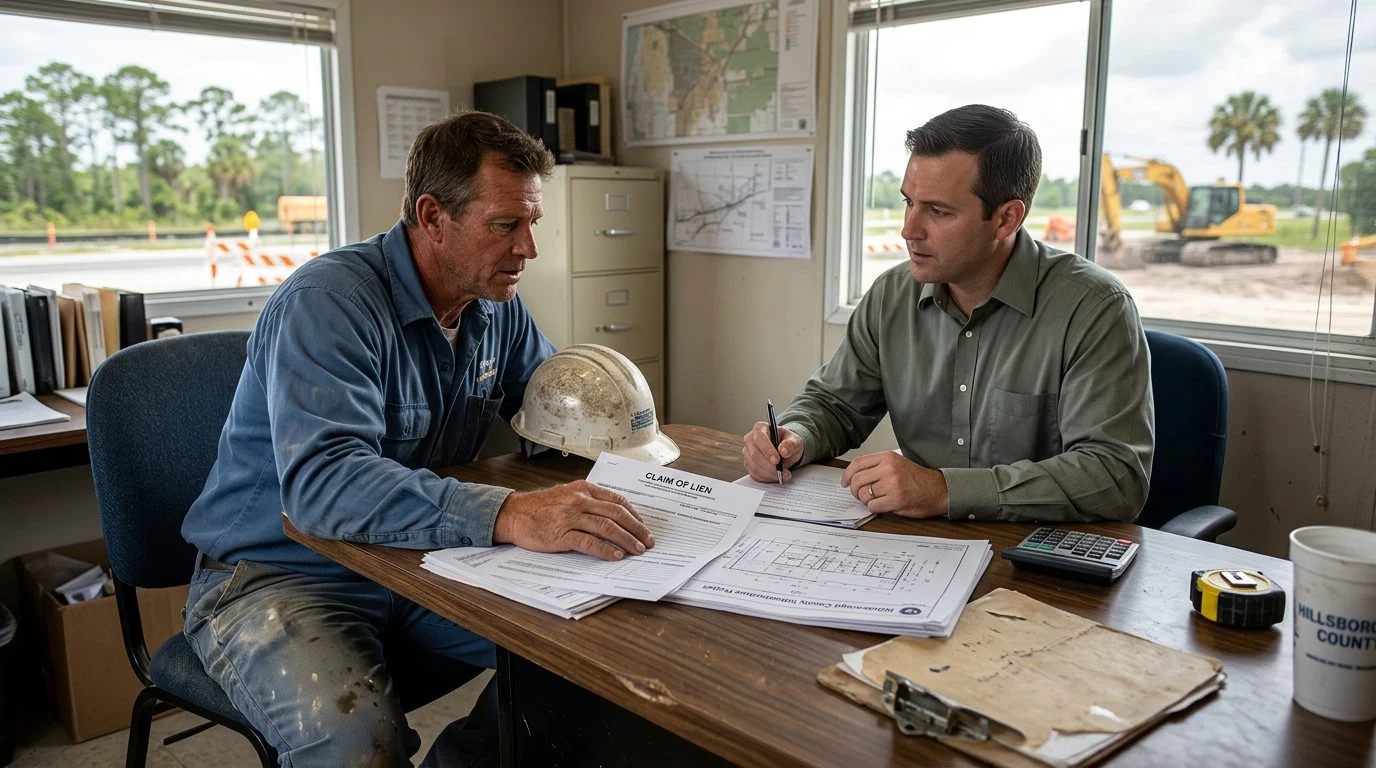
How an Unpaid Subcontractor Claim Typically Unfolds
Most claims move through five steps, from gathering records to filing suit or arbitration if the balance stays unpaid.
- Gather records. Pull the subcontract or purchase order, invoices, change orders, lien waivers, daily logs, payment history and the notice of commencement.
- Calendar the deadlines. Work backward from your first and last dates to set the notice to owner, lien recording, bond notice and suit dates.
- Send notices and demand payment. Serve the required statutory notices and a written demand.
- Weigh the options. Evaluate negotiation, bond claims and lien enforcement side by side.
- File suit or arbitration if the claim stays unpaid, and follow the case in the proper Hillsborough County court or the agreed forum.
Timing depends on negotiations, surety responses and court calendars. Each case moves at its own pace.
How Ayala Law PA Handles Subcontractor Payment Claims
Ayala Law PA represents businesses and entrepreneurs in construction litigation, including contractor and subcontractor disputes and lien foreclosure. The firm also handles commercial, contract and real estate litigation. Eduardo A. Maura is the responsible lawyer for this page.
The firm serves Hillsborough County and the Tampa Bay area from its Tampa office at 1646 W Snow Ave, Tampa, FL 33606. Clients in Tampa, Brandon, Riverview, Plant City and Temple Terrace are served from that office.
Our team, including lawyers and support staff, reviews lien and bond deadlines, contract documents and payment records with you. That review comes before any decision on a course of action.
Not sure what your next step is?
Talk it through with our team — we can walk you through how a situation like yours is usually handled and what your options are.
Common Questions About Unpaid Subcontractor Claims in Florida
Can I place a lien if I only dealt with the contractor?
Your lien rights depend on your place in the contract chain and on timely notices. Sub-subcontractors and suppliers face extra notice steps under Fla. Stat. § 713.06.
What if I don’t have a signed contract?
Bring every record you have. Lien and bond rules turn on the work you furnished and the dates you furnished it.
Can a property face a lien after the owner paid the contractor?
Yes. The City of Cape Coral notes that a property can face a lien even when the owner has paid the contractor.
How long does a case take?
Timing varies with the forum, the defenses raised and the negotiations. Each case moves at its own pace.
Should I wait for the contractor to pay first?
Waiting can carry you past a deadline. Written notice and calendaring usually come first.
Talk With Our Team About Your Unpaid Balance
A stalled job, a short payroll and a deadline on the calendar make the next few weeks hard to plan around. If that sounds familiar, you may have a claim worth reviewing.
Bring your subcontract, invoices, notices, the notice of commencement and your payment history to a case evaluation. Call (813) 414-5715 or use the contact page to reach Ayala Law PA at 1646 W Snow Ave, Tampa, FL 33606. Fees are discussed directly with our office when you call.



