
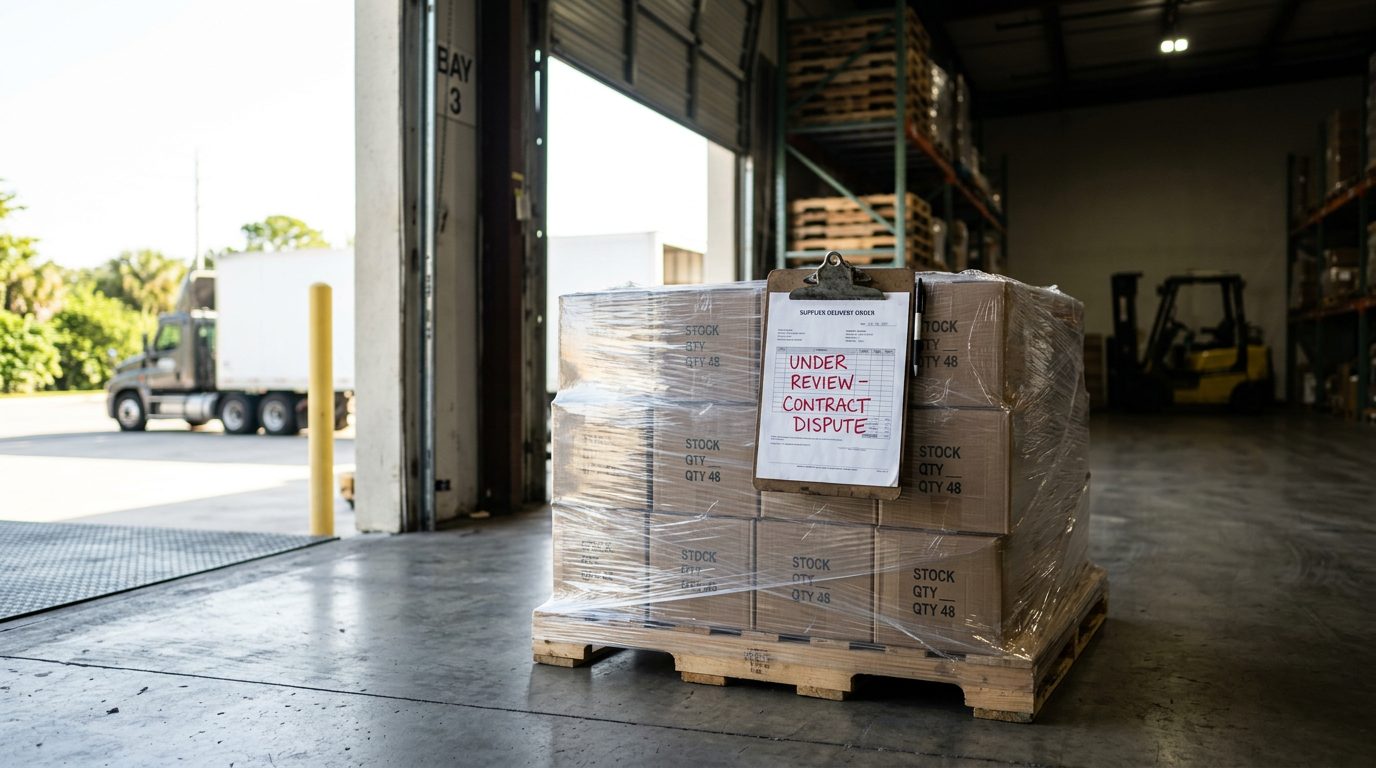
What a Supplier or Vendor Contract Dispute Is
A supplier or vendor contract dispute is a disagreement over whether one side did what a supply, purchase, or service agreement required. A supplier contract dispute in Florida raises questions that a business should address early. The dispute can run in either direction. A buyer may say goods arrived late or broken. A seller may say the buyer never paid or changed the order without agreement.
Many kinds of businesses end up in these disputes. Manufacturers, distributors, retailers, restaurants, medical and dental practices, and contractors that buy materials all depend on vendors. When one vendor stops performing, the cost to the business can grow fast.
The paperwork often decides the case. Purchase orders, invoices, order confirmations, and emails can form a contract or change its terms. Routine documents like these deserve a close look before anyone sends a demand letter.
Many disputes end through negotiation, a demand letter, or mediation. When those steps fail, the matter may move to a lawsuit or to arbitration, depending on the agreement.

Not sure what your next step is?
Talk it through with our team — we can walk you through how a situation like yours is usually handled and what your options are.
Common Situations This Practice Handles
The practice handles supply disputes involving late, defective, unpaid, or ended supply relationships. The following are examples of the situations this practice handles:
- Late or missed deliveries. This includes goods that miss an agreed delivery window or lead time.
- Defective or short shipments. These disputes often turn on whether the buyer accepted the goods or can still reject them.
- Pricing and invoice disagreements. Examples include surcharges the buyer never approved, unexpected price increases, and disputed credits or rebates.
- Nonpayment. Buyers and sellers often disagree about whether goods were accepted and how much is still owed.
- Ended agreements. This covers wrongful termination of a supply or distribution deal and missed minimum purchase commitments.
- Vendor terms. Confidentiality, intellectual property, and non-solicitation clauses in vendor agreements can also become disputed.
Each situation depends on the exact wording of the agreement and the records that show what happened.
How Florida Law Typically Frames These Claims
Disputes between suppliers and buyers over goods can arise in many commercial relationships. § 672.102 explains that this chapter applies to transactions in goods. In a deal that mixes goods and services, Florida courts have looked to the deal’s predominant purpose to decide which rules apply.
Some rules are strict. Under § 672.201, a contract for the sale of goods priced at $500 or more requires some writing sufficient to indicate that a contract was made, signed by the party against whom enforcement is sought, subject to statutory exceptions such as specially manufactured goods, admissions, and goods paid for and accepted. Between merchants, a written confirmation may count against the receiving party if it is sent within a reasonable time and the receiving party had reason to know its contents, unless that party objects in writing within 10 days.
Buyers must act on problems. Under § 672.607, a buyer who accepted goods must notify the seller of a breach within a reasonable time after discovering or should have discovered it, or be barred from any remedy. The buyer also carries the burden to prove any breach of goods it accepted.
When each side sends its own standard terms, § 672.207 can still create a contract. Extra terms do not always become part of the deal.
Florida also sets time limits for filing suit in § 95.11. Those limits vary by type of claim, so the deadline should be checked early. Arbitration clauses are generally enforceable under § 682.02, so an agreement to arbitrate can control where a claim goes.
How the Process Typically Works
A supplier dispute usually moves through five stages, though not every matter reaches every one. The steps below show the typical order.
- Intake and document review. The contract, amendments, purchase orders, invoices, and messages are reviewed to find the issues and deadlines.
- Notice and demand. Many contracts require written notice. A demand letter sets out the amount owed or the performance requested.
- Negotiation or mediation. Under § 44.102, a court must refer many civil damages cases to mediation when one party asks, but only if the requesting party is willing and able to pay the mediation costs or the costs can be equitably divided, and the listed exceptions, such as suits to collect a debt, do not apply.
- Filing. Under § 47.011, venue for many actions lies in the county where the defendant resides, where the cause of action accrued, or where the property is located, but exceptions apply, including the separate rules for corporate defendants in § 47.051 and contractual forum-selection clauses. For Tampa Bay businesses, Hillsborough County may be the right county when the facts support it. If the agreement requires arbitration, the claim goes there instead.
- Discovery and resolution. The parties exchange records, take depositions, file motions, and either settle or go to trial.
Timelines depend on court schedules, the records involved, and whether the other side cooperates. No timeline can be promised in advance.
Have questions about what happened?
Ask our team directly. Tell us what you are dealing with and we will explain how the process works from here.
Records to Gather Before You Contact a Lawyer
The most useful records are the signed agreement, the paper trail of orders and deliveries, and the messages that show what each side agreed to. Gather these items before your first meeting:
- The signed agreement, every amendment or renewal, and any terms it includes by reference, such as standard terms printed on an order form or invoice.
- Purchase orders, order confirmations, invoices, packing slips, and delivery receipts.
- Proof of inspection, acceptance, or rejection, with dates and the names of the people who received the goods.
- Emails, texts, and call notes that show what was promised, approved, or disputed, with dates.
- Payment records, credits issued, and any amount still outstanding, plus a short written timeline of the problem.
- Evidence of loss, such as replacement purchase costs or production delays.
- Copies of any notices you already sent or received.
Keep the originals in a safe place, and do not alter or delete messages.
Why Ayala Law PA for This Matter
Ayala Law PA focuses its practice on business litigation, including contract disputes, and serves clients in the Tampa Bay area from its only office in Tampa. The firm’s work covers commercial litigation, shareholder and partnership disputes, real estate litigation, and international trade litigation in Florida courts and arbitration, as well as construction litigation, including contractor and subcontractor disputes, lien foreclosure, and construction contract fraud.
Eduardo A. Maura is the lawyer responsible for this page. Our team includes assistants and office staff who help keep records and scheduling organized.
Fees and the fee arrangement are reviewed during a case evaluation. No lawyer can promise a result in a supplier dispute, because each one depends on the contract language, the evidence, and the forum.
Frequently Asked Questions
Is there a statute of limitations on contracts in Florida?
Yes. Florida sets time limits for filing suit in § 95.11. The limit depends on the type of claim, so check it early.
Is it worth suing for breach of contract?
That depends on the amount owed, the cost of the case, whether the other side can pay, and what the contract says about remedies. No lawyer can predict the outcome from a short summary.
Can I withhold payment while the dispute is pending?
Withholding payment can create its own risk. Review the contract and the Chapter 672 notice rules before you stop paying.
What if my contract requires arbitration?
Arbitration can change where the case is heard and how it proceeds. Review the clause before filing anything.
What if the supplier is located outside Florida?
Florida’s long-arm statute, § 48.193, can reach an out-of-state supplier that breaches a contract by failing to perform acts the contract requires to be performed in Florida, but the court must also find that the supplier has sufficient minimum contacts with Florida to satisfy constitutional due process. The contract’s choice-of-law and forum terms also matter.
Talk With Our Team About Your Supplier Dispute
A late shipment, a defective order, or an unpaid invoice can put real pressure on your operations, and you do not have to work through it alone. Ayala Law PA can review your agreement and records and explain the issues in plain terms. You can request a case evaluation through the firm’s contact page or call (305) 570-2208. Bring your records when you reach out. The firm cannot promise a result, but a review helps you decide your next step.



