
Your customer won’t pay an invoice, and you’re weighing whether to take the matter to court in Tampa. The answer depends on the facts of your dispute, the terms of your contract, and the documents you can show. A business can sue a customer for an unpaid invoice when the customer agreed to pay, you did the work or delivered the goods, and you can prove the amount. The claim is usually breach of contract.
This guide covers the records to gather, how to write a demand letter, when a lawsuit fits, and what happens next for businesses in Tampa and Hillsborough County.
What an Unpaid Invoice Lawsuit Is and Who It Is For
An unpaid invoice lawsuit asks a court to order a customer to pay money owed under an agreement. The agreement can be a signed contract, a purchase order, a written estimate the customer accepted, or a spoken deal both sides understood.
This path fits business owners, contractors, subcontractors, and vendors who are owed money by a business customer in Tampa or Hillsborough County. Most cases turn on three questions. Did the customer agree to pay? Did you perform or deliver? Can you show the amount owed?
For the wider picture, see our contract disputes page.
If a Tampa customer won't pay what it owes, you may have a claim worth reviewing, and our team is ready to talk through your contract and invoices with you. Talk it through with our team — we can walk you through how a situation like yours is usually handled and what your options are.
Gather Your Records Before You Send Anything
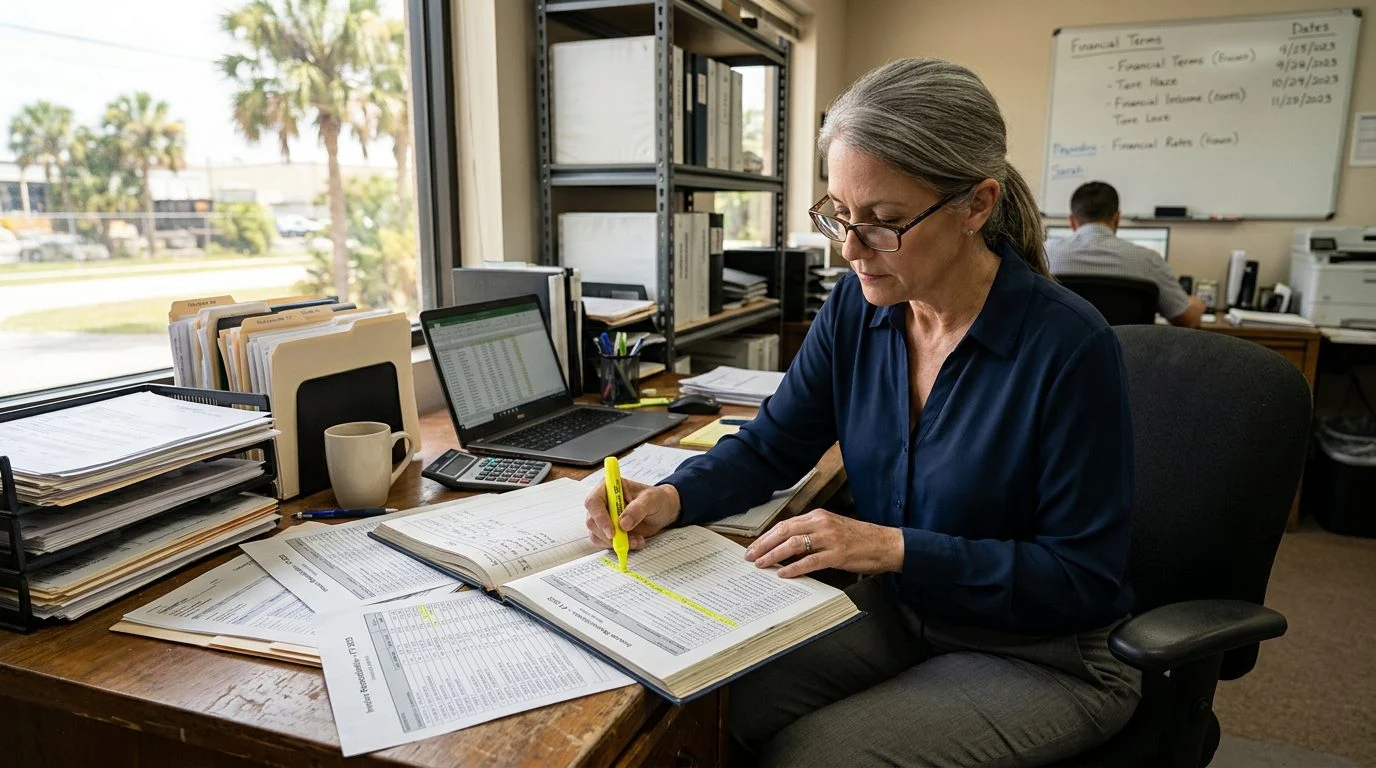
Your records decide whether a demand gets paid and whether a lawsuit holds up, so collect them first.
- The signed contract, purchase order, proposal, or estimate the customer accepted.
- Every invoice, with dates, line items, and totals, plus proof you sent it, such as email transmittals or mailing receipts.
- Proof of delivery or completion, such as work orders, job logs, signed delivery tickets, photos, or acceptance emails.
- A payment history showing partial payments, credits, and any charges the customer disputes.
- Emails, texts, and call notes about the balance, including any promise to pay.
Disputes often focus on the amount rather than the deal. Line-item detail that matches your work orders answers that quickly.
No written contract? An agreement can still be enforceable. For a sale of goods for $500 or more, Florida’s statute of frauds generally makes the contract unenforceable unless there is a record signed by the party it is enforced against (or that party’s authorized agent or broker), with exceptions (Fla. Stat. § 672.201). Gather every email, order, and text that shows the deal.
Send a Written Demand Letter and Leave Out Risky Statements
A strong demand letter states what is owed, why, and by when. It also creates a clear written record of your request.
Include:
- Invoice numbers, dates, and amounts, with the total owed.
- The contract or agreement you rely on.
- A specific payment deadline, and where and how to pay.
- A plain answer to any objection the customer has raised, such as a quality complaint.
Leave out:
- Threats you do not plan to carry out.
- Any mention of criminal charges.
- Insults or guesses about the customer’s finances.
- Admissions that weaken your claim, such as agreeing the work was defective.
Read the contract before you send anything. If it requires written notice or a chance to fix a problem, follow those steps. Send the letter in a way you can prove, such as certified mail plus email, and keep copies.
When a Breach of Contract Claim Makes Sense in Hillsborough County
A breach of contract claim usually makes sense when the customer owes a clear amount, ignores a proper demand, and your records prove the deal.
Deadlines come first. Florida’s limitations statute sets a time limit for each type of claim. In Florida, a lawsuit on an oral or other unwritten contract, including one for the sale and delivery of goods, generally must be filed within four years. The type of agreement drives the clock, so don’t let a long back-and-forth eat into the time you have.
Where to file depends on the amount and the court. County courts hear actions at law, except those within the exclusive jurisdiction of the circuit courts, where the amount in dispute does not exceed $50,000, exclusive of interest, costs, and attorney fees, for actions filed on or after January 1, 2023 (Fla. Stat. § 34.01). Circuit courts hear other actions at law and equity matters (Fla. Stat. § 26.012). Venue is limited to the county where the defendant resides, where the cause of action accrued, or where the property is located, though this rule does not apply to nonresident defendants (Fla. Stat. § 47.011).
For an invoice for goods, the seller may recover the price of goods the buyer accepted when the buyer fails to pay as it becomes due (Fla. Stat. § 672.709). A buyer who keeps goods must also notify the seller of any breach within a reasonable time after he or she discovers or should have discovered it, or be barred from any remedy (Fla. Stat. § 672.607).
Plead the contract you have.
Florida has a consumer protection law. Whether it reaches a business-to-business invoice depends on the facts.
What to Expect From Demand to Judgment
Most unpaid invoice cases move from a demand letter to a filed complaint, then to exchanging records, then to settlement or trial.
- Intake: review the contract, invoices, and communications.
- Demand: send a written letter with a clear deadline.
- Filing: if the customer still doesn’t pay, file a complaint in the proper court and serve the customer.
- Discovery: both sides exchange records, and written questions or depositions may follow. Settlement talks can happen at any stage.
- Resolution: the case ends in settlement or trial. A judgment can then be enforced.
Timelines vary with the court’s calendar and how the customer responds. Federal cases in the Tampa Division follow the Middle District’s local rules.
Why Ayala Law PA for Business Payment Disputes
Ayala Law PA focuses on business and commercial litigation, including contract disputes, from its office at 1646 W Snow Ave, Tampa, FL 33606. The firm’s work also covers shareholder disputes, construction litigation, real estate litigation, and international trade litigation in Florida courts and arbitration.
For contractors and subcontractors, construction litigation includes payment disputes and lien foreclosure. The firm serves Tampa, Hillsborough County, and the Tampa Bay area from that Tampa office.
Eduardo A. Maura is the responsible lawyer for this page. Our team includes assistants and office staff who help keep records and deadlines organized.
Not sure what your next step is?
Talk it through with our team — we can walk you through how a situation like yours is usually handled and what your options are.
Frequently Asked Questions About Suing for an Unpaid Invoice
Can I sue a customer who won’t pay an invoice?
Yes, if the customer agreed to pay and you performed or delivered. The claim is usually breach of contract.
What is the deadline to sue?
It depends on the type of agreement. An unwritten contract generally must be started within four years under Florida’s limitations statute.
What should a demand letter leave out?
Leave out threats you won’t carry out, references to criminal charges, insults, and admissions that weaken your claim.
Do I need a signed contract?
Not always. For goods priced at $500 or more, Florida law generally requires a signed record, with exceptions.
Can I sue without a demand letter?
A demand letter isn’t the only path, but it creates a written record of the request and the deadline.
Does Florida have a consumer protection law?
Yes. Whether it applies to your invoice is a question we can discuss when you reach out.
Talk Through Your Unpaid Invoice With Ayala Law PA
If a customer has stopped paying an invoice, the choice in front of you is whether to send a demand, file suit, or do both. Call (813) 414-5715 or use our contact form to describe the customer, the invoice amount, and the date payment was due.



