
If a business partner stopped paying, stopped delivering, or went silent partway through a job, you’re probably asking whether you have a claim.
The short answer: four elements of breach of contract in Florida
The contract must be valid. The defendant must have breached. And the breach must have caused damages.
This structure is a practical way to organize a claim. It isn’t a list taken from one statute. If one piece is missing, the claim can fail, even when the other side clearly did something wrong. How the test plays out in your agreement depends on the facts and the contract’s wording.
If an unpaid invoice or a stalled project has you wondering where your contract stands, you don't have to sort it out alone, and we can talk it through with you. Talk it through with our team — we can walk you through how a situation like yours is usually handled and what your options are.
Element 1: A valid contract existed between the parties
The first element is proof that both sides formed a binding agreement. That usually means an offer, an acceptance, something of value exchanged, and an intent to be bound. A paid job, a purchase order, or a signed project agreement often shows these pieces.
Acceptance doesn’t always need a formal letter. For a sale of goods, Florida law says that, unless the offer’s language or the circumstances unambiguously indicate otherwise, an offer invites acceptance “in any manner and by any medium reasonable in the circumstances,” under Fla. Stat. § 672.206. Emails and texts can matter.
Writing matters in some cases. For a sale of goods priced at $500 or more, Fla. Stat. § 672.201 generally requires a record of the deal, signed by the party you want to hold to it. Under that rule, the record must be signed by the party against whom enforcement is sought or by that party’s authorized agent or broker; the section itself does not address electronic signatures, which are covered by Fla. Stat. § 668.004. Fla. Stat. § 668.004 gives it the same force as a written signature, unless another law says otherwise.
Courts also ask whether the terms are clear enough to enforce. A deal that leaves the price, scope, or delivery date wide open is harder to enforce.
Element 2: You performed, or had a legal excuse for not performing
If you didn’t finish, you need a legal excuse, such as the other side’s conduct stopping or blocking your work.
Here’s a common example. A subcontractor finishes the agreed scope on a commercial job. The general contractor then withholds final payment over a dispute about a minor item. The signed scope, daily logs, photos, and completion sign-off are the records that show performance.
A party who stopped work after the other side stopped paying may argue that the non-payment excused further work. Whether that argument holds up turns on the contract’s terms, the amounts owed, and what each side did next. Keep records of every request and every response.
Element 3: The other side breached, and materiality matters
In short, you need proof that the other side failed to perform a duty the contract imposed, and that the failure matters to the deal.
Courts often sort breaches into two groups. Under Covelli Family, a party’s failure to perform some minor part of its contractual duty is not classified as a material or vital breach. Not every breach of a contract carries the same weight, and the practical effect of any breach depends on the facts of each dispute, including the terms of the agreement and the harm involved.
Is every breach a material breach?
No. A minor breach is usually treated differently, and that difference can change what you’re allowed to do next.
Element 4: Damages caused by the breach
Guesses about future profits are much harder to prove than invoices and bills.
Can I recover attorney’s fees for breach of contract?
Only if the contract or a statute allows it. Fla. Stat. § 57.105 says that when a contract allows fees for enforcing it, a court may allow reasonable fees to the party that prevails, whether plaintiff or defendant. The breach alone doesn’t create that right.
Types of breach a Florida court may see
The two types most often discussed are actual breach and anticipatory breach.
An anticipatory breach happens before the due date. The injured party may then treat the contract as broken right away, though the details matter.
The label matters less than the facts behind it.
For goods you’ve already accepted, timing can decide the claim. § 672.607 says a buyer who accepted goods must notify the seller of a breach within a reasonable time after the buyer discovers or should have discovered it, or be barred from any remedy.
Not sure what your next step is?
Talk it through with our team — we can walk you through how a situation like yours is usually handled and what your options are.
How the elements are proven: documents, messages, and timing
Most claims are proven with the paperwork and messages that show each element. Gather the agreement, invoices, payment records, proof of delivery or completion, and every email or text about the work.
Messages carry weight. Emails and texts can show an offer, an acceptance, or notice of a problem. Our page on text message enforceability in Florida covers that question in more detail.
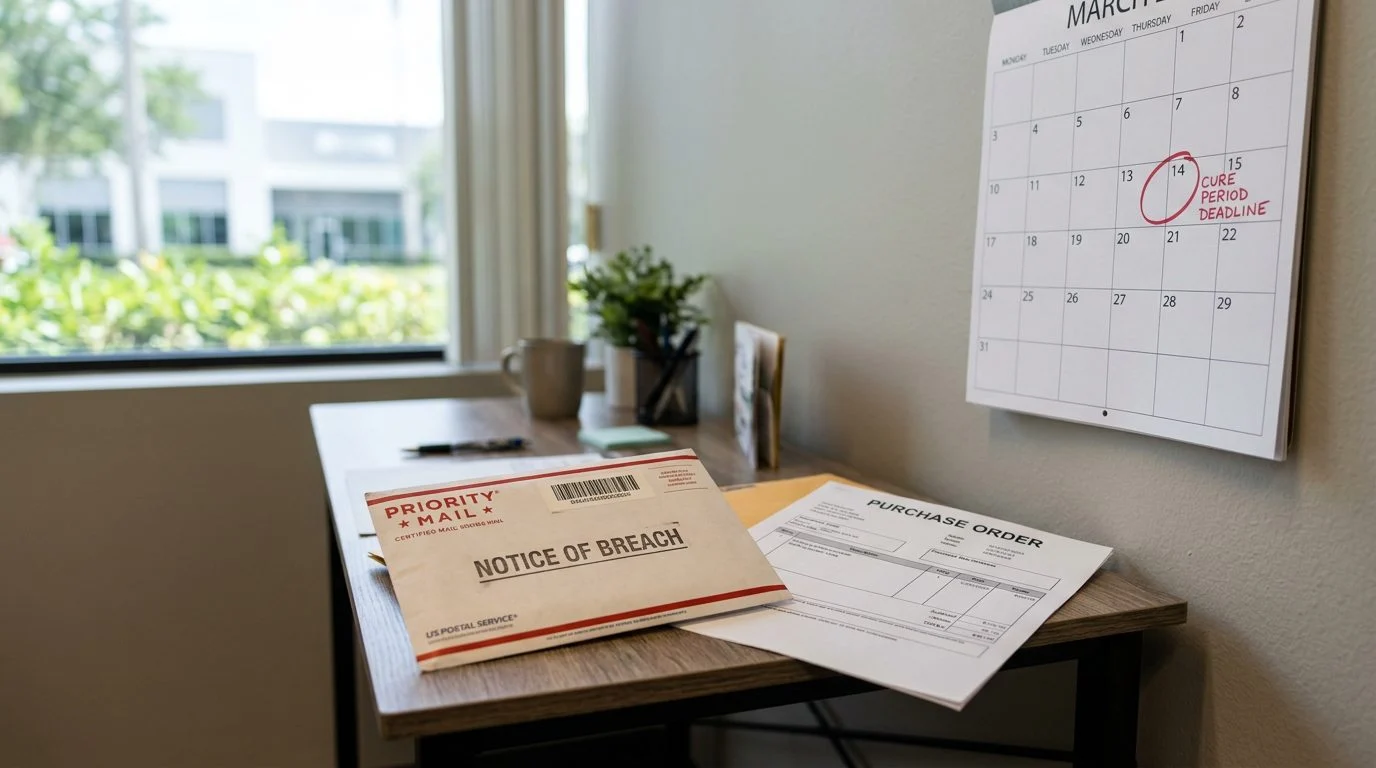
Timing matters too. Under Fla. Stat. § 95.031, a cause of action accrues when the last element of it occurs. The clock generally starts at that point, not on the day the contract was signed. Check any notice and cure terms in the contract against the calendar.
Florida sets time limits for suing in Fla. Stat. § 95.11, and the limit depends on the type of action. Write the timeline down while the facts are fresh.
Can a contract set a shorter deadline to sue?
No. Fla. Stat. § 95.03 says a contract provision that sets a shorter time to begin an action than the statute of limitations allows is void.
When a breach raises rescission or termination questions
When the other side breaches, you may need to decide whether to end the contract, rescind it, or keep performing. Each choice carries consequences.
Keep performing and you may keep the deal alive. But you may also keep working for a party that isn’t paying. Ending the contract too early can create a problem of your own if you weren’t entitled to end it. Check whether the contract requires written notice before you choose.
For the steps involved, read our guides on the Florida right of rescission and how to legally rescind a contract in Florida. The right move turns on the contract’s wording, the record, and the timing.
Talk through your contract with Ayala Law PA
If you’re dealing with an unpaid invoice, a stalled project, or a partner who stopped performing, these situations can be stressful and time-sensitive. You don’t have to work through the contract alone.
Ayala Law PA focuses on business litigation, commercial litigation, contract disputes, shareholder disputes, construction litigation, real estate litigation, and international trade litigation in Florida courts and arbitration. The firm’s only office is at 1646 W Snow Ave, Tampa, and it serves Tampa and Hillsborough County businesses from that office. Eduardo A. Maura is the lawyer responsible for this page. Our commercial contract dispute services page describes that work in more detail.
Contact our team to talk through your situation. To talk through your agreement and the facts behind it, phone our Tampa office at (813) 414-5715 or reach out using the firm’s contact page.



