
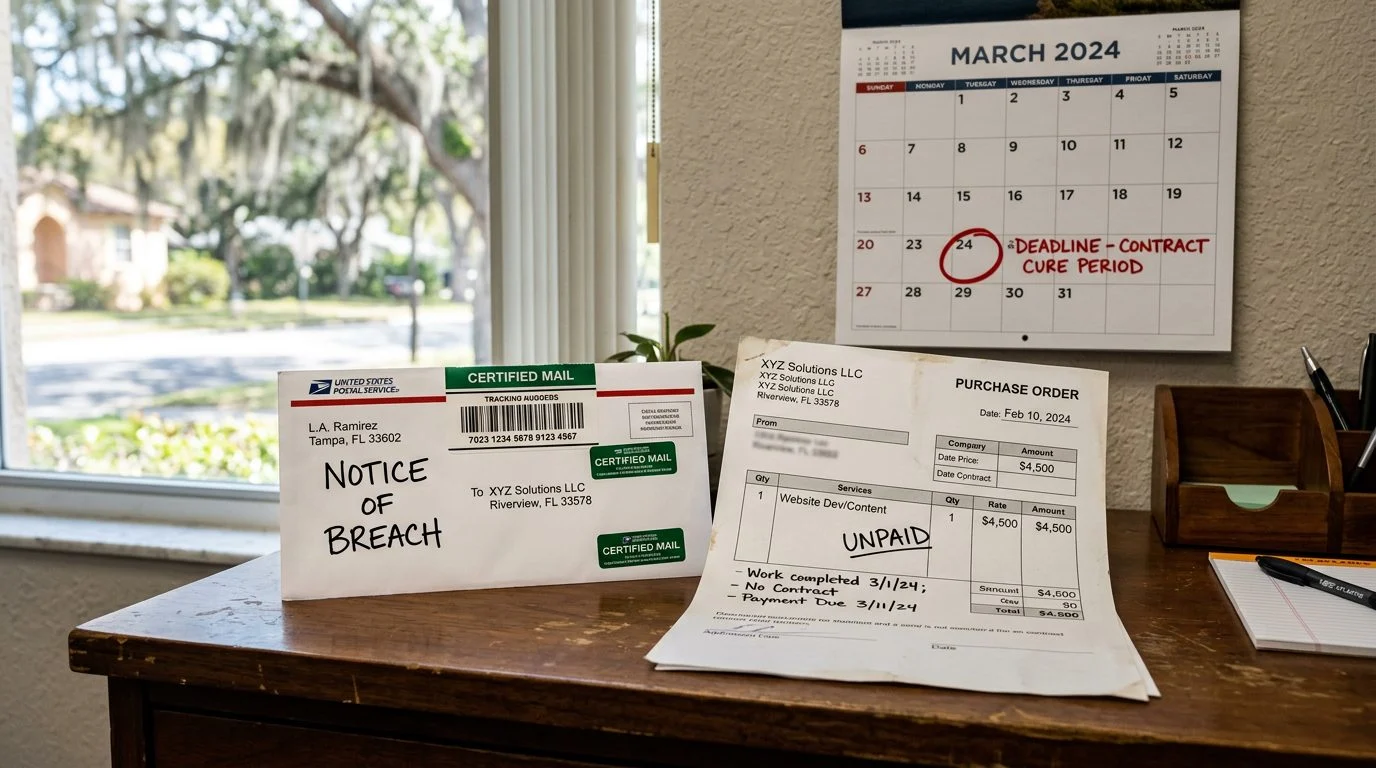
You did the work, sent the bill, and the money never arrived. Now there is no signed contract to point to. A missing signed document does not automatically mean you cannot get paid for work you performed.
What the parties said, wrote, and did is often central to a business dispute. The proof you gather early often shapes what happens next. This page explains how unpaid service claims work in Florida, what evidence matters, which time limits to watch, and the steps that usually come before a lawsuit. It is general information for business owners, contractors, and consultants in Tampa and Hillsborough County. For the wider practice, the firm’s business litigation overview is a good starting point.
Who This Page Is For and What “No Written Contract” Means
This page is for anyone who did paid work for a business without a signed agreement and has not been paid. That often includes consultants, independent workers, contractors, subcontractors, and small business owners in Tampa and Hillsborough County.
An agreement can be written, spoken, or implied from conduct. For example, a client asks you to finish a job, you do it, and the client accepts the finished work. Each step can help show that an agreement existed, even with no signed page.
A missing signature is a proof problem more often than a dead end. The key questions are what work was requested, what it was supposed to cost, and whether the other side accepted it.
This page focuses on business and service disputes between companies, owners, and clients. Eduardo A. Maura is the responsible lawyer for this page, and the firm’s details appear below.
If you are still waiting on payment for finished work, you may have a claim, and our team can review your records with you at the Tampa office. Talk it through with our team — we can walk you through how a situation like yours is usually handled and what your options are.
Can You Still Get Paid Without a Signed Contract in Florida?
A dispute over a contract that was never put into signed form often turns on what terms the parties actually agreed to. Start with four points: the work, the price or rate, the payment timing, and who agreed.
- Scope: what you were asked to do and what you actually finished.
- Price or rate: the agreed number, or proof that no number was set.
- Timing: when invoices were due and what the client was told about payment.
- Parties: who asked for the work and who had authority to approve it.
When no price was set, the parties’ disagreement may center on the value of the work performed. When the two sides tell different stories about what was said, the paper trail usually decides the matter. How a court would view your claim depends on the facts.
If you are a contractor, check your license status first. Under Fla. Stat. § 489.128, a contract made by an unlicensed contractor cannot be enforced by that contractor, and the unlicensed contractor has no lien or bond claim for the labor, services, or materials provided under it. The statute leaves other parties’ rights to enforce contract and lien remedies in place.
Evidence That Proves the Work and the Agreement
The strongest proof is usually a record made at the time of the work, not a memory of it. Keep everything in one place and sort it by date.
- Messages: texts and emails showing the request, the scope, the rate, and the client’s acceptance.
- Money paperwork: invoices, estimates, quotes, purchase orders, and any payment received or promised.
- Work records: logs, timesheets, project photos, delivery receipts, and completion sign-offs.
- Bank records: deposits, partial payments, and payments that match the project.
- Witnesses: people who saw the request made or the work finished.
A short text that says “go ahead” can matter as much as a formal order. Common mistakes include deleting message threads, replacing a phone without a backup, and losing the original invoice file. Keep originals and back up your devices now.
How Florida Time Limits Affect an Unpaid Services Claim
Florida sets filing deadlines for civil claims in Fla. Stat. § 95.11. The deadline depends on the type of claim, so identify your claim type early.
Under Fla. Stat. § 95.031, a cause of action accrues when the last element of the claim occurs. In plain terms, the clock generally starts when the last element of the claim occurs, often a breach such as a missed payment date, but for a note payable on demand, or payable after a date with no specific maturity date, it starts at the first written demand for payment, not at the last friendly conversation. Write down the due date and the date payment stopped.
Construction work has its own track. Under Fla. Stat. § 713.08, a claim of lien may be recorded at any time during the work but not later than 90 days after the final furnishing of labor, services, or materials; if the original contract is terminated under s. 713.07(4), the deadline is 90 days after termination or after final furnishing, whichever comes first.
Waiting while you negotiate can cost you evidence. Memories fade, and phones and email accounts change.
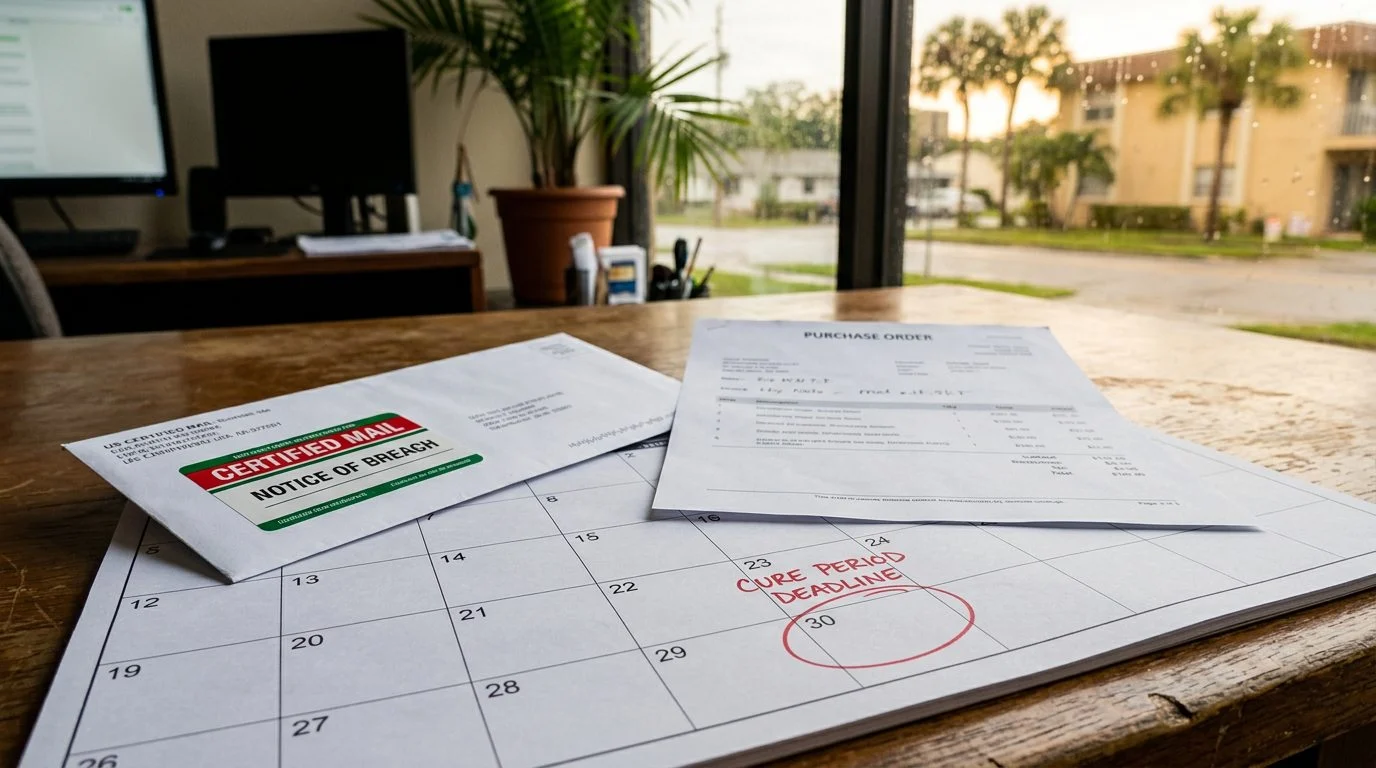
Step-by-Step: What to Do When Payment Stops
Start by building one timeline, then send a clear written demand before anything else. The usual order looks like this.
- Build a timeline. List the agreement, the work performed, each invoice, and each payment received.
- Send a written demand. State the amount, the work covered, and a payment deadline. Keep a copy.
- Check for a forum clause. A contract may require arbitration. Under Fla. Stat. § 682.02, a court decides whether an arbitration agreement exists.
- Negotiate in writing. Keep every response. Under Fla. Stat. § 90.408, offers to compromise a claim which was disputed as to validity or amount, as well as any relevant conduct or statements made in negotiations concerning a compromise, are inadmissible to prove liability or absence of liability for the claim or its value.
- File suit if needed. Under Fla. Stat. § 47.011, actions shall be brought only in the county where the defendant resides, where the claim arose, or where the property is located, and this rule does not apply to actions against nonresidents. Under Fla. Stat. § 45.061, a written offer of settlement may be served at any time more than 60 days after service of a summons and complaint on a party but not less than 60 days (or 45 days if it is a counteroffer) before trial, and it stays open 45 days unless withdrawn sooner by a writing served before acceptance; subsection (6), however, states that the section “does not apply to causes of action that accrue after the effective date of this act.”
- Collect after judgment. A judgment is one step. Collection is another, covered in the firm’s guide on collecting a contract judgment for businesses in Hillsborough County.
If you already have a timeline and documents, you can bring them to a case evaluation and review your options.
Common Objections and What Often Comes Next
Most pushback sounds like one of four statements. Each one turns on the wording and the record.
- “We never agreed on a price.” Expect the fight to focus on reasonable value and on how the two sides dealt with each other before.
- “The work was defective.” The other side may raise offsets or counterclaims. Record the scope, the acceptance, and any corrections as they happen.
- “We pay when our client pays us.” As a general rule, a Florida Fourth District Court of Appeal opinion, quoting an earlier decision, explains that conditions precedent “are not favored, and courts will not construe provisions to be such, unless required to do so by plain, unambiguous language or by necessary implication.”
- “I didn’t sign anything.” A signed document is one kind of proof, not the only kind.
Expect pressure to sign a release or take a partial payment quickly. Read any release or payment terms before you sign or cash a check.
Not sure what your next step is?
Talk it through with our team — we can walk you through how a situation like yours is usually handled and what your options are.
Why Businesses Work With Ayala Law PA on Contract Disputes
Ayala Law PA focuses its practice on business, commercial, and contract disputes in Florida courts and arbitration. The firm’s only office is at 1646 W Snow Ave, Tampa, FL 33606.
- Practice areas: business litigation, commercial litigation, contract disputes, shareholder and partnership disputes, construction litigation, real estate litigation, and international trade litigation.
- Service area: Tampa, Hillsborough County, Brandon, Riverview, Plant City, Temple Terrace, and the wider Tampa Bay area, served from the Tampa office.
- Responsible lawyer for this page: Eduardo A. Maura.
- Support: our team can help you sort invoices, messages, and payment records into a clear timeline. We can also talk through demand letters, deadlines, and forum options in plain language.
Frequently Asked Questions
Can I sue for unpaid services if there was no written contract?
A missing written contract does not automatically end a claim. A dispute like this often centers on what was agreed and whether the work was performed.
How long do I have to file?
Florida’s filing deadlines are set in Fla. Stat. § 95.11 and vary by claim type. Note the date payment was due and check your claim type early.
Do I need a demand letter first?
A written demand creates a record and is a common first step. Whether a contract requires notice before suit turns on that contract’s wording.
Is a text message enough proof?
Texts and emails can show the request, the scope, and the acceptance. They work best alongside invoices and payment records.
What if the client says the work was bad?
Record the scope, the acceptance, and any corrections. The other side may raise offsets or counterclaims.
What does a case evaluation cost?
The firm explains its fee terms when you call, before any engagement begins.
What should I bring?
Bring your timeline, invoices, messages, and payment records.
Waiting on money for work you already finished is stressful, and you do not have to sort out the next steps alone. Call the Tampa office at (813) 414-5715, or send your details through the contact page.



