
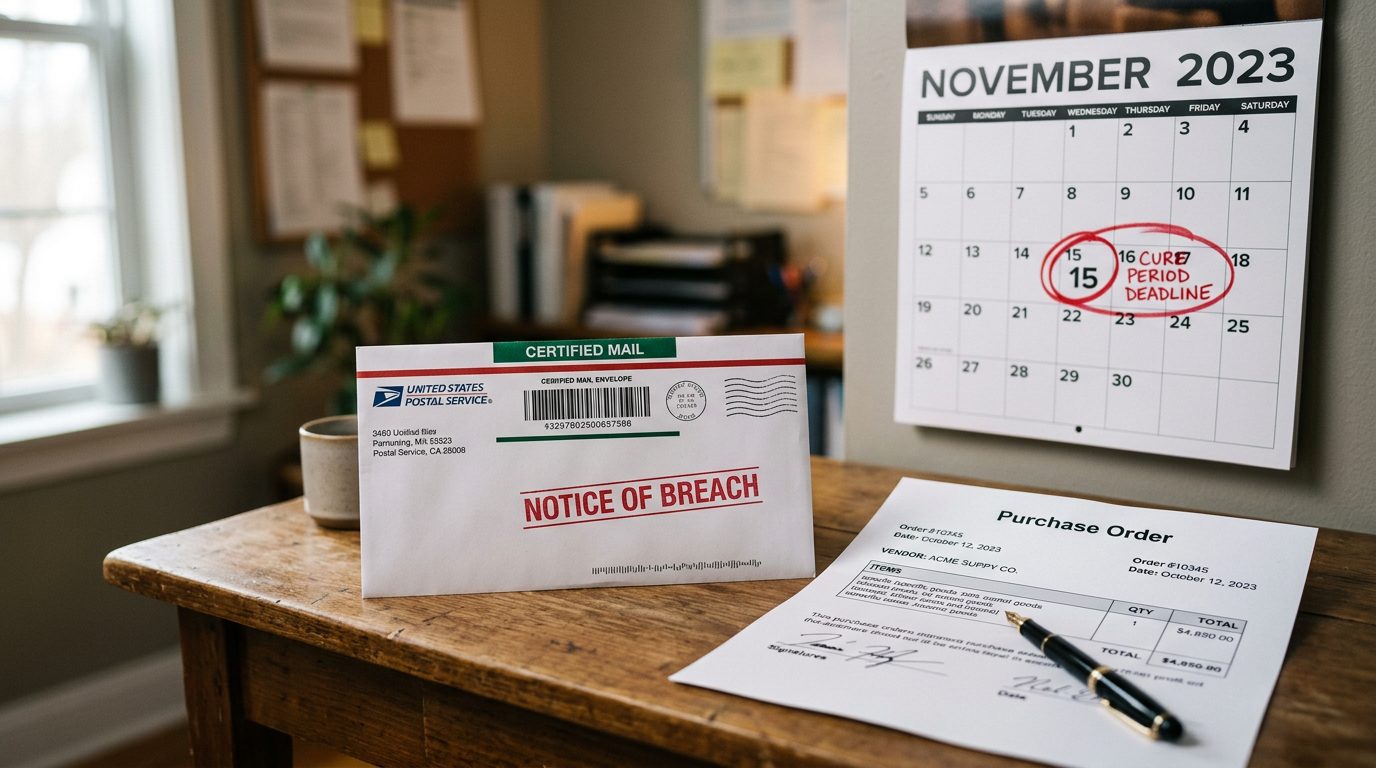
An unfair contract is an agreement, or one term in it, that places an unreasonable burden on one side. Florida does not use that phrase as a single statute or fixed legal category. Florida courts look at how a deal was made and how one-sided its terms are. Some claims also fall under the state’s consumer law. This guide explains each piece in plain language. It is general information, not legal advice.
What is an unfair contract?
An unfair contract is one that puts an unreasonable burden on one party, usually because of its terms and how it was presented. A single clause can be unfair even when the rest of the deal is fine.
The question “What is an unfair contract?” comes up most often with pre-printed forms and take-it-or-leave-it deals. One side writes the rules, and the other side signs or walks away.
Florida does not have a single statute that defines the phrase. Instead, Florida courts ask whether the deal was made fairly and whether its terms are fair. Those two questions drive every section below.
Not sure what your next step is?
Talk it through with our team — we can walk you through how a situation like yours is usually handled and what your options are.
Where the “unfair contract terms” idea comes from
Unfair contract terms laws are separate rules in Australia, New Zealand, and the European Union. They are not Florida law.
Florida readers should not assume those tests apply here. Florida courts use their own framework, built on unconscionability and state consumer law. The overseas idea helps explain the concept, but it is not the test a Florida court uses.
How Florida handles an unfair contract
Florida handles an unfair contract mainly through unconscionability. A term is unconscionable when it is so unfair that a court may refuse to enforce it.
The Florida Supreme Court set the two-part test in Basulto v. Hialeah Automotive. A court must find both procedural and substantive unconscionability. In Basulto v. Hialeah Automotive, the Florida Supreme Court concluded that both the procedural and substantive aspects of unconscionability must be present, although not necessarily to the same degree, and that both should be evaluated interdependently rather than as independent elements. Basulto involved an arbitration agreement and applied general Florida contract law.
The Florida Supreme Court explained in Basulto v. Hialeah Automotive that the procedural and substantive aspects of unconscionability are weighed together, interdependently, rather than as independent elements.
When unconscionability is raised, Fla. Stat. § 672.302 lets a court refuse to enforce the contract, enforce the rest without the bad clause, or limit the clause to avoid an unconscionable result. The parties must also get a reasonable chance to present evidence on the deal’s commercial setting, purpose, and effect.
Whether FDUTPA reaches a particular contract depends on the facts.
What makes a contract term unfair?
A term looks unfair when it gives one side far more power, and that gap is hard to see. Two ideas guide the review: significant imbalance and transparency.
Significant imbalance means one party gets much more rights, remedies, or protection than the other. Examples include one-sided termination rights and a unilateral right to change price or scope.
Transparency means a term is clearly presented. A clause buried in small print, written in confusing language, or not pointed out before signing raises questions about how the deal was made.
Context matters. The same clause may be judged differently in a negotiated deal between two companies with their own lawyers than in a form given to a small contractor.
Some terms also carry fixed rules. Under Florida law, a contract provision that sets a shorter period to sue than the statute provides is generally void (see Fla. Stat. § 95.03), and the scope of that rule depends on the statute’s terms. It is also worth checking whether the contract includes a provision on attorney’s fees, since that language can affect how a dispute unfolds. If a contract allows only one side to recover attorney’s fees for enforcing it, Fla. Stat. § 57.105(7) may allow the court to award reasonable fees to the other side when that party prevails, subject to the statute’s conditions.
Standard form contracts and take-it-or-leave-it agreements
A standard form contract is a pre-written agreement offered on the same terms to many people, with little room to negotiate. You may see one from a general contractor, a supplier, a landlord, or a software vendor.
These forms raise questions because one side often wrote the terms alone. Look at how the form reached you, who could change it, and how much time you had to read it.
Two businesses of similar size that negotiate with their own lawyers stand on different ground than a small company that signed a form it could not change. The facts decide which side of that line a contract falls on.
Keep the form, every draft, and the emails that show how the terms were offered. Those records show the commercial setting a court may look at.
What a Florida contract needs to be valid
A Florida contract needs an offer, an acceptance, consideration, and essential terms stated clearly enough. The Florida Supreme Court said an oral contract is subject to these same basic requirements in St. Joe Corp. v. McIver. A missing essential term can leave a dispute open.
Mistakes can also matter. Rescission (undoing a deal) for mutual mistake of fact is available only if the mistake is mutual and the fact is of the essence of the contract, according to the Fourth District’s Waterside ruling. A mistake about a non-essential term will not support that remedy. Neither will one side’s own mistake, on this theory.
A party can also lose the right to undo a deal. Under Flaherty v. Flaherty, ratification happens when a party entitled to rescind a voidable contract fails to do so after learning the facts that warrant rescission. Courts apply this rule case by case.
Not sure what your next step is?
Talk it through with our team — we can walk you through how a situation like yours is usually handled and what your options are.
What happens if a contract is unfair?
A court can refuse to enforce the bad term, keep the rest of the deal, or narrow the clause, as described above. Some contracts include a severability clause, which addresses whether the valid parts survive. Its exact wording matters.
The right remedy turns on the claim and the evidence. Only a review of the actual contract and records can show how these rules fit a specific deal.
How a contract can be terminated
Read the termination clause closely. A clause that lets one side end the deal without notice or a chance to fix a problem may be the kind of one-sided term discussed above. Check the time to sue, too. A contract cannot shorten the statutory period.
Talk with Ayala Law PA about a contract dispute
If you’re facing a one-sided agreement, you may be trying to understand terms you did not write. You may also be reviewing a form for a business partner, a subcontractor, or a family member. Some readers are already in a dispute that started from those terms.
Ayala Law PA focuses on business litigation. That includes commercial and contract disputes, shareholder and partnership disputes, construction litigation such as contractor and subcontractor disputes and lien foreclosure, real estate litigation, and international trade litigation. The firm handles these matters in Florida courts and arbitration and serves Tampa, Hillsborough County, Brandon, Riverview, Plant City, Temple Terrace, and the Tampa Bay area.
The firm’s office is at 1646 W Snow Ave in Tampa, FL, and the firm represents businesses in Tampa and Hillsborough County. Eduardo A. Maura is the responsible lawyer for this page. If a matter fits better with another lawyer or firm, the firm may refer it. Case evaluations are subject to a fee. This page is general information, not legal advice.
What is an unfair contract in Florida?
An unfair contract is one whose terms place an unreasonable burden on one party. Florida courts test these terms through unconscionability and related state law.
Can a court refuse to enforce an unconscionable contract?
Yes. A court may refuse to enforce a contract or clause that it finds, as a matter of law, to have been unconscionable at the time it was made.
Does consumer law cover businesses?
The definition of consumer in FDUTPA includes businesses and other commercial entities. Each contract still turns on its own facts.
Can a contract shorten the time to sue?
Generally not. Under Florida law, a contract provision that sets a shorter period to sue than the statute provides is generally void, as addressed in Fla. Stat. § 95.03.
If a one-sided agreement you signed is now causing a dispute, Ayala Law PA can talk through the terms with you. Call (305) 570-2208 to ask about a case evaluation, or use our contact page.



