
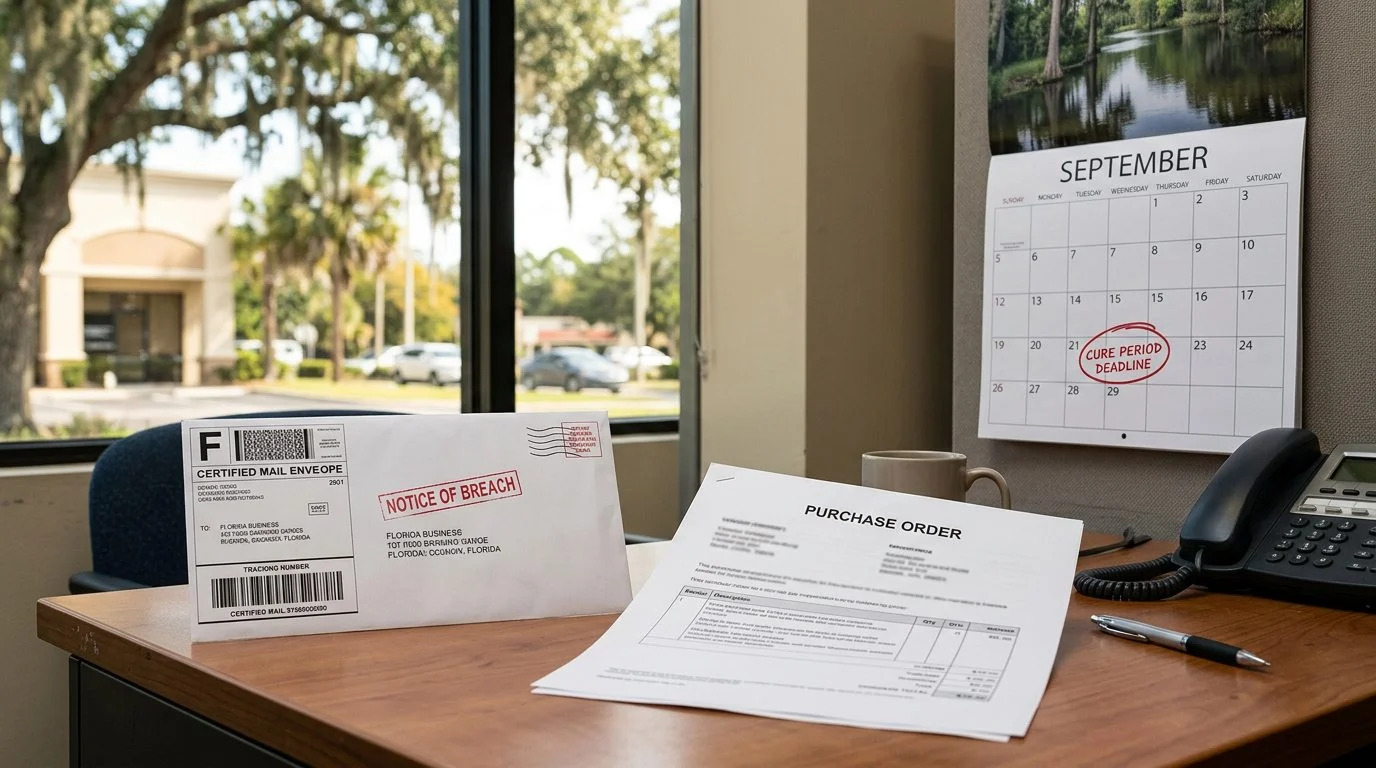
The difference between breach of contract and material breach comes down to how serious the failure is. A material breach is a serious failure that goes to the heart of the deal. That label can change what you’re allowed to do next. This page explains the difference in plain terms for Florida businesses, including owners, managers, contractors, subcontractors, and shareholders.
Short answer: breach of contract versus material breach
Every material breach is a breach, but not every breach is material. A breach of contract covers any missed promise, including late, partial, or defective work. A material breach takes away the main benefit the other side reasonably expected from the deal. A material breach may let you stop performing, which is a much bigger step.
This page is maintained by Eduardo A. Maura, responsible lawyer for Ayala Law PA. The firm’s office is at 1646 W Snow Ave in Tampa, Florida. The firm works with businesses in Tampa, Hillsborough County, and the wider Tampa Bay area. Every contract has its own terms, so the details of your agreement count.
If a breach notice or a withheld payment has your business weighing its next move, our team can talk through your agreement with you. Talk it through with our team — we can walk you through how a situation like yours is usually handled and what your options are.
What counts as a breach of contract
The failure doesn’t have to be total. Breach takes several forms:
- Nonperformance: the work or delivery never happens.
- Late performance: the work arrives after the agreed date.
- Partial performance: only part of the promised work is done.
- Defective performance: the work is done, but it doesn’t meet the contract’s terms.
A party can also breach by refusing outright to perform.
Consider a supply agreement. A distributor promises 500 units by March 1 and delivers 350 on March 20, with the rest in April. That’s late and partial performance. Whether it’s a material breach turns on what the buyer needed the units for, not just the count.
In construction, a drywall subcontractor agrees to finish walls to code by a set date. The walls go up with cracked seams and misaligned framing. That’s defective performance. The key questions are whether the defects can be fixed and whether they defeat the reason the owner hired the sub.
What makes a breach material
A breach is material when it defeats the core reason the parties made the deal.
- How much of the expected benefit does the injured side lose?
- Can money damages make that side whole?
- Is the breaching side likely to fix the problem?
- Did the breaching side act in good faith?
A small dollar problem can be material if it leaves a project unusable. A bigger invoice error may not be, if the deal still delivers what was promised.
The contract’s wording counts too. “Time is of the essence” language, milestone dates, and termination clauses can show how seriously the parties treated a deadline. Read those terms before you act.
Why the difference matters in practice
The label decides your next move. Stopping work or withholding payment over a minor problem can backfire. If a court finds the failure was not material, the party that stopped may be the one in breach.
A material breach can allow the injured party to suspend or end its own performance and pursue broader remedies. Acting without them is risky.
Anticipatory repudiation is related. A clear statement or act that the other side won’t perform can be treated as a breach before the due date. Vague worry about future performance is different from a clear refusal.
Shareholders face the same question. Florida Statutes § 607.0732 recognizes shareholder agreements that comply with the section. If one owner stops making required contributions, whether that’s material depends on what the agreement requires and why it matters to the company.
Notice, cure rights, and contract clauses to review
Many contracts require written notice and a chance to fix the problem before termination. This is often called a notice-and-cure provision. Florida’s sales-of-goods rules show why notice matters. A buyer who accepted goods must notify the seller of a breach within a reasonable time after he or she discovers or should have discovered it, or be barred from any remedy (Fla. Stat. § 672.607). A seller whose nonconforming delivery was rejected, while the time for performance has not yet expired, may seasonably notify the buyer of its intent to cure and make a conforming delivery within the contract time (Fla. Stat. § 672.508).
Check these clauses before you act:
- termination for cause and default
- cure periods and notice addresses
- dispute resolution and arbitration terms
- limits on remedies
- attorney’s fee provisions
Florida law makes a written agreement to arbitrate valid and enforceable, except on grounds that allow revoking any contract (Fla. Stat. § 682.02). The International Chamber of Commerce’s arbitration clause guidance says a clause should name the governing law, the location, and the language, and avoid unclear wording.
Timing matters too. Florida sets filing deadlines for lawsuits by statute, and the deadline depends on the type of claim. A contract can’t shorten that time below the statute’s period. A provision that tries to do so is void (Fla. Stat. § 95.03).
How this plays out in Florida construction and commercial disputes
In construction, the material-breach question often arises when an owner stops paying. The owner may argue that delays or defective work are serious enough to justify withholding payment or ending the contract. The contractor may argue the problems were minor, fixable, or already being corrected. Both sides point to the schedule, change orders, and inspection records.
Subcontractors face the question from the other direction. A sub who isn’t paid may ask whether the general contractor’s nonpayment is serious enough to stop work.
Owners of Florida LLCs see it too. An operating agreement can govern many matters inside the company. It can’t eliminate the obligation of good faith and fair dealing (Fla. Stat. § 605.0105). Buy-sell and operating agreement disputes often come down to what the agreement required, when, and what happened next.
Commercial contract disputes in Florida courts or arbitration follow the same basic questions. These cases turn on documents and timing. Start gathering proof early.
Not sure what your next step is?
Talk it through with our team — we can walk you through how a situation like yours is usually handled and what your options are.
If you received a breach notice or are deciding whether to stop performing
A notice of default, a withheld payment, or a contract that’s coming apart can put real pressure on a business. Deadlines may already be running, and the other side may want a fast answer.
Start by keeping everything. Save the contract and any amendments, emails, texts, invoices, change orders, and photos. Write a dated timeline of what happened and when. Read any notice against the contract’s notice and cure terms before you respond.
Ayala Law PA focuses on business litigation, commercial and contract disputes, shareholder disputes, construction litigation, real estate litigation, and international trade litigation. If a breach notice or a withheld payment has your business weighing whether to keep performing, withhold payment, terminate, or sue, call (813) 414-5715 or reach out through our contact page. Fee terms are discussed directly with the firm.
Frequently asked questions
What is the difference between breach of contract and material breach?
A material breach is a serious failure that defeats the main purpose of the deal.
Can I stop performing if the other side breaches?
Sometimes, but usually only for a material breach, and after following the contract’s notice steps. Whether stopping work or payments could affect your position depends on the terms of your contract and the facts of your situation.
How long do I have to sue for breach of contract in Florida?
Florida sets time limits for contract claims in § 95.11.
Can a contractor withhold payment for defective work?
Withholding payment is risky. Whether it’s allowed depends on the contract’s terms and how serious the defects are.



