
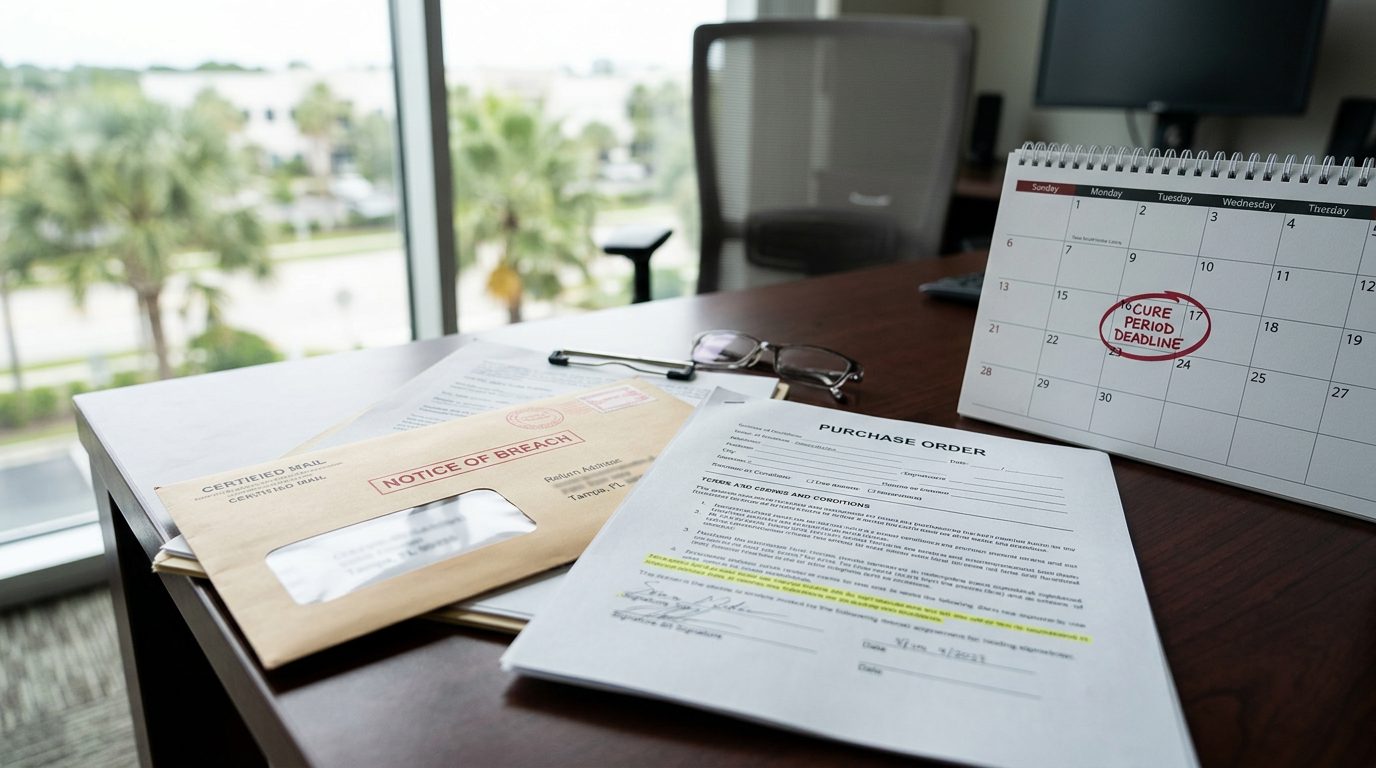
What is the meaning of contract dispute? In plain terms, it is a disagreement between the parties to a contract about what the contract requires. It usually starts when one side believes the other did not do what it promised. This guide explains the term, the common forms it takes, the key words you’ll see, how Florida disputes get resolved, and what to gather first. It is written for business owners, managers, contractors, and partners in Tampa and Hillsborough County who are researching a situation they did not choose.
What a contract dispute means
A contract dispute is a disagreement over a deal both sides made and what each side owes under it. A contract is an enforceable agreement. Florida courts apply basic contract rules, including to oral agreements. Those rules require an offer, an acceptance, consideration (something of value exchanged), and enough detail on the essential terms. The St. Joe Corp. v. McIver decision applies these rules to an oral contract.
A dispute starts when one side says the other did not perform, performed late or differently, or reads a key term another way. Disputes often begin with terms that were discussed but never written down. Consider a supplier that bills a client for monthly service. The client pays 60 days late and says the work was incomplete. Both sides now disagree about performance and payment under the same agreement.
An ordinary business complaint is different because no binding agreement is at stake. A complaint about a vendor’s attitude is a business problem. A claim that the vendor missed a deadline in a signed contract is a contract dispute. For a broader overview, read the Florida contract disputes guide.
If a late payment or a disagreement over your agreement has your business stuck, you don't have to sort out the contract alone, so call Ayala Law PA at (305) 570-2208 to talk through the facts. Talk it through with our team — we can walk you through how a situation like yours is usually handled and what your options are.

Common forms a contract dispute takes
Most contract disputes fall into a few patterns: nonpayment, late or defective work, and disagreements over what the terms mean. Each pattern shows up across the work Ayala Law PA focuses on.
Breach of contract is a common form. A breach happens when a party does not do what the agreement requires. That can mean unpaid invoices, late or incomplete delivery, or work that misses the agreed specifications.
Construction disputes often involve contractors and subcontractors who disagree over scope, change orders, and who pays for extra work. These projects can also involve lien rights, which follow their own procedures.
In commercial agreements, disputes often center on termination, renewal, pricing, or ownership terms. Shareholder and partnership disputes usually turn on the internal agreement. Under Fla. Stat. § 620.8103, relations among partners are governed by the partnership agreement first, and the statute fills gaps.
Real estate disputes can involve purchase, sale, or lease agreements. International trade disputes often involve supply contracts.
Key terms that appear in a contract dispute
A breach is a failure to perform a contract duty. Damages are the money or other relief one side may claim because of it. A material breach is serious enough to defeat the core purpose of the deal. A late delivery of a minor part differs from a failure to deliver the main product. For more on these terms, read the contract dispute terms page.
Ambiguity means a term can reasonably be read more than one way. The exact wording matters, and courts read the whole agreement for context. Unfair terms can also be challenged. Under Basulto v. Hialeah Automotive, a term is refused as unconscionable only when procedural unfairness (how the deal was made) and substantive unfairness (how one-sided the terms are) are both present.
Many contracts require written notice and a chance to fix a problem before a claim. For goods a buyer has accepted, the buyer must notify the seller of a breach within a reasonable time after he or she discovers or should have discovered it, or be barred from any remedy, under Fla. Stat. § 672.607.
Governing law and forum clauses decide which state’s law applies and where a dispute is heard. For transactions covered by Florida’s Uniform Commercial Code that bear a reasonable relation to Florida and another state or nation, the parties may generally agree which of those places’ law governs their rights and duties, except where the code itself specifies the applicable law, under Fla. Stat. § 671.105. An arbitration clause sends disputes to arbitration. Florida makes an agreement contained in a record to submit to arbitration valid and enforceable, except on grounds that exist at law or in equity for the revocation of a contract, under Fla. Stat. § 682.02.
The statute of limitations sets the deadline to file suit. Under Florida’s statute of limitations, a claim on an oral or other unwritten contract, including one for the sale and delivery of goods, must be brought within 4 years.
How contract disputes are resolved in Florida
Contract disputes are usually resolved through talks, mediation, arbitration, or a lawsuit in court. Many start with direct negotiation and a written demand letter that states the problem and the fix.
Mediation brings in a neutral mediator to help the parties reach agreement. Florida courts may refer some filed money-damage cases to mediation when a party requests it, and the rules that apply depend on the court and the case. The American Arbitration Association notes that mediation can be used for cross-border commercial disputes involving international contracts.
Arbitration happens only when the contract requires it. The International Chamber of Commerce advises that arbitration clauses name the governing law and the place of arbitration, and avoid vague wording that can delay resolution.
Litigation means filing suit in a Florida court.
Which path fits depends on the facts, the contract’s terms, and what the parties want. Construction disputes may involve lien rights and specific procedures, covered in construction contract dispute resolution. Cost matters too, so review the cost to sue for breach of contract guide before choosing a path.

First steps if you are facing or researching a contract dispute
Start by gathering every document tied to the agreement, checking its notice and dispute terms, and holding off on written admissions until you’ve reviewed them.
You may be reading this for a company you run, a partner, or a family member’s business. You may not have chosen this situation. The steps below help you organize the facts before any decision.
Gather the signed contract, every amendment, purchase orders, invoices, change orders, payment records, and emails or letters about the problem. Keep them in one place, in date order if you can.
Read the contract for notice requirements, cure periods, dispute-resolution clauses, and deadlines. Florida sets deadlines for filing suit, so note any dates early.
About this page: Ayala Law PA’s only office is at 1646 W Snow Ave, Tampa, Florida. The firm serves businesses in Tampa and Hillsborough County. Eduardo A. Maura is the responsible lawyer for this page. Fees for case evaluations are discussed directly with the firm.
If a late payment or a disagreement over your agreement has your business stuck, you don’t have to sort out the contract alone. Call Ayala Law PA at (305) 570-2208 or use the contact page to talk through your agreement and the facts.



