
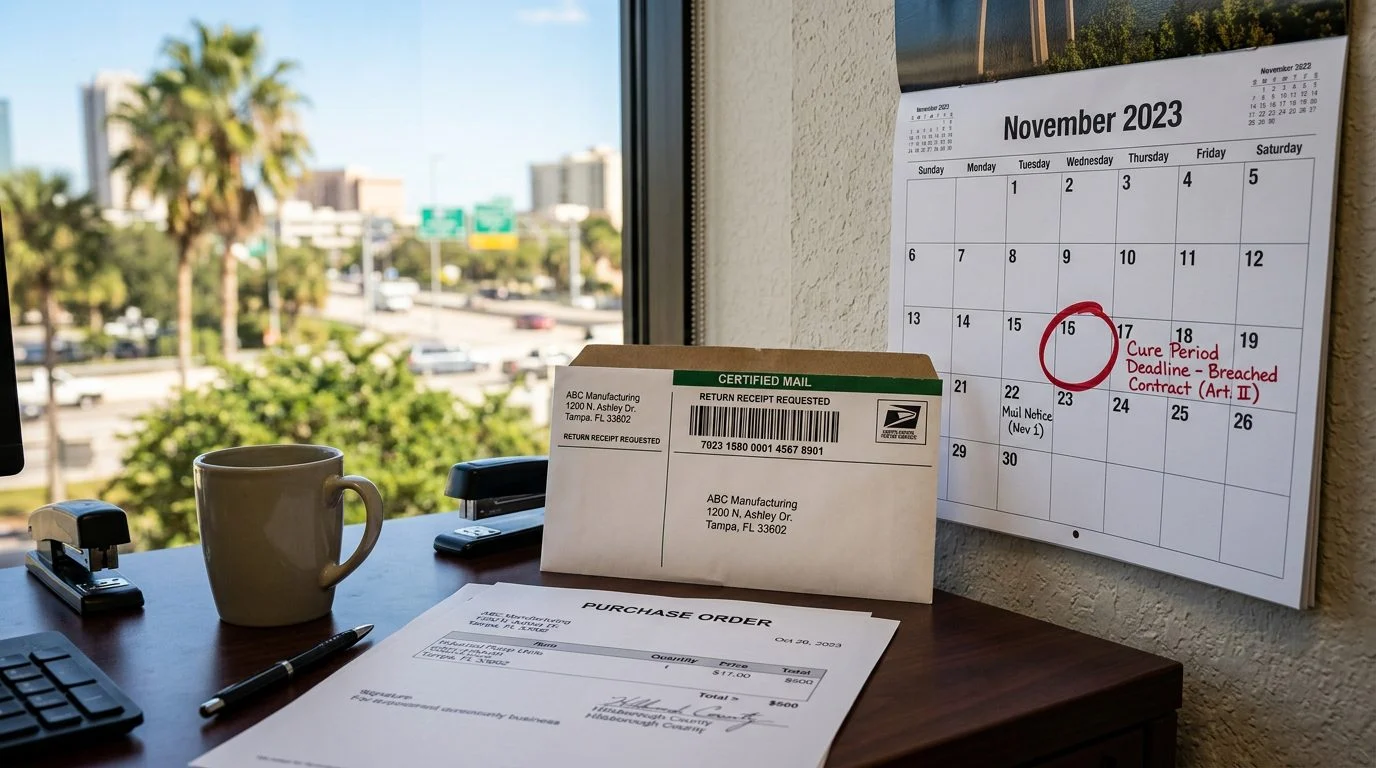
You agreed to buy a batch of equipment by phone, and now the seller is backing out. Can a court enforce a deal that was never written down?
Usually not, if the goods cost $500 or more. Florida’s sales-of-goods law generally makes a contract for goods priced at $500 or more unenforceable in court unless a signed record shows that a sale was made, or an exception applies § 672.201. Here is what counts as a record and where the exceptions come in.
When Does the $500 Writing Requirement Apply?
The writing rule applies to a contract for the sale of goods priced at $500 or more.
A mixed deal, like a product sold with installation, is governed by the goods rules when the sale of goods is the main part of it, though other law may still apply to its non-goods aspects; otherwise only the goods provisions that relate primarily to the sale of goods apply § 672.102.
Ten units at $60 each make a $600 contract.
An oral deal isn’t automatically void. It is still a contract, and it must meet ordinary contract rules, such as offer, acceptance, consideration, and clear essential terms (St. Joe Corp. v. McIver). The writing rule limits whether a court will enforce it.
Not sure what your next step is?
Talk it through with our team — we can walk you through how a situation like yours is usually handled and what your options are.
What Must a Writing Show to Be Enforceable?
A writing counts only if it shows that a contract for sale was made. It must be signed by the party you want to hold to the deal, or by that party’s authorized agent or broker § 672.201.
The record doesn’t need every term of the deal. A missing or wrong term doesn’t erase the record. But the contract can be enforced only up to the quantity the record shows. If a purchase order says 40 units and the deal was for 60, the record covers only the 40.
Electronic signatures can count. Under Florida law, an electronic signature generally has the same force as a written signature unless another law says otherwise § 668.004. The electronic transactions law applies only when both parties agreed to deal electronically. That agreement is judged from the context and the parties’ conduct § 668.50.
Whether a given email qualifies depends on the facts.
Which Exceptions Can Make an Oral Deal Enforceable?
Under Fla. Stat. § 672.201, a contract that does not meet the signed-record requirement but is valid in other respects is enforceable in certain listed situations, including specially manufactured goods, an admission in court that a contract was made, and goods that have been paid for and accepted, within the limits the statute sets.
Custom goods. A seller can enforce an oral deal for goods made specially for the buyer. The goods must not be suitable for sale to others in the seller’s ordinary business. The seller must have made a substantial start on them, or committed to buy materials, before getting notice of repudiation § 672.201.
Admission in court. If the other side admits in a pleading, in testimony, or otherwise in court that a contract was made, the deal can be enforced. It is enforceable only for the quantity admitted.
Accepting part of a commercial unit counts as accepting the whole unit § 672.606.
A merchant deals in goods of that kind, or by occupation holds himself or herself out as having knowledge or skill peculiar to the practices or goods involved, or is someone to whom such knowledge or skill may be attributed by employing an agent or broker or other intermediary who by occupation holds himself or herself out as having such knowledge or skill § 672.104. Between merchants, a written confirmation of the contract that arrives within a reasonable time, is sufficient against the sender, and is received by a party who has reason to know its contents can satisfy the writing requirement against that party under § 672.201(2), unless that party gives notice in a record of objection to its contents within 10 days after receiving it. If they don’t, and the conditions above are met, the confirmation can count against them § 672.201.
Does the Cooling-Off Rule Apply to Business Sales?
Chapter 672 doesn’t repeal or impair statutes that regulate sales to consumers, farmers, or other specified classes of buyers § 672.102. Consumer protections are a separate track.
Don’t assume you can walk away from a business deal because it was made by phone or at a trade show. How a deal was made still matters as evidence, even when no cancellation right applies.
What Problems Show Up in Verbal Product Deals?
The most common problem is a dispute over what was agreed, especially quantity and price. Other problems tend to come up in the same kinds of deals:
- Price changes mid-deal. A supplier that tries to raise an agreed price creates a dispute over which price governs.
- Partial payments. A check marked “payment in full” raises questions about what was accepted and what is still owed.
- Signals of non-performance. If one side clearly says it won’t perform, the other side’s options depend on timing and the records.
- Written limits on damages. Written terms that limit damages often matter in product disputes.
A handshake promise to pay later can look like an easy fix. It isn’t. Florida’s Supreme Court has held that promissory estoppel cannot be used to enforce an oral agreement that a statute of frauds requires to be in a signed writing (DK Arena, Inc. v. EB Acquisitions I, LLC). A promise of future action can also be fraud if the person making it had no intention of keeping it (Frutafino, S.A.S. v. Dole Chile, S.A.).
What Should You Do Next With a Verbal Deal Over $500?
Start by saving every record of the deal. That includes emails, texts, purchase orders, invoices, order confirmations, delivery receipts, and payment records. Then write down the quantity, the agreed total price, and whether the goods were custom-made, delivered, accepted, or paid for. Those facts line up directly with the rules above.
Ayala Law PA is a business litigation firm. Its practice focuses on commercial litigation, contract disputes, and international trade litigation in Florida courts and arbitration. The firm’s office is at 1646 W Snow Ave in Tampa, Florida, and it serves businesses in Hillsborough County and the Tampa Bay area. Eduardo A. Maura is the responsible lawyer for this page.
Frequently Asked Questions
Is a verbal agreement to buy products enforceable in Florida?
For goods priced at $500 or more, generally not, unless a signed record or an exception applies.
Can an email satisfy the writing requirement?
It can, if the email shows a sale was made, states a quantity, and is signed by the party you’re enforcing against. Whether a given email qualifies depends on the facts.
Does an electronic signature count?
Under Florida law, an electronic signature generally has the same force as a written signature, unless another law provides otherwise.
Do I have to object to a written confirmation?
Between merchants, yes. Object in writing within 10 days after you receive it, or the confirmation can count against you.
If a verbal deal for products worth $500 or more has gone sideways, you don’t have to sort out the writing rules alone. Contact our team at (305) 570-2208 or through our contact page to talk through the facts of your deal.



