
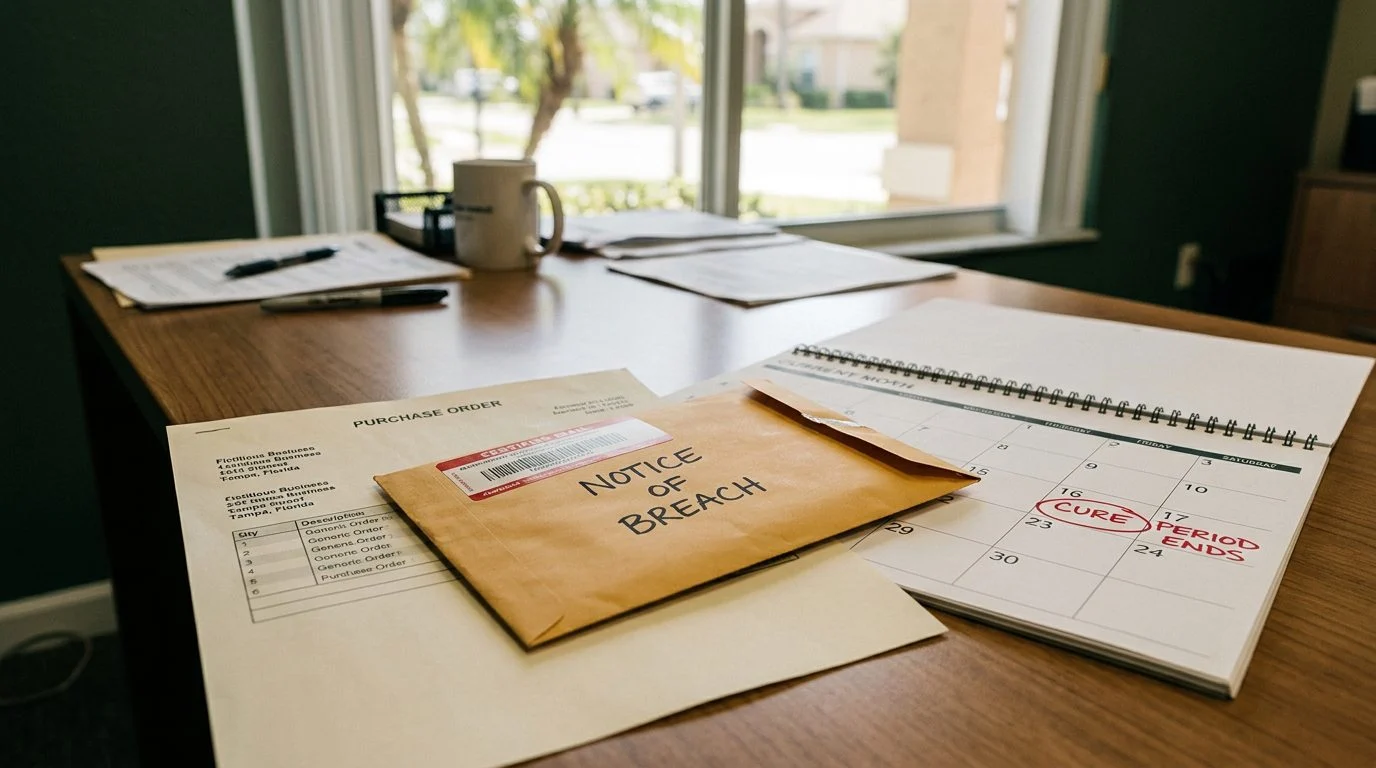
When a contract requires written notice before a claim can proceed, the first question is whether that requirement is a condition precedent. Florida courts generally disfavor conditions precedent and will not read a provision as one unless plain, unambiguous language or necessary implication requires it, a Florida appellate court explained. Many business agreements require written notice and a cure period before a party can declare a default or sue. This section covers notice clauses, cure periods, anticipatory breach, silent contracts, and how the filing deadline runs on its own track.
Short answer: often yes, when the contract says so
If your contract requires written notice or a cure period before a claim, you generally need to take that step first. In practical terms, a court generally will not treat a contract provision as a condition precedent unless plain, unambiguous language or necessary implication requires that reading (see the court’s opinion). When it comes to written notice before a breach of contract claim in Florida, the notice clause is the first place to look. Whether a required step applied, and whether it was met, turns on the facts and the language. Think of notice as a gate built into the deal. If the gate is in the agreement, skipping it can weaken a claim. The checklist later on this page shows where to find that gate in your own papers.
Not sure what your next step is?
Talk it through with our team — we can walk you through how a situation like yours is usually handled and what your options are.
The elements of a breach of contract claim in Florida and where notice fits
A Florida breach of contract claim generally requires a valid contract, the plaintiff’s own performance or a valid excuse for not performing, a material breach by the other side, and resulting damages. Notice is not a separate element on that list. It can still matter. A notice step may be a condition, meaning an event that must happen before the other side’s duty arises or before a claim can rest on it. A judge reading the complaint will compare the allegations with the contract text. Clear wording helps. The breach must also be material, meaning significant to the deal, not a minor slip.
What a notice clause usually spells out
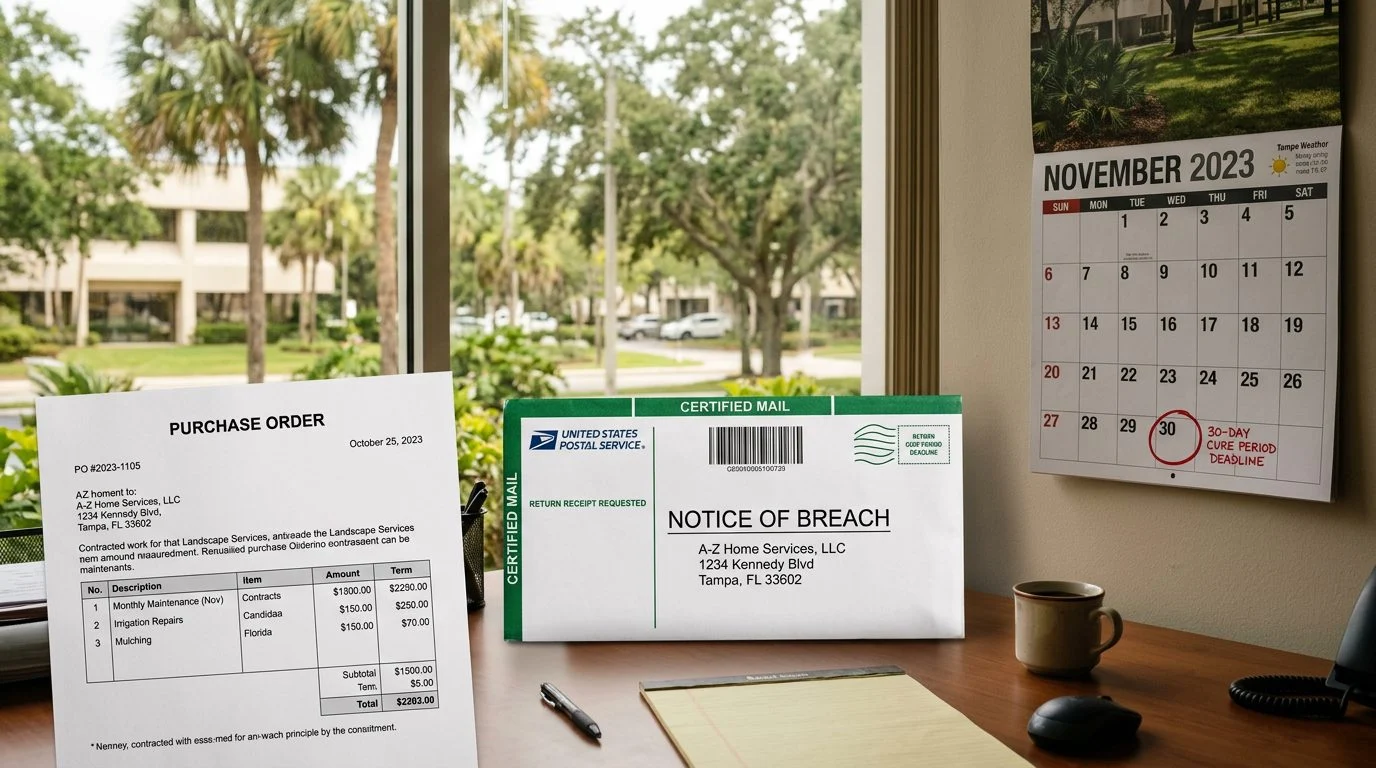
A notice clause usually answers four questions: who gives notice, who receives it, how it must be sent, and where. Read each answer closely. The clause may require a signed writing, delivery by a set method such as certified mail or courier, and a specific address. It may also require a copy to counsel or a named officer. Check whether email counts. Under Fla. Stat. § 605.0117(2), a notice or demand given under chapter 605 of the Florida Statutes, the Florida LLC chapter, may be delivered to the registered agent of a Florida limited liability company at its registered office in this state. Depending on how the company is run, it can also go to a manager or member, or to another Florida address that is in fact its principal office. See § 605.0117 for notices under that chapter. A notice sent to the wrong address, or by a method the clause does not allow, invites an argument that notice never happened. Keep proof of sending and delivery, such as certified mail receipts or courier confirmations.
Cure periods and default provisions
A cure period is a set window after notice in which the other party can fix the problem. Many contracts pair a notice requirement with one. The clock often starts when notice is received, not when it is sent. The clause decides the start point. Default provisions may list separate triggers, such as nonpayment, a missed milestone, or insolvency. Each trigger can carry its own notice step and timing. Some clauses say a default is not final until the cure period ends. Write down three dates in one place: when notice was sent, when it was received, and the last day to cure. Missing one date can change who looks like the party that broke the deal. A simple timeline keeps the facts clear if the dispute reaches a court or an arbitrator.
Anticipatory breach and when waiting may not be required
Anticipatory breach happens when a party clearly signals it will not perform before the performance date arrives. In general, a clear refusal can let the other side treat the contract as breached without waiting for that date. The signal has to be clear and unequivocal. Read emails, texts, and letters together, since context changes what a message means. Even after a clear refusal, review the notice clause. The contract may still require a written demand or a cure window before you cancel work or stop paying. Treating a statement as a repudiation is a serious step. Check the words, the timing, and the contract before you act.
When the contract is silent
Silence does not make the dispute simple. Courts ask whether the breach is material, because a material breach affects whether the other side may stop performing or sue. Prior dealings, past practice, and written messages can still matter. Contracts to buy goods follow a different rule. Under § 672.607, a buyer who has accepted goods must notify the seller of a breach within a reasonable time after discovering it or when it should have been discovered. Otherwise the buyer may be barred from any remedy. Acceptance itself is described in § 672.606.
Not sure what your next step is?
Talk it through with our team — we can walk you through how a situation like yours is usually handled and what your options are.
How a missed notice step can affect a claim, and common defenses
The defendant can argue the claim was never ready to file. A defendant may also argue the plaintiff committed a prior material breach. These defenses are not automatic wins. Each one turns on the contract language, the messages exchanged, and what each side did. Some contracts include anti-waiver language, saying a delay does not give up rights. Check for that language before you rely on a late response. The goal is to see where notice problems usually surface in a dispute.
Deadlines run separately from notice steps
A notice or cure period does not stop the filing clock on its own. The time to sue comes from the statute of limitations, not from the notice clause. Florida’s limitations statute, § 95.11, covers legal and equitable actions on a contract founded on a written instrument. Florida’s limitations statute, § 95.11, sets the periods within which actions other than for recovery of real property must be commenced, but it does not itself say whether a contract can shorten that time. Under § 95.03, a provision that sets a shorter period to sue than the statute provides is void. The tolling rules in § 95.051 list events that can pause the clock, such as the pendency of an arbitral proceeding on the same dispute. A notice or cure period is not on that list. Map your notice dates against the filing deadline. A long cure window can leave less time to act once it closes.
A pre-notice checklist for Florida business owners
Before you send a default notice or start a cure clock, work through these steps:
- Find the notice and default sections, plus any definition of “notice.”
- Note the required method, address, and recipient, including any copy to counsel.
- Identify any cure period and the event that starts it.
- Check for waiver or anti-waiver language.
- Record the dates of every notice, receipt, and cure deadline in one place.
Also review amendments, change orders, and side letters. Each one can change notice terms. This checklist is a starting point. Read the actual agreement, every page, before you act. For a broader view of how these disputes move, see our Florida contract disputes guide.
Review your notice language with Ayala Law PA
If you’re deciding whether to send a default notice, start a cure window, or treat a supplier’s message as a refusal to perform, the notice wording is the first thing to examine. Ayala Law PA concentrates in business litigation, contract disputes, shareholder disputes, construction litigation, and real estate litigation in Florida courts and arbitration. Eduardo A. Maura is the responsible lawyer for this page. The firm’s only office is at 1646 W Snow Ave, Tampa, Florida. Businesses in Tampa, Hillsborough County, Brandon, and the Tampa Bay area are served from that Tampa office. You can also read about commercial litigation in Tampa or breach of contract cases.
Frequently asked questions
When should the notice provisions in a contract be reviewed?
When a notice step is required, skipping it can give the other side a defense.
Does a cure period stop the deadline to sue in Florida?
Not under the tolling rules in Florida’s limitations statute, which do not list notice or cure periods.
Can email count as written notice?
Check the clause. It decides whether email is an approved method.
If you’re weighing Florida’s rules on written notice before a breach of contract claim against a contract in front of you, reach our Tampa office at (813) 414-5715 or use the contact form. Ayala Law PA can review your notice and cure terms with you.



