
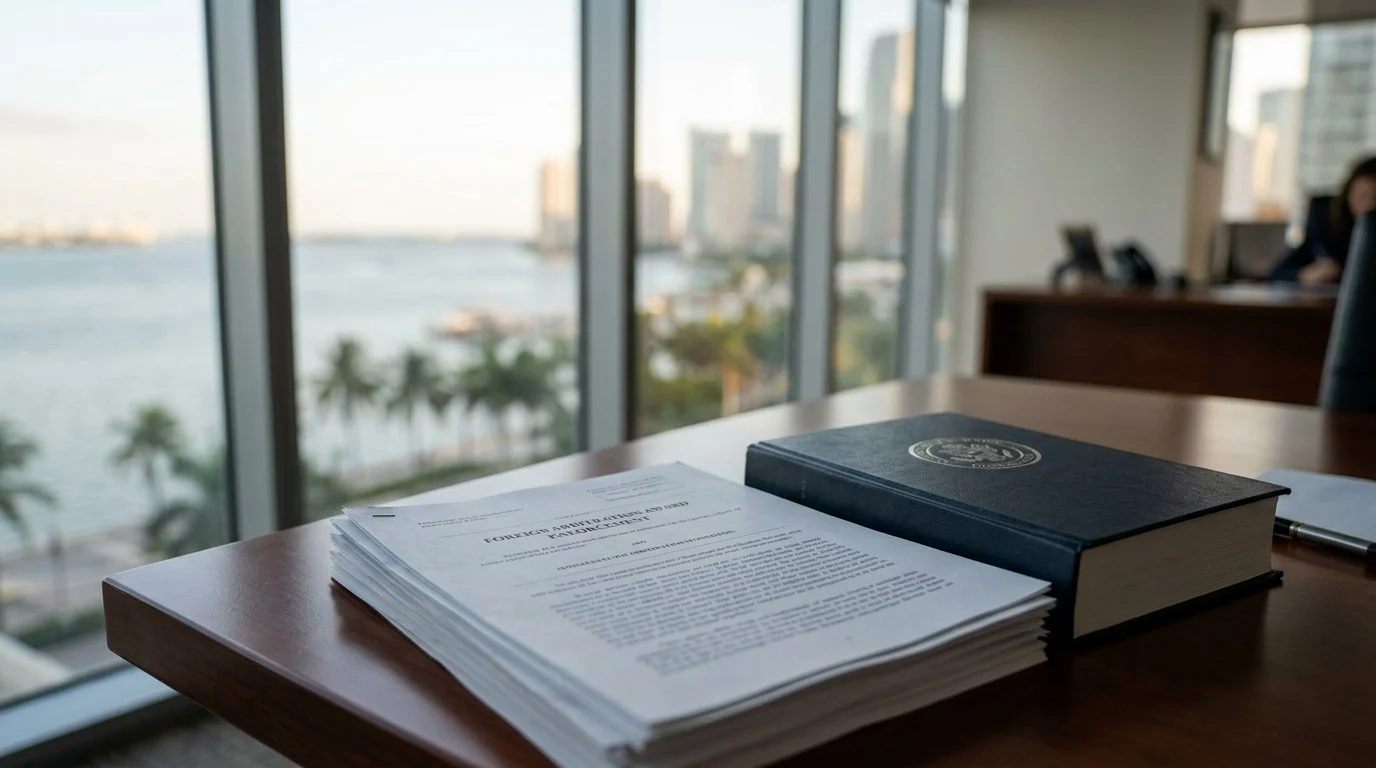
If you hold a foreign arbitration award and the other side won’t pay, the usual first step is asking a Florida court to confirm it. An arbitration award is a decision by arbitrators, not a court judgment, so a court’s confirmation is what lets you move toward collection. Ayala Law PA focuses its practice on business litigation, commercial litigation, contract disputes, and international trade litigation in Florida courts and arbitration. This page explains how to enforce a foreign arbitration award in Florida, what the other side can raise, and where a case can be filed.
What Enforcing a Foreign Arbitration Award in Florida Means
To enforce a foreign arbitration award in Florida, you ask a Florida court to confirm the award. Once it is confirmed, you can use the collection tools Florida law gives a judgment holder.
Enforcing an award is not the same as enforcing a foreign court ruling. An award comes from private arbitration under a contract. A court ruling comes from a court. The paperwork and steps differ, so know which document you hold before you file.
This service fits businesses holding an award against a counterparty that has not paid or performed. Common examples include supply, distribution, and cross-border contract disputes. Federal law gives a starting point. 9 U.S.C. § 2 says a written arbitration provision in a contract involving commerce is “valid, irrevocable, and enforceable.” The exception is grounds that exist to revoke any contract.
If the other side has stopped paying under an award you hold, you don't have to sort out the Florida steps alone. Call Ayala Law PA at (305) 570-2208 to talk it through. Talk it through with our team — we can walk you through how a situation like yours is usually handled and what your options are.

What the Engagement Covers
The engagement covers the filings and follow-up needed to ask a Florida court to confirm an award and to pursue collection on property in Florida. In practice, it includes:
- Document review. We check the arbitration agreement, the final award, and proof of notice to the other side. The goal is to confirm the award can be presented to a Florida court.
- Petition to confirm. We prepare and file the request asking a Florida court to confirm the award.
- Service on the other side. We arrange formal delivery of the papers. Papers sent abroad often take longer than papers delivered in the United States.
- Translations. We coordinate translations of any agreement, award, or exhibit not written in English.
- Responses to challenges. We answer the other side’s objections, including arguments based on the grounds described below.
- Collection after judgment. We pursue the Florida tools that reach property located in Florida.
How the Process Works, Step by Step
The process moves from document review to a court filing, then the other side’s response, then collection. Each phase can take a different amount of time.
- Intake and documents. Gather the signed agreement, the final award, proof of notice, and records of any payment or non-performance.
- Deadline check. Confirm the filing windows that apply. Under Fla. Stat. § 682.13, a motion to vacate generally must be filed within 90 days after the movant receives notice of the award, unless the movant alleges that the award was procured by corruption, fraud, or other undue means, in which case the motion must be made within 90 days after the ground is known or by the exercise of reasonable care would have been known by the movant. Whether that statute governs a particular foreign award depends on the facts.
- Filing and service. The petition is filed, then served on the other side.
- Response period. The other side may oppose the petition, which can lead to briefing and a hearing.
- Judgment and collection. Once confirmed, the award can be enforced against assets located in Florida.
Defenses the Other Side May Raise
The other side can ask a court to vacate an award, and enforcement is not automatic. For awards under Florida’s arbitration statute, the statute lists the grounds. A court must vacate an award if it was procured by corruption, fraud, or other undue means. On a party’s motion, under Fla. Stat. § 682.13, a court must vacate an award on other listed grounds, including evident partiality by an arbitrator appointed as a neutral arbitrator, an arbitrator exceeding the arbitrator’s powers, or no agreement to arbitrate, unless the person participated in the arbitration proceeding without raising the objection under s. 682.06(3) not later than the beginning of the arbitration hearing.
Federal law also keeps the grounds that exist to revoke any contract. These are contract defenses, so the facts of the agreement matter.
If a motion to vacate is denied and no motion to modify or correct is pending, the court shall confirm the award. Our team reviews likely challenges early, so you know the probable fight before anything is filed.
Choosing the Florida Court and Where to Collect
A Florida action generally goes in the county where the defendant resides, where the cause of action accrued, or where the property in litigation is located. If the counterparty has property in Hillsborough County, that county may fit the venue rule.
Collection follows the assets. Florida law lets a judgment holder levy on goods, chattels, and stock in corporations under an execution. A judgment lien certificate must list the debtor’s legal name, the creditor’s name and address, the court and case number, and the amount due with the interest rate.
Interest also matters. Under Fla. Stat. § 55.03, any judgment for money damages must bear, on its face, the rate of interest payable on it. That rate is set when the judgment is obtained and is adjusted each January 1, until the judgment is paid, to the rate then in effect as set by the Chief Financial Officer. Judgments entered by the clerk of the court under ss. 55.141, 61.14, 938.29 and 938.30 are not adjusted annually. An action on a judgment or decree of a court of record in this state must be commenced within twenty years, under Fla. Stat. § 95.11; an action on a judgment of a court of the United States, another state, or a foreign country must be commenced within five years.
Why Work With Ayala Law PA on This Matter
Ayala Law PA focuses its practice on business litigation, commercial litigation, contract disputes, shareholder disputes, construction litigation, real estate litigation, and international trade litigation. The firm handles these matters in Florida courts and arbitration.
Eduardo A. Maura is the responsible lawyer for this page. Support staff help keep documents and filing dates organized.
The firm’s only office is at 1646 W Snow Ave in Tampa, Florida. This page serves businesses in Tampa, Hillsborough County, Brandon, Riverview, Plant City, Temple Terrace, and the wider Tampa Bay area.
Not sure what your next step is?
Talk it through with our team — we can walk you through how a situation like yours is usually handled and what your options are.
Questions People Ask Before Filing
Is an arbitration award the same as a court judgment?
No. An award becomes enforceable through a Florida court’s confirmation. That is why the court filing comes first.
Do I need to translate the award?
Documents written in another language need translations for the case. We coordinate those translations as part of the engagement.
How long does enforcement take?
Timing varies with court calendars, service on the other side, and whether the other side challenges the award.
Can I collect if the other side has no assets in Florida?
Florida collection tools reach property located in Florida. The location of the counterparty’s assets shapes what can be done.
Is this the same as enforcing a foreign court ruling?
No. A foreign court ruling follows a different path from an arbitration award, so the paperwork differs.
Talk Through Your Award Before the Deadline Passes
If a counterparty abroad has stopped paying under an award, you may be weighing the paperwork, the timing, and the business impact all at once. You don’t have to work out the Florida steps alone. Call Ayala Law PA at (305) 570-2208, or reach out through our contact page, to talk through the award, the agreement, and the timing.



