

Do minority shareholders have any power? Often, yes, but not control. A minority owner usually cannot win a vote alone. Florida law and most company documents still give minority owners rights they can use. This page explains where those rights come from, where they stop, and which facts can change the answer.
Yes, but the power comes from rights, not control
Minority shareholders have some power, but it comes from rights rather than voting control. Still, power exists in three places.
The second is the company’s articles of incorporation and bylaws. The third is any shareholder agreement the owners signed.
Ownership percentage alone does not decide everything. Two owners with the same percentage can hold very different rights. A shareholder agreement can give a smaller owner a say over certain decisions. A bylaw can require a supermajority vote on some matters.
Your situation depends on the facts. The company’s structure, its documents, how shares were issued, and what has already happened all matter. The rest of this page maps where minority power shows up and where it ends.
Minority shareholders have rights that attach to their shares
Minority shareholders generally keep rights that attach to their shares, even after they lose a vote. Common rights include voting on matters that the law or the governing documents reserve to shareholders, and getting notice of shareholder meetings. Voting power follows ownership. A minority vote carries the most weight when a decision needs a supermajority or unanimous approval.
Payouts are not automatic. Under § 607.06401, the board of directors may authorize distributions, subject to the articles and to legal limits. No distribution may be made if, afterward, the company could not pay its debts as they come due, or its total assets would be less than its total liabilities plus (unless the articles permit otherwise) the amount needed to cover preferred shareholders’ rights on dissolution.
Under § 607.0732, an agreement among shareholders can govern voting power, who serves as directors or officers, and how a deadlock is broken. Every shareholder at the time must approve it.
Because the paperwork shapes these rights, the company’s documents are the place to start.
Yes, a minority shareholder can usually inspect company records
Yes. Under § 607.1601, a corporation must keep records such as its articles, bylaws, minutes of shareholder meetings, and written communications to shareholders from the past three years.
Under § 607.1602, a shareholder who gives the company written notice at least 5 business days ahead can inspect the core records at the company’s principal office during regular business hours. Other records, such as board minutes and financial records, require more. The demand must be made in good faith and for a proper purpose, and the records sought must be directly connected with that purpose. It must also describe the purpose and the records with reasonable particularity.
The articles and bylaws cannot take this right away. The statute says the right of inspection cannot be abolished or limited by them.
If the company refuses, a court can step in. Under § 607.1604, a circuit court may summarily order inspection of the core records at the company’s expense.
Florida law protects minority owners from some unfair conduct, but not all of it
Under § 607.1430 of the Florida Statutes, shareholders may ask a court to dissolve a corporation in specific situations, including certain shareholder deadlocks and a corporation’s abandonment of its business when it has failed within a reasonable period of time to liquidate and distribute its assets and dissolve. The dissolution statute lists these grounds in § 607.1430. Some grounds are for the state to bring. Others, including abandonment of the business, may be brought by a shareholder.
Owners often raise situations like pay that goes only to the majority, company money spent on personal items, or being cut off from information. Whether any of these supports a claim turns on the facts and the documents.
A court that finds grounds has options besides dissolution. Under § 607.1434, and upon a showing of sufficient merit to warrant such remedy, the court, as an alternative to dissolution, can appoint a receiver or custodian, appoint a provisional director, order a buyout of the petitioning shareholder’s shares, or make other equitable orders.
If the harm is to the company itself, a shareholder may need to sue on the company’s behalf. Under § 607.0742, that complaint must be verified. It must also allege with particularity the demand made on the board and either that the board refused, rejected, or ignored the demand before 90 days expired, or why waiting out the 90 days would cause irreparable injury to the corporation or misapplication or waste of corporate assets causing material injury to the corporation; if no demand was made, it must give the reason the shareholder did not make the effort.
In a 50-50 deadlock, a stalemate is the main risk
In a 50-50 company, neither owner can outvote the other, so a deadlock can stall decisions. A deadlock sale provision is a term in a shareholder agreement that complies with § 607.0732 that breaks the stalemate, such as a buyout or a governance change. Florida law recognizes these provisions in § 607.1430. Filing a dissolution case does not cancel a valid one, as long as it is started and carried out before the court enters an order.
§ 607.0732 allows that mechanism.
Under § 607.1436, in a shareholder dissolution case the corporation, or if it does not, one or more shareholders, can elect to buy all of the petitioning shareholder’s shares at fair value, and that election can be filed within 90 days after the petition. A later filing is possible if the court allows it. The election is irrevocable unless the court finds it equitable to set it aside.
If the parties cannot agree on price, the court sets the fair value of the shares. That value is measured as of the day before the petition was filed, unless the court picks another date.
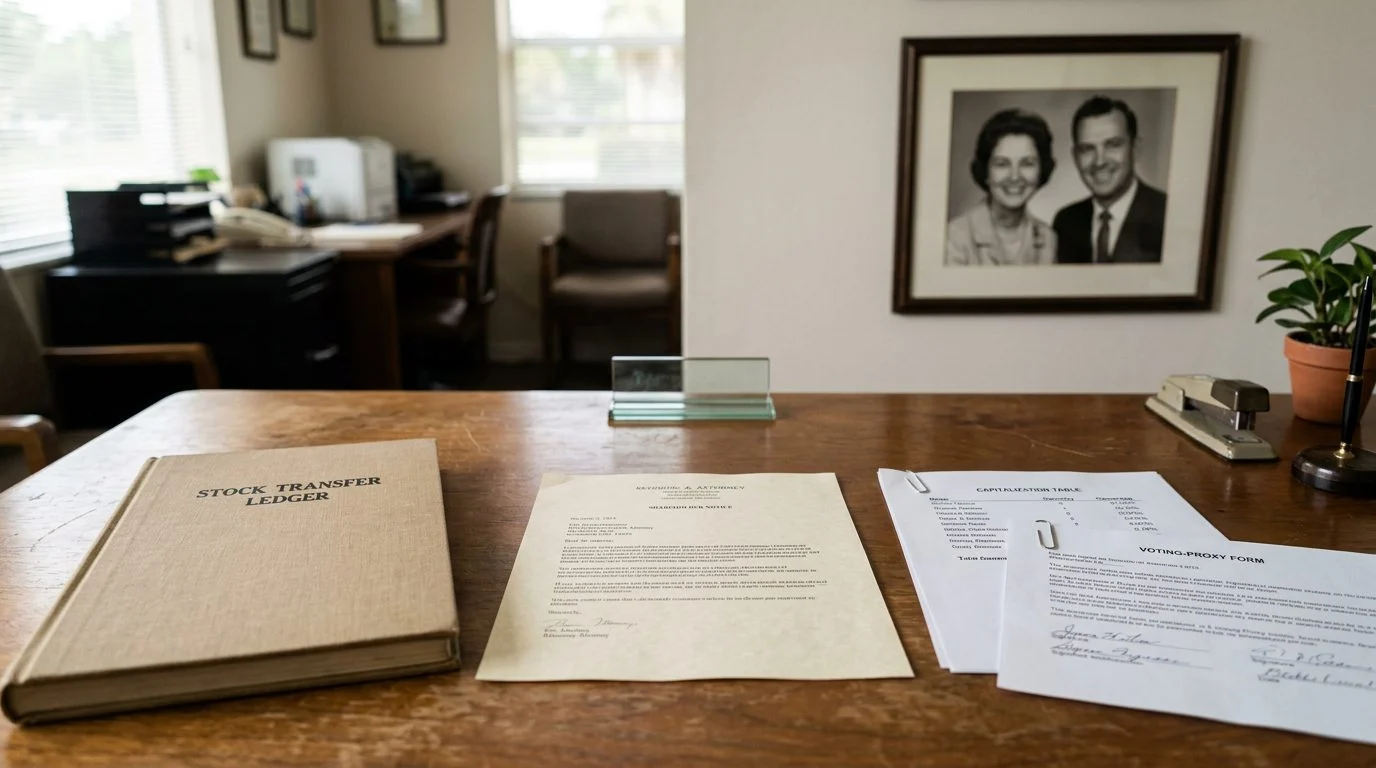
A minority stake is a share too small to control votes alone
A minority stake is an ownership share too small to control the company’s votes by itself. Bylaws or shareholder agreements can set higher thresholds. A supermajority rule can give a holder under 50 percent a blocking position on certain decisions.
Ownership can also shrink. The Florida Office of Financial Regulation notes that share class, governance, and contract terms affect shareholder control. The same guide notes that newly issued shares can dilute a minority holder’s ownership percentage.
You may see a “five shareholder rule” online. The thresholds that matter for a specific right come from the statute, the bylaws, or the shareholder agreement. Start with those documents.
A majority owner can remove a minority owner from a role, but not automatically from ownership
A majority owner may be able to remove a minority owner from an officer job. That does not end the ownership stake by itself. Shares, board seats, officer jobs, and employment are separate things.
Under § 607.0842, an officer may be removed at any time, with or without cause, by the board of directors, by the appointing officer unless the bylaws or the board of directors provide otherwise, or by any other officer if the bylaws or the board of directors authorize it. The bylaws or board provisions can add limits. Employment terms depend on the employment agreement and any corporate action.
A shareholder agreement can set who serves as directors or officers, and how they are removed. Under § 607.0732, those terms can be part of the agreement.
A minority owner who is pushed out of management still holds shares. The distribution rules and the records rules still apply to that owner. A buyout may be part of how the dispute is resolved.
A court does not step in on unfairness alone
A court acts on a specific legal ground and on evidence. A sense that something is unfair is a starting point, not a claim by itself.
The Florida Supreme Court, in Basulto v. Hialeah Automotive, stated: “we conclude that both the procedural and substantive aspects of unconscionability must be present, although not necessarily to the same degree, and both should be evaluated interdependently rather than as independent elements.”
Courts can also shift costs. Under § 607.1431, a court may, in its discretion, award attorney fees and other reasonable expenses to the other parties to the proceeding who have been affected adversely by such actions, against a party who acted arbitrarily, frivolously, vexatiously, or not in good faith in a dissolution case.
Timing matters too. The 90-day window for a buyout election under § 607.1436 runs from the filing of the dissolution petition, though the court may allow a later time in its discretion. Preparation usually includes gathering the governing documents, making a written demand where the statute calls for one, and writing down the conduct at issue with dates. No general article can predict how a particular case will turn out.
Next steps if you hold a minority stake
The first step is to gather your company’s core documents and a written timeline before deciding anything. Useful items include:
- The articles of incorporation and the bylaws, as currently in effect
- Any shareholder agreement, and whether the articles or bylaws reference it
- Annual financial statements and any records you have already received
- Written notices, demands, and messages about major decisions
- A dated timeline of meetings, votes, payments, and changes in your role
You may be reading this because you are the one being outvoted. You may also be reading for a co-owner, a family member, or a business partner in that spot. Either way, this situation was not chosen, and it can feel urgent.
Eduardo A. Maura is the responsible lawyer for this page. Ayala Law PA’s office is at 1646 W Snow Ave, Tampa, FL. The firm represents businesses in Tampa, Hillsborough County, Brandon, Riverview, Plant City, Temple Terrace, and the Tampa Bay area in Florida courts and arbitration. Some matters may be referred to another lawyer or firm.
So, do minority shareholders have any power? Often, yes, through the rights the statute and the documents give them. If a minority stake is putting you under pressure, you don’t have to sort it out alone. Call (305) 570-2208 or use the Ayala Law contact page to start the conversation.



