

Short Answer: Is a Shareholder Agreement Required in Florida?
Many business owners choose to put their arrangements in a written shareholder agreement. If you’re asking do I need a shareholder agreement Florida, start with a simpler question: what should happen when two owners disagree? Whether you need one depends on the facts, including how many owners there are, whether ownership is equal and how the business is set up.
Florida’s corporate law recognizes these agreements as a tool owners may use. Under Fla. Stat. § 607.0732, an agreement among shareholders that meets the section’s requirements is effective, even when it differs from other parts of the chapter.
“Not required” doesn’t mean “not needed.” The default rules apply to every company alike. They rarely address a buyout price, a departing owner or what happens after an owner’s death.
If co-owners are stuck on a buyout price or a deadlocked vote, you don't have to sort it out alone. Contact Ayala Law PA to talk through your documents. Talk it through with our team — we can walk you through how a situation like yours is usually handled and what your options are.
What Happens When There Is No Written Agreement
They rarely say what a departing owner gets paid.
These gaps show up fast. There’s often no agreed valuation method, no payment schedule and no limit on selling shares to an outsider. Transfer restrictions can live in the articles, the bylaws, an agreement among shareholders, or an agreement between shareholders and the corporation. A restriction does not affect shares issued before it was adopted, unless those holders are parties to the restriction agreement or voted for it. A restriction does not affect shares issued before it was adopted, unless those holders are parties to the restriction agreement or voted for it. Unless it’s noted, it isn’t enforceable against someone without knowledge of it.
Owners also have information rights. For other records, such as accounting records, board minutes excerpts and financial statements, the demand must also be made in good faith and for a proper purpose, describe the purpose and the records with reasonable particularity, and the records must be directly connected with that purpose, under § 607.1602.
A common mistake is treating a handshake deal as settled. When two owners remember the deal differently, a business question becomes a lawsuit.
Provisions That Decide Most Shareholder Disputes
Buy-sell terms, valuation rules, transfer limits and dispute clauses decide most shareholder fights. They answer one question: what happens when an owner wants out?
Buy-sell provisions name the triggers, such as retirement, death, disability or breach, and say who may buy. They also set the price or the formula. Put the valuation method, the valuation date and the payment terms in writing before anyone leaves.
Transfer limits matter just as much. A right of first refusal can require an owner to offer shares to the company or other owners first.
Arbitration clauses set the forum before any court case starts. Under § 682.02, a written agreement to arbitrate existing or future disputes is valid and enforceable, with limited exceptions.
Deadlock and Decision-Making Between Equal Owners
When owners hold equal shares, neither one can win a vote alone, so a deadlock can freeze the company. Good drafting plans for that before it happens.
Florida law recognizes a mechanism for breaking a deadlock, including one used in place of a court dissolution order (§ 607.0732). The steps must start and finish within the time periods the corporation has to act under § 607.1436 (§ 607.1430).
Timing matters. An election to purchase, instead of dissolution, generally must be filed within 90 days after the petition, unless the court allows a later filing (§ 607.1436). The clock can run out.
If no agreed mechanism exists, the court has other options. As an alternative to dissolution, and upon a showing of sufficient merit to warrant such remedy, the court may appoint a receiver or a provisional director, order a purchase of the petitioning shareholder’s shares, or grant other equitable relief (§ 607.1434).
Vague deadlock clauses, or none at all, often push owners into court. Write down the voting thresholds, the tie-breaker steps, any mediation steps and the buyout trigger.
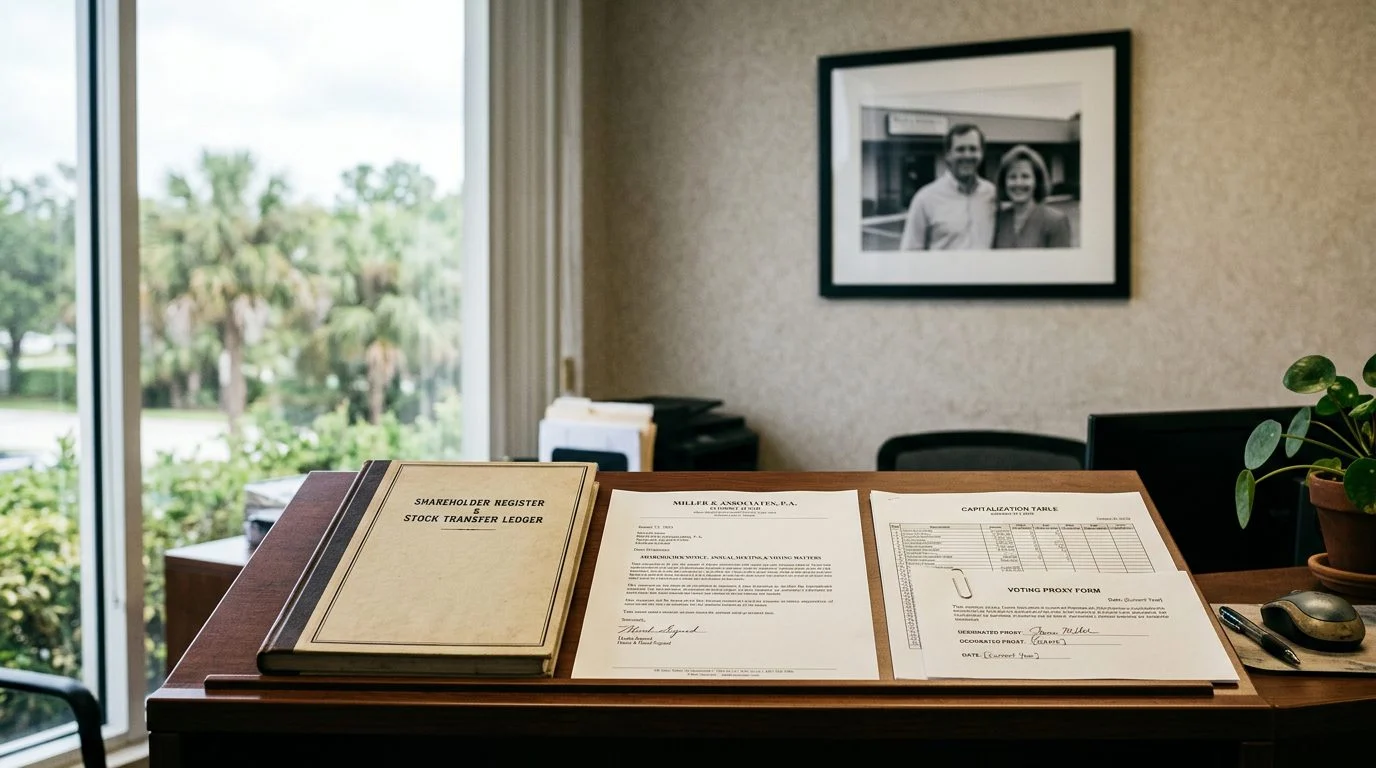
Funding a Buy-Sell Obligation and LLC Operating Agreements
A buy-sell promise is only as strong as the money behind it. Common funding approaches include installment payments, cash reserves and life or disability insurance. Pick the method before a departure, not after one.
LLCs follow a different structure. Except as otherwise provided in subsections (3) and (4), a Florida LLC’s operating agreement governs relations among members and between the members and the company. It can also vary many default rules (§ 605.0105). The LLC is bound by its operating agreement and may enforce it. A person who becomes a member is deemed to agree to it (§ 605.0106).
The LLC statute also sets limits. It also cannot relieve a person of liability for conduct involving bad faith, willful or intentional misconduct, or a knowing violation of law (§ 605.0105).
Don’t assume corporate shareholder rules apply to an LLC because the owners look alike. Review the funding terms and the governing documents together.
How Florida Courts Read These Documents
Courts start with the written words, so unclear drafting is a common source of disputes. Clear terms carry more weight than what owners meant but never wrote down.
Courts also check whether the agreement qualifies. To qualify, the agreement must be set forth or referenced in the articles or bylaws and approved by all shareholders at the time, or be set forth in a written agreement signed by all shareholders at the time and made known to the corporation (§ 607.0732). Missing that step can invite a challenge.
Conflicts between documents create their own fights. When a shareholder agreement, the articles, the bylaws and an operating agreement disagree, owners may argue about which one controls. Settle that order of priority in the drafting.
Florida courts also test whether a term is fair. To refuse to enforce a term as unconscionable, a court must find both procedural and substantive unfairness. The court weighs them together (Basulto v. Hialeah Automotive).
Minority owners also face dilution. The Florida Office of Financial Regulation guide says newly issued shares can reduce a minority shareholder’s ownership percentage. Read the issuance rules before a new investor comes in.
A new agreement signed mid-dispute can still be effective if it complies with the statute, including by establishing a mechanism for breaking a deadlock among the directors or shareholders of the corporation, in lieu of a judicial dissolution. Document any change carefully. For more on how these fights unfold, read our shareholder disputes overview.
Not sure what your next step is?
Talk it through with our team — we can walk you through how a situation like yours is usually handled and what your options are.
Frequently Asked Questions
Do I need a shareholder agreement Florida?
The agreement is a tool that sets ownership rules before a disagreement starts.
What does it mean to be a minority shareholder?
A minority shareholder owns less than a controlling share. Those owners’ rights come from Florida statute and the company’s governing documents.
Can I write my own shareholder agreement?
Owners can draft their own. Unclear terms, though, often create the disputes they were meant to prevent, so careful review before signing matters.
Does a shareholder agreement replace bylaws?
It usually works alongside the articles and bylaws. Under Florida’s statute, an agreement among shareholders can be effective if it is set forth or referenced in the articles of incorporation or bylaws and approved by all shareholders at the time of the agreement, or if it is set forth in a written agreement signed by all shareholders at the time and made known to the corporation (§ 607.0732).
Talk With Ayala Law PA About Your Owners’ Agreement or Dispute
Maybe you’re an owner who wants out, but no written price terms exist. Maybe you’re an equal owner whose partner won’t agree on anything. In either case, the documents you have now shape your options.
Ayala Law PA focuses on business litigation, including shareholder disputes. The firm serves businesses and owners in Tampa, Hillsborough County, Brandon, Riverview, Plant City and Temple Terrace. The firm’s office is at 1646 W Snow Ave in Tampa, Florida, and it represents businesses in Tampa and Hillsborough County. Eduardo A. Maura is the responsible lawyer for this page.
No outcome can be promised. Fee terms are explained when you contact us. Call (305) 570-2208 or send a message through our contact page.



