
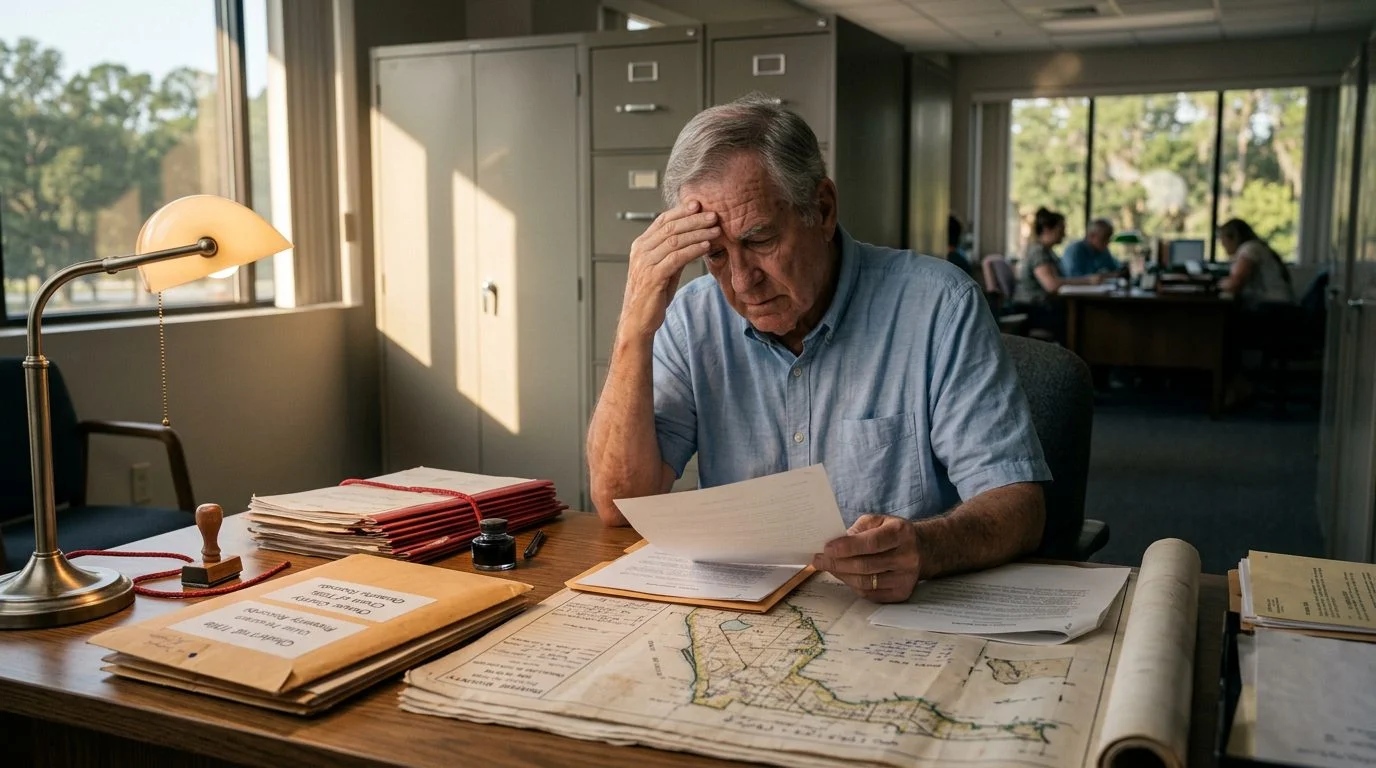
How difficult is it to get a quiet title? The answer depends on how clean the property’s records are. A single owner with a clear deed and no competing claims is usually simpler than a parcel with missing signatures, several heirs or unknown claimants. A quiet title action is the lawsuit that asks a Florida court to decide who holds the rights to a property. This page explains what makes the case harder or slower. It is general information, not advice about your property.
What a Quiet Title Action Does
A quiet title action is a court case that settles competing claims to real property and clears the public record. The goal is to give the owner a title that others can rely on, so the property can be sold or financed with fewer doubts.
The problem is often called a cloud on title. A cloud is a recorded claim or defect that makes ownership look uncertain. Common clouds include old or defective deeds, unreleased liens, unrecorded interests and conflicting claims.
Quiet title cases often arise in real estate litigation, and they can overlap with business disputes. A company that buys, sells or holds property may face a cloud that needs a court to resolve it.
If you inherited property with an unclear deed, or a co-owner won't sign, reach out and we'll talk through your title facts with you. Talk it through with our team — we can walk you through how a situation like yours is usually handled and what your options are.

Why the Difficulty Depends on the Facts
How hard a quiet title case is depends on the facts of the property, the parties and the records. No two parcels look the same on paper, so the work differs from one file to the next.
A single owner with a clean chain of title is usually simpler. A parcel with several co-owners, heirs or business entities adds work. Each party with a possible interest must be identified, named and notified.
The number of parties directly affects the scope of the case. Finding the right entity and its agent takes time.
Common Title Defects That Make the Case Harder
Defects in the deed chain are a common reason a case gets harder. Florida law says a conveyance of a freehold or of a term of more than 1 year generally must be a written instrument signed in the presence of two subscribing witnesses by the party making it or that party’s lawfully authorized agent, unless made by will; a lease of real property still needs a writing but does not need subscribing witnesses. See Fla. Stat. § 689.01. A defective witnessing can become a central issue.
Real estate disputes often turn on what interest each party actually holds, so reviewing the title records early is worthwhile. Under Fla. Stat. § 689.01, the subsection on validated witnessing does not preclude a challenge to the validity or enforceability of an instrument or electronic record based upon fraud, forgery, impersonation, duress, incapacity, undue influence, minority, illegality, unconscionability, or any other basis not related to the act of witnessing. A grantor who lacked authority can also put a deed in question.
Adverse possession is a different route. It is a claim that someone has possessed land long enough to own it.
Co-ownership also matters. A conveyance to two or more people generally creates a tenancy in common, under Fla. Stat. § 689.15. Fla. Stat. § 689.15 reads: “The doctrine of the right of survivorship in cases of real estate and personal property held by joint tenants shall not prevail in this state; that is to say, except in cases of estates by entirety, a devise, transfer or conveyance heretofore or hereafter made to two or more shall create a tenancy in common, unless the instrument creating the estate shall expressly provide for the right of survivorship; and in cases of estates by entirety, the tenants, upon dissolution of marriage, shall become tenants in common.”
How the Florida Quiet Title Process Works
The process usually starts with a title search. The search shows the recorded deeds, liens and claims that may cloud ownership. Lawsuits over property often involve more than one party with a stake in the outcome.
Locating every person who may have a stake in a property can be a practical challenge. The case then turns on evidence that supports the owner’s position, such as the deed chain, witness records and proof of possession.
Venue follows a fixed rule. Under Fla. Stat. § 47.011, an action is brought only where the defendant resides, where the cause of action accrued, or where the property in litigation is located, and this section does not apply to actions against nonresidents. For land in Hillsborough County, the property’s location is one place the case can be filed.
Clerk materials also matter. The Miami-Dade Clerk’s quiet title complaint instructions describe filing fees, summons fees, service responsibilities and required title documents. Those are the kinds of items a filer must track.
Where Quiet Title Cases Slow Down
Locating and serving parties is a common source of delay. A claimant may have moved, may be hard to find, or may have died. Identifying heirs can take additional research.
Contested claims slow things further. A co-owner who disagrees may lead to other claims, including a partition lawsuit that asks the court to divide or sell the property. Each new claim adds motions and deadlines.
Some cases settle before trial. Preparing for a Mediation explains that mediation is a process in which parties may choose to try to resolve a dispute before continuing with litigation.
An occupant who is living on or operating from the property can raise separate possession questions. Under Fla. Stat. § 95.12, an action to recover property or its possession generally may be maintained only if the person seeking recovery, or an ancestor, predecessor or grantor, was seized or possessed of the property within 7 years before the action begins.
Costs, Timing and Next Steps With Our Office
Costs and timing depend on the facts. The firm does not offer a free consultation, and fees are discussed when you reach out. Eduardo A. Maura is the responsible lawyer for this page.
The firm’s office is at 1646 W Snow Ave in Tampa, Florida, and the firm represents businesses in Tampa and Hillsborough County. The firm serves businesses in Tampa, Hillsborough County and the Tampa Bay area.
How long does a quiet title case take in Florida?
Timing depends on the facts, including how many parties must be found and whether anyone contests the claim. Serving missing or unknown claimants often adds time.
What makes a quit claim deed invalid?
Under Florida law, a deed generally needs two subscribing witnesses. A challenge based on fraud, forgery, impersonation, duress or incapacity can also put a deed in question.
Where must a quiet title lawsuit be filed in Florida?
Under Fla. Stat. § 47.011, an action is brought only where the defendant resides, where the claim arose, or where the property is located, and this section does not apply to actions against nonresidents.
If you inherited property with an unclear deed, or a co-owner won’t sign, contact our office or call (305) 570-2208 to talk through your title facts.



