
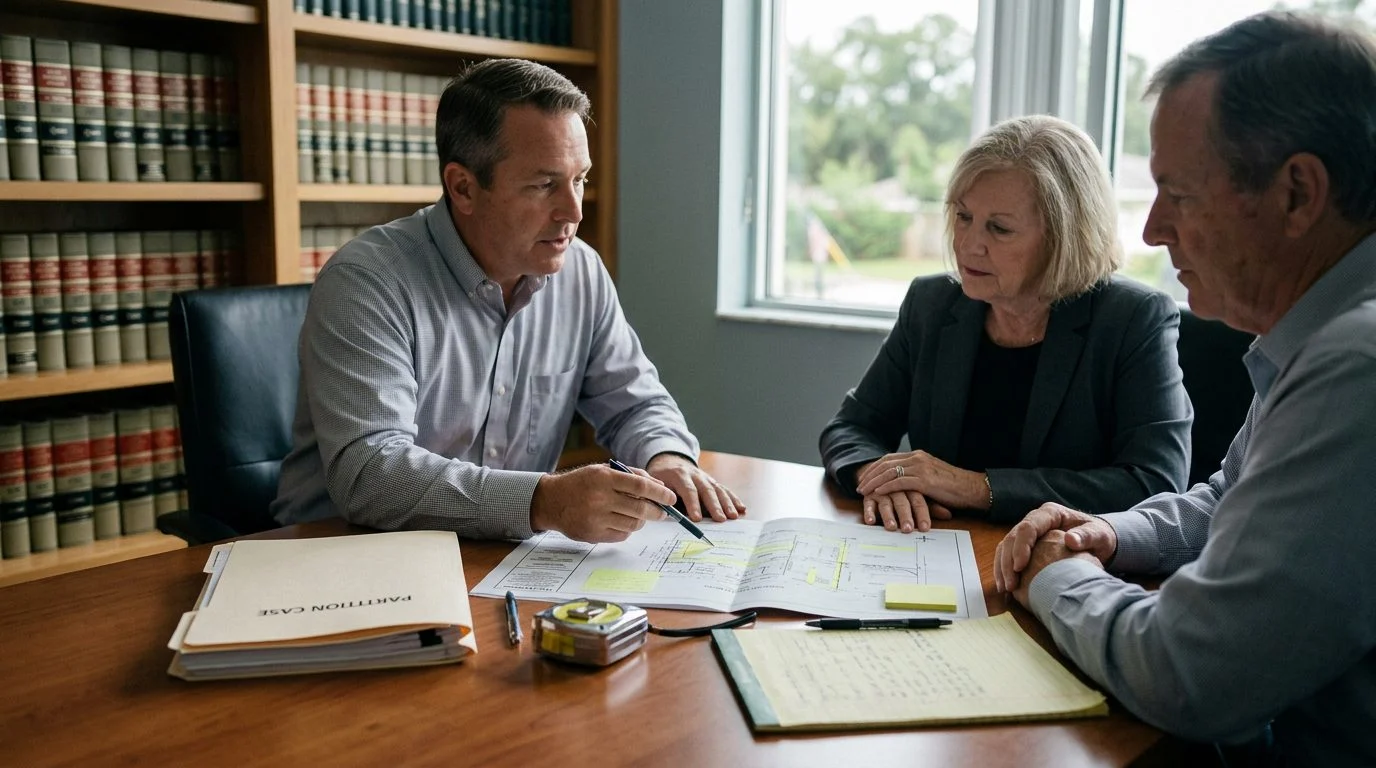
How does a partition lawsuit work? In short, one co-owner asks a Florida court to end shared ownership of a property. The judge then divides the property among the owners or orders it sold and splits the money.
Partition cases often involve siblings who inherited a house, business partners who own a building together, or co-buyers who can’t agree on what comes next. This guide explains the process in plain language, from where the case is filed to what affects the cost.
What Is a Partition Action and Why Do Co-Owners File One?
A partition action is a court case that asks a judge to end co-ownership of real property. Real property means land and the buildings on it. When two or more people own a property together, each one holds a share.
Co-owners usually end up in court because they can’t agree. One owner may want to sell while another wants to keep the property. One owner may have quit paying their share of taxes or repairs.
Consider three siblings who inherit a lake house. One wants to sell, one wants to keep it, and one has stopped paying the bills. If they can’t reach an agreement, a partition case may follow.
Often, one owner files the case while the others are caught off guard. The owner who files is the plaintiff. The other owners are the defendants. Court papers can feel alarming, but the case follows set steps and deadlines. Knowing those steps is the first move.
For the wider picture, read our guide to real estate disputes in Florida.
If a co-owner has just sent you a partition complaint, you don't have to sort out your next step alone. Call Eduardo A. Maura at Ayala Law PA or reach out through our contact page. Talk it through with our team — we can walk you through how a situation like yours is usually handled and what your options are.
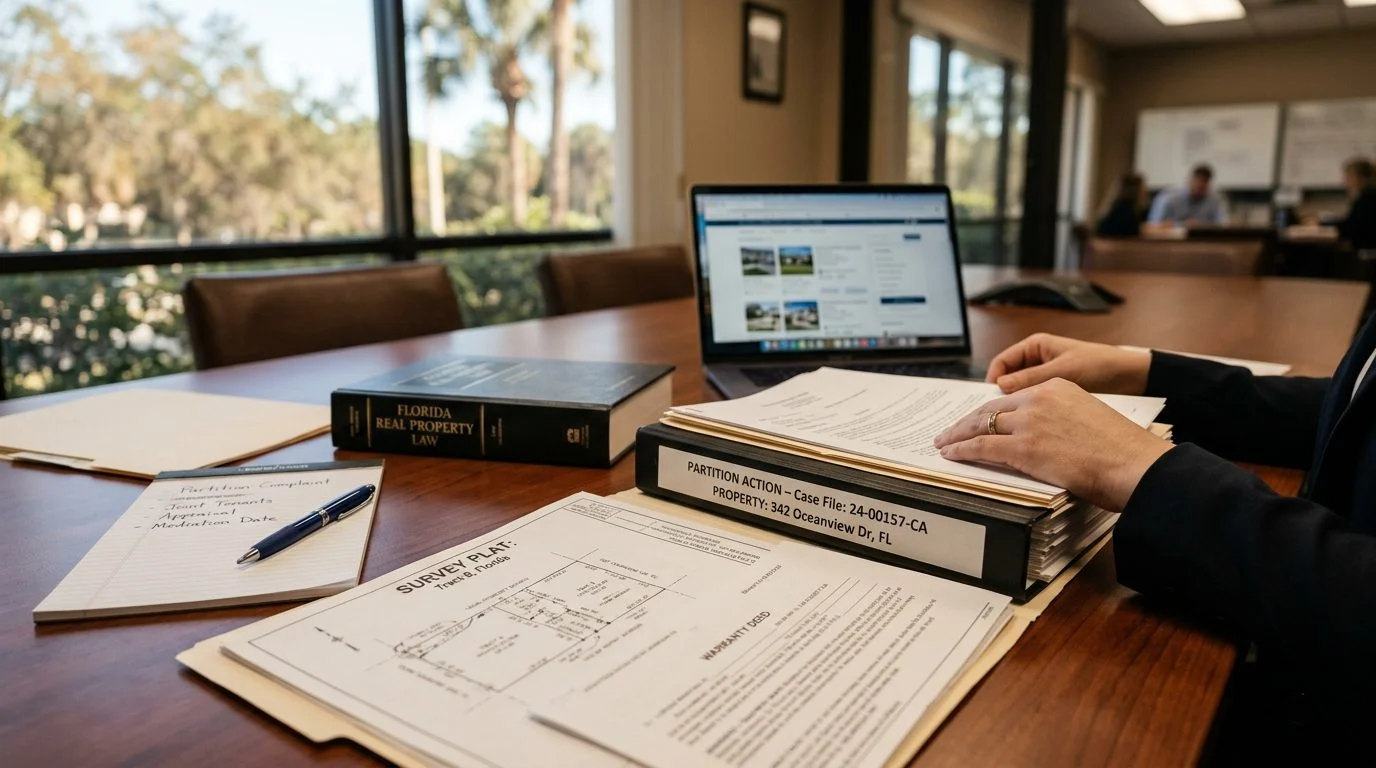
The Two Types of Partition Actions in Florida
Co-owners who cannot agree on how to handle shared property often face difficult choices. Each co-ownership dispute depends on its own facts and the property involved.
Co-ownership disputes often raise questions about how shared property is handled. Outcomes in these disputes vary with the facts of each case.
Judges look at the property itself and whether a fair physical split is practical. A large parcel may be easy to divide. A single house or a small commercial building often is not, so a sale may be the result.
Owners sometimes focus only on who is right. A partition case also asks what happens to the property and how each share gets paid out. Co-owners can still agree on a division or a sale themselves, which can resolve the matter without a judge choosing the method.
How a Partition Case Starts: Filing and Service
A partition case starts when a co-owner files a complaint in the county where the property is located. Florida’s venue statute says actions are brought only in the county where the defendant resides, where the cause of action accrued, or where the property in litigation is located (Fla. Stat. § 47.011). For Hillsborough County land, that means Hillsborough County.
When co-owners live in different counties, Fla. Stat. § 47.021 allows the case in any county where any defendant resides.
The complaint names the property, lists the owners and their interests, and states what the filing owner wants. That may be a division, a sale, or both. Anyone involved in a co-ownership dispute should keep records of the property and of any agreements between the owners. Service gives each owner notice of the case and a chance to respond.
Mortgage holders and lienholders with an interest in the property are commonly named. That way, their interests are addressed in the final order.
What Are the Steps to the Partition Process in Florida?
After filing, a partition lawsuit usually moves through six stages. Each one has its own paperwork and deadlines.
- Response. Owners who disagree file a written answer by the deadline the court sets.
- Information. The parties exchange records on title, ownership shares, liens, rent collected, and improvements.
- Valuation. Appraisals help establish what the property is worth. Value matters when deciding whether a fair split is possible.
- Accounting claims. An owner who paid taxes, insurance, or repairs for everyone can ask to be reimbursed.
- Mediation. A court must, on one party’s request, refer a filed civil action for monetary damages to mediation, provided the requesting party is willing and able to pay the costs of the mediation or the costs can be equitably divided between the parties, unless a listed exception applies, and may refer all or part of any other filed civil case to mediation (Fla. Stat. § 44.102). A federal appeals court guide to mediation explains what mediation involves.
- Judgment. The judge enters a final order for division or sale. If the property is sold, the proceeds are paid out as the order directs. A judgment can become a lien on real property once a certified copy is recorded in that county, provided the judgment contains the lienholder’s address or a separate affidavit with that address is recorded at the same time (Fla. Stat. § 55.10).
Keeping organized records from the start makes each stage easier to follow.
What Happens If a Co-Owner Does Not Respond to a Partition Suit?
A co-owner who is properly served and does not respond in time can see the case move forward without their side of the disputed points. Silence does not stop the case. It can cost that owner the chance to argue for a particular division method, a sale, or reimbursement of expenses they paid.
Owners who receive court papers should check the response deadline right away. The court sets those dates, and missing one can lead to a default.
Responding doesn’t mean agreeing to anything. It puts your position on the record. It also keeps the door open to negotiation and mediation.
An owner who has been served should write down what they paid and when. Those records support any accounting claim they may raise later.
Can a Partition Action Be Avoided in Florida, and Is a Partition Deed Legally Valid?
Co-owners can often avoid a contested case by reaching a written agreement on a division, a buyout, or a sale. A written deal should state who gets what, who pays what, and how the transfer will be recorded.
Informal deals still count as contracts. The Florida Supreme Court says an oral contract is subject to offer, acceptance, consideration, and sufficient specification of essential terms (St. Joe Corp. v. McIver). Vague terms make a deal harder to enforce, so write them down.
Validity of a partition deed turns on how it was prepared, signed, and witnessed. A transfer of a freehold interest in real property, or of an interest for a term of more than one year, must be made by a written instrument signed in the presence of two subscribing witnesses, although lease instruments are exempt from the witness requirement. It must be signed in the presence of two subscribing witnesses by the party transferring the interest or that party’s lawfully authorized agent. Section 55.10 covers judgment liens: a judgment becomes a lien on real property when a certified copy is recorded in that county, provided the judgment contains the lienholder’s address or a separate affidavit with that address is recorded at the same time. Fla. Stat. § 55.10 reads: “A judgment, order, or decree does not become a lien on real property unless the address of the person who has a lien as a result of such judgment, order, or decree is contained in the judgment, order, or decree or an affidavit with such address is simultaneously recorded with the judgment, order, or decree.” Section 689.01 also addresses witnessing of deeds through audio-video communication technology.
A deed signed by only some co-owners does not transfer the shares of the owners who didn’t sign. Section 55.10 allows any person with an interest in the real property to transfer a lien to other security by deposit or bond. Section 55.10 does not address challenges to deeds for fraud, duress, incapacity, or undue influence. It applies to judgments, orders, and decrees of record that constitute a lien on real property, except that any judgment, order, or decree recorded prior to July 1, 1987, remains a lien until the period provided for in s. 55.081 expires or until the lien is satisfied, whichever occurs first.
Not sure what your next step is?
Talk it through with our team — we can walk you through how a situation like yours is usually handled and what your options are.
How Much Does a Partition Lawsuit Cost, and What Drives the Expense?
Partition costs have several parts, and the total turns on the facts of each case. Common categories include court filing fees, service of process, appraisal costs, recording costs for deeds and judgments, and attorney time.
The main drivers are the number of co-owners, whether the property is contested, whether a sale is ordered, and how much records exchange and motion practice the case needs.
Florida generally follows the American Rule. Each party generally pays its own attorney’s fees unless a contract or statute provides otherwise (Price v. Tyler). A contract may include a fee clause. If it does, Fla. Stat. § 57.105 lets the court allow reasonable fees to the other party when that party prevails on the contract.
Sanctions for rejected settlement offers are limited in scope: Fla. Stat. § 45.061 does not apply to causes of action that accrue after the effective date of that act. For causes of action within its scope, if the offeror moves within 30 days after the entry of judgment and the court finds a rejected offer was rejected unreasonably, resulting in unnecessary delay and needless increase in the cost of litigation, the court may impose an appropriate sanction. Those can include fees incurred after the offer. A judgment at least 25 percent greater than a defendant’s offer, or at least 25 percent less than a plaintiff’s offer, creates a presumption of unreasonable rejection.

Talking Through Your Co-Owned Property with Ayala Law PA
Understanding how a partition lawsuit works is easier when you can see your own facts. Ayala Law PA focuses on real estate litigation, along with business litigation, commercial litigation, contract disputes, shareholder disputes, construction litigation, and international trade litigation in Florida courts and arbitration. The firm serves businesses and property owners in Tampa and Hillsborough County from its office at 1646 W Snow Ave in Tampa. Eduardo A. Maura is the responsible lawyer for this page.
Before any conversation, gather the records that show ownership. That includes the deed, title papers, tax and insurance receipts, repair invoices, and any rent records.
Those documents shape the choices in front of you. You may need to decide whether to respond to a complaint, whether to propose a buyout, or whether an agreed sale makes more sense than a contested case.
Common Questions
Can co-owners settle a partition case without a trial?
Yes, they can reach a written agreement. A court may also refer a filed civil case to mediation under Fla. Stat. § 44.102.
Is a partition deed valid?
Its validity turns on whether it is in writing and signed before two subscribing witnesses, as Fla. Stat. § 689.01 requires.
If a co-owner has just sent you a partition complaint, you don’t have to sort out your next step alone. Call Eduardo A. Maura at Ayala Law PA at (305) 570-2208, or reach out through our contact page.



