
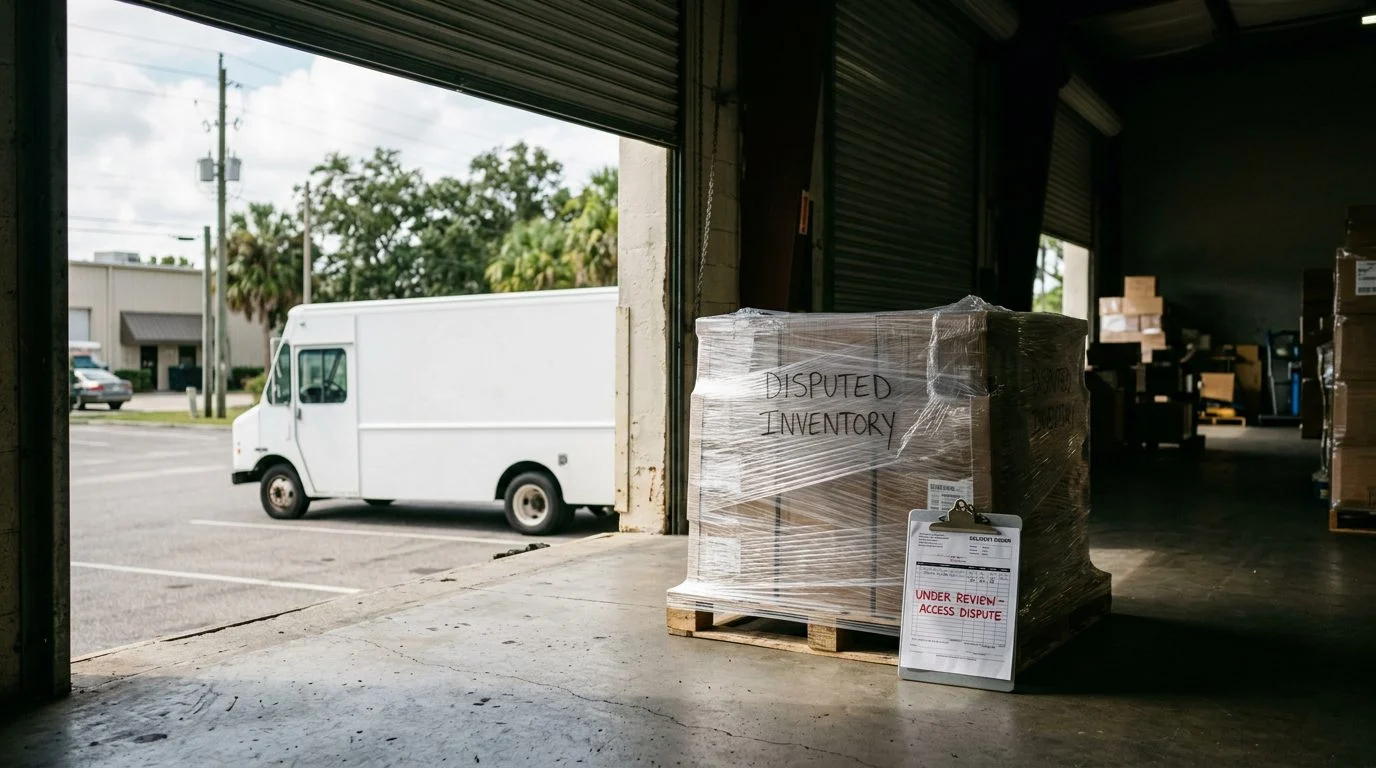
A blocked loading dock, a gate across the shared drive, or a new survey that moves the line under your building can stop a business cold. If you’re dealing with blocked access to your business property in Tampa, the short answer is this: Florida courts usually start with the written papers, then look at how the land was actually used. Depending on what those papers say, you may have a claim to keep your route open.
This guide covers the common situations, the legal theories Florida courts consider, and the steps that usually follow.
What a Blocked-Access or Property Line Dispute Looks Like for a Business
A commercial access dispute is a disagreement over who may use a route, a strip of land, or a boundary that affects how your business runs.
- Property line dispute: the owners disagree about where one parcel ends and the next begins.
- Easement dispute: one owner claims a legal right to cross or use another owner’s land, such as for a driveway, utility line, or drainage path.
- Blocked-access dispute: a fence, gate, vehicle, or stored equipment keeps deliveries, customers, or staff from reaching the property.
These disputes hit businesses harder than homes. A blocked dock can halt shipments the same day, and a blocked customer entrance costs sales every day it stays closed. The owner, a tenant, or both may have a stake. The right party to act depends on the documents. Losses from a blocked route often grow each day it stays closed, so the record matters from the start.
If a neighbor has gated your loading dock or moved a boundary under your business, you may have a claim, and our Tampa team can review your documents with you. Talk it through with our team — we can walk you through how a situation like yours is usually handled and what your options are.
Common Tampa Business Access Situations
Most access disputes begin with a change on the ground, such as a new gate, a parked truck, or a fresh survey.
- A fence, gate, or barrier placed across a shared drive or loading dock.
- A neighbor parking or storing equipment in a shared lane or delivery area.
- A new survey showing the true boundary sits somewhere other than everyone assumed.
- A route used for years with no written document, until the neighbor objects.
- Drainage, utility, or access crossings disputed after a sale or redevelopment.
Each one turns on two questions: what do the recorded papers say, and how has the land actually been used? A business often learns about a boundary problem only when a lender, buyer, or contractor orders a survey. By then, the neighbor may already have parked on the disputed strip. Tenants face a related problem when the landlord’s arrangement with a neighbor does not cover the tenant’s delivery route.
The Legal Theories and Remedies Florida Courts Consider
- Florida generally requires an estate or interest of freehold, or a term of more than 1 year, in land to be created by a signed written instrument witnessed by two subscribing witnesses, with exceptions such as wills, and with no subscribing witnesses required for a lease of real property (Fla. Stat. § 689.01). The exact words of the grant matter.
- The proof is fact-specific, so the history matters.
- Adverse possession. This is a separate claim to the land itself. Under § 95.18, 7 years of actual continued possession under a claim of title exclusive of any other right, not founded on a written instrument, judgment, or decree, also requires payment, subject to s. 197.3335, of all outstanding taxes and matured special improvement lien installments within 1 year after entering into possession, and a return to the property appraiser within 30 days after that payment. The possessor must also keep paying all taxes and matured installments for all remaining years needed to establish the claim.
- Circuit courts may issue injunctions (§ 26.012), and they hear actions involving the title and boundaries of real property.
- Where to file. Actions are brought only in the county where the defendant resides, where the cause of action accrued, or where the property in litigation is located; this rule does not apply to actions against nonresidents (§ 47.011).
How the Process Typically Works, Step by Step
A typical matter moves from document review to a written demand, then to negotiation, and to a court filing only if needed.
- Intake and document review. Gather the deed, title work, plats, recorded easements, leases, and past correspondence.
- Survey and site documentation. Fix the boundary and the disputed route on paper and on the ground.
- Written demand. A cease-and-desist letter states the access right and sets a deadline to respond.
- Negotiation. Talks may produce a written access or boundary agreement. Read any notice steps closely.
- Filing, if needed. A suit in circuit court can include a request for a temporary injunction when access is lost now. A recorded notice of lis pendens warns later buyers and lenders. Fla. Stat. § 48.23 reads: “(1)(a) An action in any of the state or federal courts in this state operates as a lis pendens on any real or personal property involved therein or to be affected thereby only if a notice of lis pendens is recorded in the official records of the county where the property is located and such notice has not expired pursuant to subsection (2) or been withdrawn or discharged.” Under § 48.23, it expires after 1 year unless the claim rests on a recorded instrument or on a lien claimed under part I of chapter 713 against the property, or the court extends it on reasonable notice and for good cause.
- Mediation and settlement. When a filed civil action seeks money damages, the court must refer it to mediation upon the request of one party, provided the requesting party is willing and able to pay the costs of the mediation or the costs can be equitably divided between the parties, subject to exceptions (§ 44.102).
- Resolution. The case ends by settlement, judgment, or trial. How long each stage takes depends on the facts and the court’s calendar.
What to Do and Avoid While the Dispute Is Pending
Your strongest position usually comes from dated records and calm conduct while the dispute is still open.
- Document the blockage. Take dated photos and video. Keep delivery logs, customer messages, and vendor notes that show lost access.
- Keep every paper. Save each deed, survey, lease, plat, and recorded easement tied to the property.
- Avoid self-help. Don’t remove the barrier, cut a fence, or block the neighbor in return. Those moves can invite counterclaims.
- Notify the right parties. If a lease, loan, or insurance policy requires notice, send it on time.
- Track the losses. Record missed deliveries, lost customer traffic, and extra labor costs. These feed any damages claim.
- Check fee clauses. For contracts entered into on or after October 1, 1988, if an agreement lets a party recover attorney’s fees when that party is required to take any action to enforce the contract, § 57.105(7) may allow reasonable fees to the other party when that party prevails on that contract.
About Ayala Law PA and Its Tampa Office
Ayala Law PA focuses on business litigation, commercial litigation, contract disputes, real estate litigation, and construction litigation in Florida courts and arbitration.
- The firm’s only office is at 1646 W Snow Ave, Tampa, FL 33606.
- Eduardo A. Maura is the responsible lawyer for this page. The firm’s lawyers and support staff handle matters from that Tampa office.
- Tampa, Hillsborough County, and Tampa Bay clients are served from that office, including businesses in Brandon, Riverview, Plant City, and Temple Terrace.
- The firm can review a property’s records and discuss which options fit those facts.
- No outcome is promised. Each matter turns on its own documents and facts.
Not sure what your next step is?
Talk it through with our team — we can walk you through how a situation like yours is usually handled and what your options are.
Common Questions About Blocked Access and Easement Disputes
The questions below cover the points business owners raise first.
Can I talk to the neighbor first?
Yes. A calm, written message often makes the position and the record clearer.
Do I need a new survey before acting?
A survey often helps fix the boundary and the route before anyone takes the next step.
Can a neighbor block access if we have used the route for years?
Long use can matter, but the proof is fact-specific. A recorded grant or written agreement can change the answer.
How long does a case take?
It varies with the court’s schedule and whether the neighbor contests the claim.
What costs should a business expect?
Filing, service, recording, and survey costs may apply. The firm discusses fees directly with prospective clients before any engagement.
Talk With Our Team About Your Access Dispute in Tampa
If a blocked dock, a gated drive, or a moved survey line is hurting your business now, you may have a claim worth reviewing.
You may be gathering facts for a business you did not start, a building you lease, or a property you inherited. You don’t need every answer yet. Bring the deed, survey, lease, and photos you have. Call (813) 414-5715 or request a case evaluation at lawayala.com/contact. Ayala Law PA is located at 1646 W Snow Ave, Tampa, FL 33606.



