
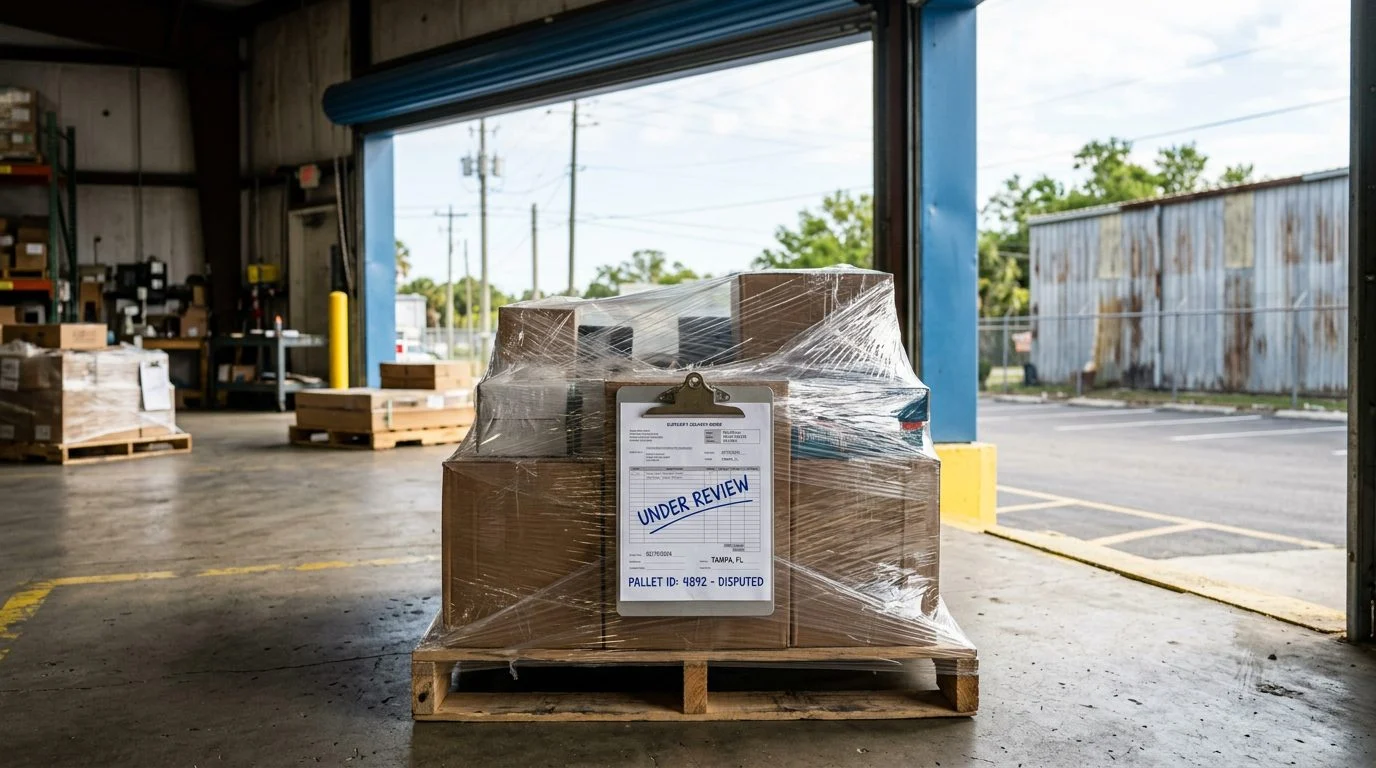
A neighbor’s wall, fence, or parking area may sit across your commercial lot line. That raises questions about parking, access, tenants, and selling. A neighbor encroachment on commercial property in Hillsborough County can be handled through a written demand, a negotiated fix, or a court case.
What a Commercial Boundary Encroachment Is
An encroachment is any improvement that crosses a legal boundary onto land the neighbor does not own. Common examples on commercial lots include a wall that runs past the line, a drive paved onto the next parcel, a canopy that hangs over it, or a fence set a few feet too far.
Property lines are commonly described in recorded deeds, plats, and legal descriptions.
Commercial lots raise the stakes. A few feet can change parking counts, loading access, setbacks, or the leasable area a tenant pays for. Lease and sale terms often depend on those exact lines.
An encroachment is different from a simple fence-line argument.
This page is for owners, business operators, and property managers in Hillsborough County. Many learn of the problem from a survey, a contractor, a lender, or a buyer.
If a neighbor's structure now crosses your commercial lot line, our team can review the survey, deed, and timeline with you at our Tampa office. Talk it through with our team — we can walk you through how a situation like yours is usually handled and what your options are.
What Florida Law Generally Gives the Affected Owner
Building on a neighbor’s land does not, by itself, give the builder ownership of that land. Florida’s adverse possession rules under Fla. Stat. § 95.18 require more, including actual, continued possession under a claim of title for the statutory period and under the conditions the statute sets.
Florida does allow adverse possession claims, but the rules are strict. The claimant must also pay all outstanding taxes and matured installments of special improvement liens levied against the property within 1 year after entering into possession.
Time limits also matter. Under Fla. Stat. § 95.12, no action to recover real property is allowed unless the person seeking recovery, or the person’s ancestor, predecessor, or grantor, was seized or possessed of the property within 7 years before the case starts. Have the dates reviewed early.
The facts of each lot decide how these rules apply.
Document the Encroachment Before You Send Anything
Start with a current boundary survey from a licensed surveyor. Then gather these records before you contact the neighbor:
- The survey, compared against the recorded plat and deed.
- Dated photos and video of the structure from several angles, with reference points tied to the survey.
- The deed, plat, title documents, easements, and any site plan on file with the county.
- Permit history, if any, and who built the structure and when.
- Dated notes on every conversation with the neighbor.
Check the property appraiser’s records too. Under Fla. Stat. § 95.18, an adverse possession claim is filed as a return with a full legal description and a notarized attestation, and the property appraiser keeps it on file. A return on file is a clear signal to act early.
Hold off on threats, self-help removal, and social media posts. A calm, factual record is more useful later than heated messages.
How a Commercial Encroachment Dispute Typically Moves Forward
Most commercial boundary disputes move from document review to a written demand, then to negotiation, and to court only if needed.
- Intake and document review. Confirm ownership, the recorded description, the survey, and the timeline of the structure.
- Written demand. The letter identifies the encroachment, the survey evidence, the remedy requested, and a response deadline.
- Negotiation. Options include removal, relocation, a recorded boundary line agreement, or a written license or easement with payment terms.
- Litigation if needed. The case is filed in Florida court.
Florida law also lets a party ask a court to refer many civil actions for money damages to mediation, provided the requesting party is willing and able to pay the costs of the mediation or the costs can be equitably divided between the parties, subject to listed exceptions. Fla. Stat. § 44.102 reads: “(2) A court, under rules adopted by the Supreme Court: (a) Must, upon request of one party, refer to mediation any filed civil action for monetary damages, provided the requesting party is willing and able to pay the costs of the mediation or the costs can be equitably divided between the parties, unless: 1.” See Fla. Stat. § 44.102.
Timelines vary with the neighbor’s response and court calendars. No particular result can be promised.
Court Options and What a Lawsuit Can Ask For
A boundary lawsuit usually starts in Florida circuit court. Under Fla. Stat. § 26.012, circuit courts have exclusive original jurisdiction in all actions involving the title and boundaries of real property. The same section lets the circuit court issue injunctions.
Venue follows state law too. Under Fla. Stat. § 47.011, actions shall be brought only in the county where the defendant resides, where the cause of action accrued, or where the property in litigation is located. This section shall not apply to actions against nonresidents.
Money damages and court orders do not always end the dispute. Some parties need a recorded line agreement too.
If a lease, contract, or recorded agreement has an arbitration clause, Florida law generally enforces it. See Fla. Stat. § 682.02.
If the parties signed a boundary agreement built on a wrong survey, undoing it is harder. Under Waterside at Boynton Homeowners’ Ass’n v. Southern Homes of Palm Beach, LLC, rescission for mutual mistake is available only if the mistake is mutual and goes to the essence of the contract.
How an Encroachment Affects a Sale, Financing, or Title
An encroachment usually has to be dealt with before a sale closes. Owners can fix it, agree to it in writing, or address it in the purchase contract.
- Buyers, lenders, and title companies may order surveys that reveal the problem.
- Title insurers and lenders may require disclosure, resolution, or an exception from coverage.
- Owners may resolve the issue before listing, record a boundary line agreement, or write terms into the contract.
- Buyers may ask for a price change or a delayed closing.
Under Fla. Stat. § 689.01, an estate or interest in real property of freehold, or for a term of more than 1 year, generally must be created by a signed writing witnessed by two subscribing witnesses. Leases are a noted exception.
If a lawsuit over the line is filed, a notice of lis pendens can be recorded. Under Fla. Stat. § 48.23, the notice takes effect only when recorded in the county’s official records. Because of this, a business buying or lending against property will often want to check the county’s official records for a notice of lis pendens before it closes. The notice expires 1 year after the action begins, unless the pending pleading shows the relief sought is founded on a duly recorded instrument or on a lien claimed under part I of chapter 713 against the property; the court may extend the time on reasonable notice and for good cause.
Not sure what your next step is?
Talk it through with our team — we can walk you through how a situation like yours is usually handled and what your options are.
Why Work With Ayala Law PA on This Matter
Ayala Law PA focuses its practice on business litigation, commercial litigation, contract disputes, shareholder disputes, construction litigation, real estate litigation, and international trade litigation.
The firm’s office is at 1646 W Snow Ave, Tampa, FL 33606. From that Tampa office, the firm serves Hillsborough County, Brandon, Riverview, Plant City, Temple Terrace, and the wider Tampa Bay area.
Eduardo A. Maura is the lawyer responsible for this page. Our team, including assistants and office staff, helps organize documents and keep matters moving. Our lawyers handle commercial matters of this kind from the firm’s Tampa office.
If a matter falls outside these practice areas, the firm may refer it to another lawyer or firm, and it will tell you so.
Frequently Asked Questions
What are the legal requirements for encroachment on property lines in Florida?
A current survey is often used alongside the recorded legal description to show where a property line sits. Claims that a neighbor took land through long use require 7 years of continued possession and other steps under Fla. Stat. § 95.18.
What happens if a survey shows an encroachment?
Save the survey, document the structure, and review the dates. Next steps usually include a written demand, a negotiated fix, or a court case if the neighbor refuses.
Can you sell a property with an encroachment?
Yes, a sale is possible, but the encroachment usually must be disclosed and addressed in the deal. Buyers, lenders, and title companies may each require a fix or an exception.
What is considered a property encroachment?
An encroachment is an improvement, such as a wall, fence, paving, or canopy, that crosses a legal boundary onto a neighbor’s land. A parking lot that runs a few feet past the line is a common commercial example.
Does a neighbor encroachment on commercial property always end in a lawsuit?
No. Many matters resolve through a written demand, negotiation, a recorded boundary agreement, or mediation. Outcomes cannot be predicted in advance.
How much does a case evaluation cost?
Fee terms are explained when you contact the firm, so ask about them at that point.
Talk With Ayala Law PA About Your Tampa-Area Commercial Lot
Finding a structure across your line can create parking, tenant, and sale questions all at once. Gather the survey, deed, plat, photos, and your dated notes before you reach out. Then contact Ayala Law PA at 1646 W Snow Ave, Tampa, FL 33606, or call (813) 414-5715 to talk through your situation with our team.



