
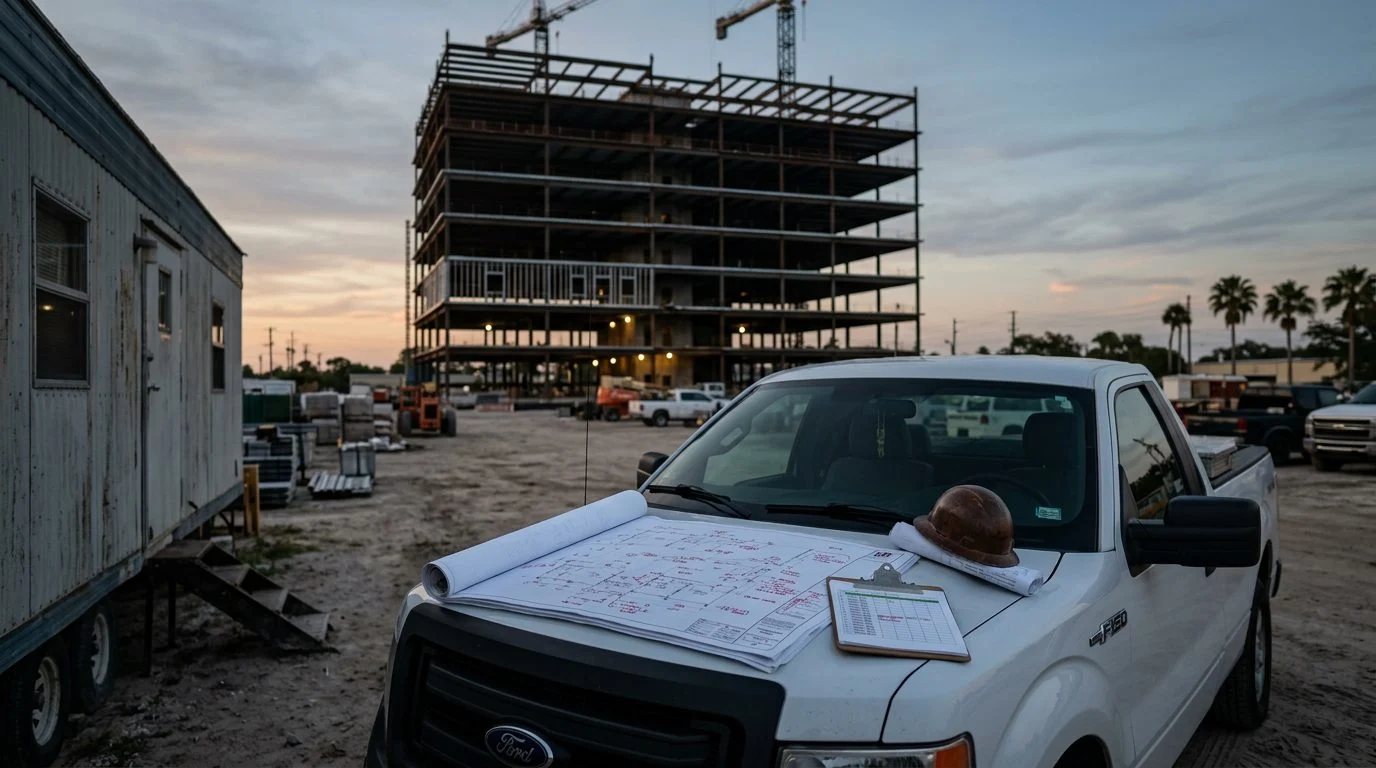
If a title company won’t close because of a construction lien in Tampa, the deal isn’t necessarily dead. A title company may decline to close while the lien is unresolved, and a buyer may hold off too. The lien itself, the purchase contract, and the title commitment decide what happens next.
If you’re facing this with a closing date close by, you may not have caused the problem. Eduardo A. Maura is the responsible lawyer for this page, and the points below are written for families in Tampa and Hillsborough County working through it.
Why Does a Construction Lien Halt a Real Estate Closing?
A construction lien halts a closing because it is a recorded claim against the property. The buyer would take the property subject to that claim unless it is cleared.
A construction lien is a claim by someone who furnished labor, services, or materials for improvements to real property. It secures payment for that work.
Title companies pay attention because a recorded lien can affect the title the buyer receives. Underwriters want to know who holds a claim and how it will be resolved before they insure.
The problem often surfaces late. Many owners first learn of it from a title search, often close to the closing date.
If a construction lien has put your Tampa closing on hold, you don't have to sort out the title paperwork alone. We can talk through the dates and documents with you. Talk it through with our team — we can walk you through how a situation like yours is usually handled and what your options are.
Can a Title Company Refuse to Close Over a Lien?
Yes, a title company can decline to insure or disburse funds while a recorded lien remains unresolved.
A title company usually looks at the title commitment, which lists what must be cleared before a policy issues. A recorded lien often appears there as a requirement. The underwriter may ask for a release, a bond, or an agreed escrow.
A recorded lien differs from a verbal complaint, a threatened claim, or an unpaid invoice that was never filed. A title agent generally works from the public record. A lender may still set its own conditions.
The answer depends on the facts: whether the lien is recorded, the amount, the parties, and what this underwriter requires. Ask the title agent for each requirement in writing.
Can the Buyer Walk Away or Refuse to Close?
Start with the contract and every addendum. Look at title requirements, marketable-title language, closing conditions, contingency clauses, and default terms. Check whether the seller must deliver title without liens or other encumbrances.
If the contract requires clean title and a recorded lien is on the property, the buyer may have a contractual basis to refuse. If it doesn’t, refusing can start a dispute over the deposit and claims of default.
Fee clauses matter here. If a contract entered into on or after October 1, 1988 lets a party recover fees for enforcing it, § 57.105 lets the court award reasonable fees to the other side when that party prevails on the contract.
Oral promises deserve caution. Florida’s highest court has said promissory estoppel may not be used to get around the Statute of Frauds for an oral deal that must be in a signed writing.
Undoing a deal over a mistake is also hard. Courts may allow rescission of a contract for mutual mistake, and whether a particular mistake qualifies depends on its facts and the terms of the agreement.
How Long Does a Construction Lien Last in Florida?
Florida sets deadlines for recording and enforcing a construction lien. The dates on the recorded documents decide which deadline applies.
Chapter 713 controls the lien itself, including the time limits for recording a claim of lien and for enforcing it. Day counts depend on the dates of the work and the type of claimant.
Separate limits apply to lawsuits. Under the Florida limitation statute, § 95.11, a claim tied to the design, planning, or construction of an improvement to real property must be commenced within four years, and that period runs from the earliest of the certificate or abandonment date listed in the statute. The four-year period is not the deadline for every lien-related claim, so a shorter deadline may apply to some lien enforcement actions. When the action involves a latent defect, the time runs from when the defect is discovered or should have been discovered with the exercise of due diligence, but the action must in any event be commenced within seven years after the earliest of those certificate or abandonment dates. Fla. Stat. § 95.11 reads: “(3) WITHIN FOUR YEARS.— … (b) An action founded on the design, planning, or construction of an improvement to real property, with the time running from the date the authority having jurisdiction issues a temporary certificate of occupancy, a certificate of occupancy, or a certificate of completion, or the date of abandonment of construction if not completed, whichever date is earliest; except that, when the action involves a latent defect, the time runs from the time the defect is discovered or should have been discovered with the exercise of due diligence.”
Under § 95.031, a cause of action accrues when its last element occurs.
What Are the Options for Clearing a Lien Before Closing?
The usual routes are paying or settling with the claimant, challenging the lien, bonding it off, or holding funds in escrow at closing.
Settlement is the most direct route. The claimant signs a release, and the release gets recorded. Talks over a disputed amount are protected. Under § 90.408, an offer to compromise a disputed claim generally can’t be used to prove liability or the claim’s value.
Chapter 713 also has procedures for challenging a lien. Those procedures carry time limits, so raise them early rather than near the closing date.
Whether a title company accepts a bond depends on its underwriter, so ask before you commit.
Escrow is a written holdback. Buyer and seller agree to hold funds at closing until the dispute ends. Put the terms in writing.
If a lawsuit is filed, § 44.102 requires courts to refer many filed damages actions to mediation when one party asks and is willing and able to pay the costs or the costs can be equitably divided, with listed exceptions. Fla. Stat. § 44.102 reads: “(2) A court, under rules adopted by the Supreme Court: (a) Must, upon request of one party, refer to mediation any filed civil action for monetary damages, provided the requesting party is willing and able to pay the costs of the mediation or the costs can be equitably divided between the parties, unless: 1.”
Why Do Lien Waivers and the Paper Trail Matter?
Read the amount, the through-date, and the project address on each one. A waiver signed for a different job may not cover yours.
Gather the contract, addenda, invoices, payment records, waivers, notices, and the recorded lien before you talk with a lawyer. A complete file makes the dates easier to test.
Real estate transfers follow strict form too. Under § 689.01, a conveyance of a freehold or of an interest for a term of more than 1 year must be in a signed writing, signed in the presence of two subscribing witnesses by the party or the party’s lawfully authorized agent, though no subscribing witnesses are required for a lease of real property. Electronic witnessing is allowed under that section. For more on waiver language, read our Florida lien waiver guide.
Not sure what your next step is?
Talk it through with our team — we can walk you through how a situation like yours is usually handled and what your options are.

Talk Through Your Closing With Ayala Law PA
If a lien has put your closing at risk, Ayala Law PA can talk through the dates and documents with you.
Eduardo A. Maura is the responsible lawyer for this page. The firm focuses on business litigation, construction litigation, and real estate litigation for businesses and families. Its only office is at 1646 W Snow Ave in Tampa, and it serves Tampa and Hillsborough County clients from that office.
Fees for case evaluations are explained before any engagement.
For the broader picture, see our Tampa construction litigation guide. To take the next step, contact Ayala Law PA or call (813) 414-5715.
How long does a construction lien last in Florida?
Deadlines turn on the recorded dates and the claimant’s role under Chapter 713.
Can a buyer walk away over a lien?
Without a contractual basis to refuse, refusing to close can lead to a dispute over the deposit.
What is a conditional lien waiver?
Lien waiver forms can differ in their wording and in when they take effect, so each document should be read carefully before it is signed.



