
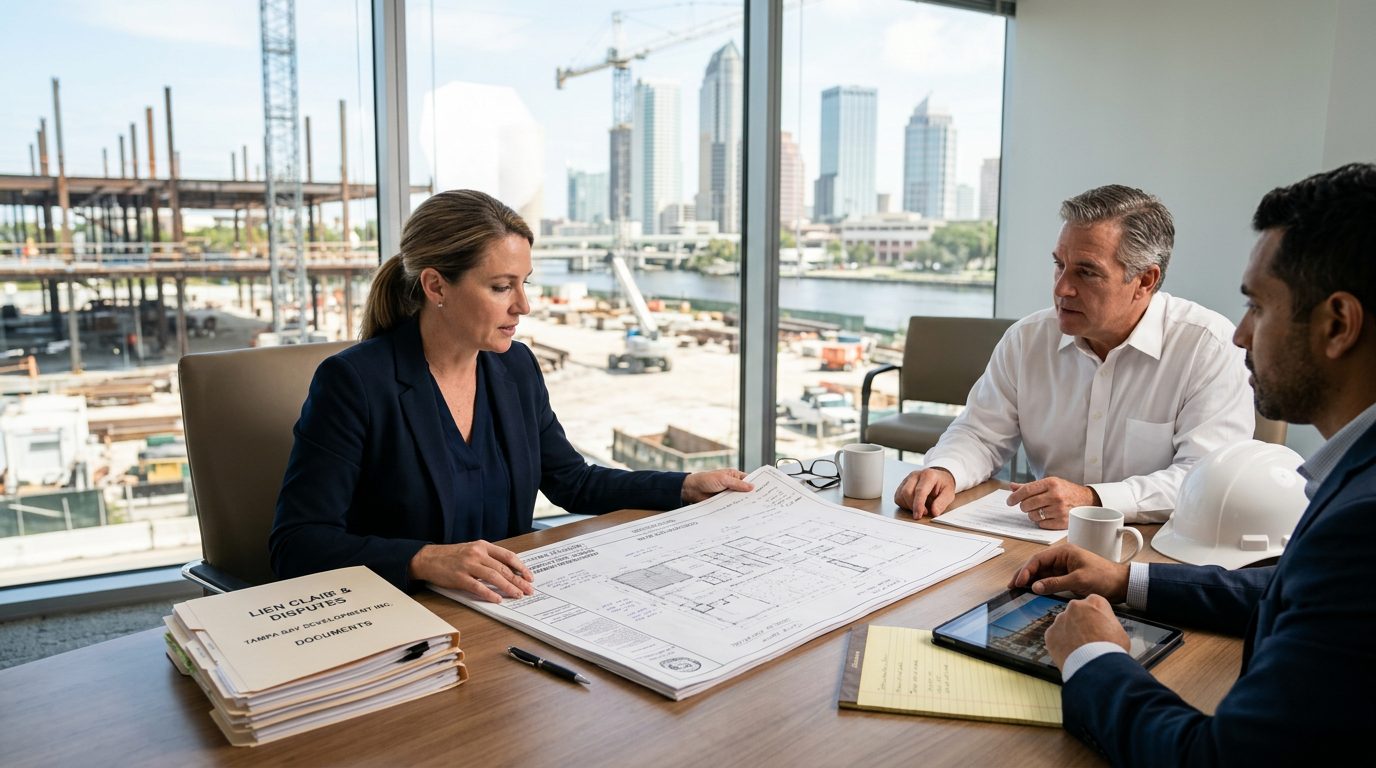
This guide explains construction litigation in Tampa. It covers common disputes, how Florida construction liens work and when a lawsuit may make sense. Ayala Law PA serves Tampa and Hillsborough County clients from its only office, in Tampa.
Common Construction Disputes That End Up in Tampa-Area Courts
Most construction disputes involve unpaid money, defective work, missed schedules or fraud. On a typical Tampa Bay job, an owner hires a general contractor, who hires subcontractors, who buy materials and hire crews. One missed payment can affect every contract below it.
Payment fights are the most common. A general contractor may hold back money from a subcontractor, or an owner may stop paying after the work is done. Back-charges, where a contractor deducts repair or cleanup costs from a subcontract, cause many disputes too.
Defect and delay claims come next. An owner may say the work was incomplete or poorly built. The contractor may say the owner changed the plans or caused the delay. Written change orders, which record approved changes, often decide which account the paperwork supports.
Construction contract fraud is a separate claim. It can involve billing for work never done or misstating the materials used. These cases turn on invoices, records and proof behind each payment.
An owner’s claim against a contractor and a subcontractor’s claim against a general contractor differ in who signed what. An owner usually has a direct contract with the general contractor. A subcontractor’s claim often depends on its own subcontract and on lien rights.
If an unpaid contractor, a lien claim or defective work is holding up your project, we are ready to talk through your options with you. Talk it through with our team — we can walk you through how a situation like yours is usually handled and what your options are.

How Florida Construction Liens and Lien Foreclosure Work
Construction lien matters often turn on the specific facts of each project and property. How lien rights play out on a construction project depends on that project’s specific facts, contracts and paperwork, so it helps to review the details early.
Lien foreclosure refers to a court action in which a lien claimant asks a court to enforce a lien against a property. The steps are technical, and a missed notice or filing step can affect whether a lien holds up. Keep copies of every notice you send and proof of how it was delivered.
Many people assume a recorded lien will be paid automatically. It is not. A lien generally expires if a foreclosure action is not started within one year after the claim of lien is recorded, under Fla. Stat. § 713.22, so claimants should calendar that deadline from the date of recording. An early review usually leaves more options to evaluate, while waiting can narrow them.
Is It Worth Suing a Contractor in Florida?
It can be worth suing when the amount at stake justifies the cost and the contractor can pay a judgment. No lawyer can promise how a court will rule, so the decision rests on the facts and the numbers.
Start with the paperwork. A signed contract, written change orders, photos, daily logs and clear invoices make a claim easier to prove. Gaps in those records can weaken a claim, so check them early. Also look at the contractor’s insurance, bonding and assets.
Timing is a major factor. For construction on an improvement to real property, Florida generally allows four years to sue, measured from the earliest certificate or abandonment date. For latent defects, the time generally runs from when the defect is discovered, or should have been discovered with due diligence, but that discovery rule is subject to the outer limit of the statute of repose in Fla. Stat. § 95.11, after which no action may be brought regardless of when the defect was discovered. Contract terms that try to shorten that window are void Fla. Stat. § 95.03.
Fee clauses and settlement offers also matter. If the contract allows attorney’s fees, a court may allow reasonable fees to the other party when that party prevails Fla. Stat. § 57.105. Rejected settlement offers can also shift fees and costs under specific percentage tests. Litigation takes time and money, so weigh the realistic recovery against those costs before you file.
Litigation, Arbitration and Mediation: Choosing the Path
The contract and the location of the project usually decide where a construction dispute is heard. Read the dispute clause before you act.
Many construction contracts require arbitration, a private process where an arbitrator decides the dispute. Florida’s arbitration law makes these agreements valid and enforceable, except on grounds that exist for revoking any contract Fla. Stat. § 682.02. If one side refuses to arbitrate, a court can order arbitration. It may not refuse only because the claim lacks merit Fla. Stat. § 682.03.
Mediation is often a step before trial.
Where a lawsuit is filed also matters under Fla. Stat. § 47.011. An action is brought in the county where the defendant resides, where the cause of action accrued, or where the property in litigation is located Fla. Stat. § 47.011. That rule does not apply to actions against nonresidents. For a Hillsborough County project, it may point to the county where the work or property is located.
How Ayala Law Handles Construction Disputes for Tampa Bay Clients
Ayala Law PA focuses its practice on business litigation, including construction litigation for contractors, subcontractors and property owners. The firm handles contractor and subcontractor disputes, lien foreclosure and construction contract fraud in Florida courts and in arbitration.
Eduardo A. Maura is the lawyer responsible for this page. Our team includes support staff who help with intake and document organization. Each matter starts with a review of the documents and the timing.
Our only office is at 1646 W Snow Ave in Tampa. Clients in Tampa, Brandon, Riverview, Plant City, Temple Terrace and across Hillsborough County are served from that Tampa office. The firm maintains its office in Tampa.
When you reach out, the firm can explain whether your matter falls within its practice areas. If a matter should go to another lawyer or firm, the firm will say so.
Next Steps If You Have an Active Construction Dispute
Gather your records before the first conversation, because they shape what can be reviewed. Pull together the signed contract, any change orders, invoices and payment records, lien notices, correspondence with the other side, and photos or daily logs from the job.
Fees depend on the matter, and the firm explains them before any engagement begins.
Frequently Asked Questions
Is it worth suing a contractor in Florida?
It can be, depending on the amount at stake, the strength of your records and whether the contractor can pay a judgment. No lawyer can promise how a court will rule.
How long do I have to sue over construction work?
Fla. Stat. § 95.11 lists time periods by type of action, so the period that applies depends on the nature of the claim. Latent defects can follow a different start date, so check your project’s facts.
Does Ayala Law handle construction litigation in Tampa?
Yes. Ayala Law PA handles construction litigation for clients in Tampa and Hillsborough County, served from its Tampa office.
If an unpaid invoice, a lien claim or defective work is holding up your project right now, call (305) 570-2208 or book a case evaluation with Ayala Law PA.



