
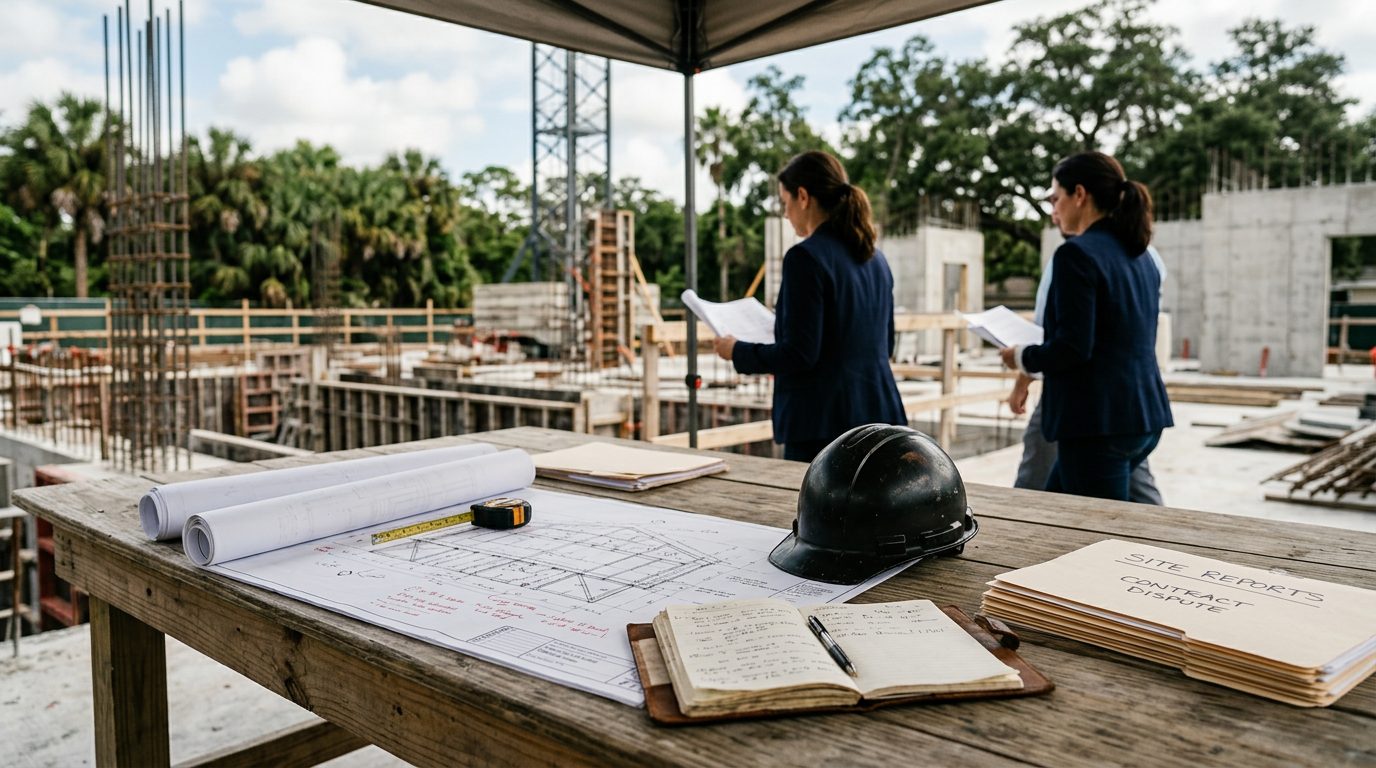
For Temple Terrace businesses, construction litigation is the court or arbitration process for settling disputes over building and improvement work. These disputes often involve a contractor and subcontractor, a construction lien on a property, or a contract someone says was misrepresented. Ayala Law PA focuses on these matters within its business litigation practice. Clients in Temple Terrace are served from the firm’s only office, in Tampa. Eduardo A. Maura is the lawyer responsible for this page’s content.
What Construction Litigation Covers for Temple Terrace Businesses
Construction litigation resolves who owes what on a building or improvement project. Ayala Law PA handles contractor and subcontractor disputes, construction lien foreclosure, and construction contract fraud. Each can end in a lawsuit or in arbitration, depending on the contract.
Arbitration is a private process where an arbitrator, not a judge, decides the dispute. Under § 682.02, a written agreement to arbitrate is valid, enforceable, and irrevocable, except on a ground that exists to revoke any contract. A clause in your subcontract can decide how the dispute is heard.
Where a case is filed depends on the facts. Under § 47.011, an action must be brought in the county where the defendant resides, where the cause of action accrued, or where the property in litigation is located. For a Temple Terrace project, that can mean Hillsborough County.
Talk it through with our team — we can walk you through how a situation like yours is usually handled and what your options are.
Common Disputes Between Contractors and Subcontractors
Most disputes come down to money, scope, or timing. A subcontractor who has finished work but is still waiting on a progress draw or final payment is a common starting point. A general contractor may see the same fight from the other side, often over back-charges or defect claims.
Scope and change orders cause many fights. Extra work done without a signed change order is hard to prove was approved. Who requested the work, and whether the owner or general contractor agreed in writing, can decide the case.
Delay claims are another common issue. One side says the other missed a deadline, while the other says the schedule changed. Back-charges are amounts one party deducts for costs it says the other caused.
Written records carry real weight. Signed contracts, pay applications, change orders, daily logs, and emails show what was agreed and when. Gaps in these records can make a dispute harder to prove, even when the work was done.
Is It Worth Suing a Contractor?
Whether suing is worth it depends on the amount in dispute, the contract terms, the records you have, and whether the other side can pay a judgment. No one can predict how a particular dispute will end.
A lawsuit takes time and money, and it can disrupt a project that is still running. Before filing, business owners often compare a written demand letter, a lien claim where one is available, a negotiated settlement, and a court or arbitration case.
Contract terms can change the math. Under § 57.105, if a contract allows attorney’s fees to a party that must enforce it, the court may also allow reasonable fees to the other party when that party prevails. Read the fee clause before you decide.
Settlement offers matter too. Under § 768.79, a written offer of judgment that is not accepted within 30 days can shift costs and attorney’s fees, but only when the final judgment lands far enough from the offer.

Lien Deadlines and Why Timing Matters in Florida
Construction lien steps run on set timelines, so review a lien issue promptly.
Suit deadlines are separate, and they matter just as much. Under § 95.11, an action founded on the design, planning, or construction of an improvement to real property generally must start within four years. That period runs from the earliest of the certificate of occupancy, certificate of completion, or date of abandonment. Suit must also start within seven years of that date in any event. For a hidden defect, the clock starts when the defect is discovered, or should have been discovered with due diligence.
Under § 95.031, a cause of action accrues when its last element occurs. A contract clause that sets a shorter period than the statute allows is void, under § 95.03.
Before your first conversation with a lawyer, gather the signed contract and amendments, pay applications and invoices, change orders, any lien notices, and letters or emails about the dispute.
How a Litigation Lawyer Differs From a General Practice Lawyer
A litigation lawyer focuses on disputes that a court or arbitrator decides. A general practice lawyer may handle many kinds of legal work, such as wills, real estate closings, and family matters. Our team can also discuss with you whether a small demand letter fits your matter.
Litigation follows a set path. The case starts with pleadings, the written complaint and answer that frame the claims. Discovery comes next, when each side exchanges documents and testimony. Motions can narrow or decide issues along the way. The case then ends in mediation, trial, or arbitration.
Ayala Law PA focuses on business litigation, including commercial litigation, contract disputes, shareholder disputes, real estate litigation, and construction litigation. The firm makes no claim of certification in any area, and our team supports each matter from the Tampa office.
Contacting Ayala Law PA About a Temple Terrace Construction Dispute
A stalled project, an unpaid subcontractor invoice, or a lien notice that needs a response is a good reason to talk with a lawyer soon. Ayala Law PA can review your contract, records, and timing with you, so you can see your options before choosing one.
Fee terms are part of that first conversation. Florida’s fee rule expects costs to be communicated to the client, preferably in writing, as Florida Bar Rule 4-1.5 explains. The firm discusses fee terms with you and confirms them in writing.
If an unpaid invoice or a lien notice has your business stuck, call (305) 570-2208 or request a case evaluation through the contact page.
Frequently asked questions
Is it worth suing a contractor in Florida?
It depends on the amount in dispute, the contract, the records, and whether the other side can pay. No one can predict the result in advance.
How long do I have to sue over construction work?
Florida’s § 95.11 sets time limits by type of action, and claims tied to the design, planning, or construction of an improvement to real property fall under a separate limitation period, so the deadline that applies depends on the specific type of claim. Timing depends on the facts, so review it early.
Can a Temple Terrace construction dispute be heard in Hillsborough County?
It can, if the defendant lives there, the claim arose there, or the property is there. Temple Terrace matters are handled from our Tampa office.



