
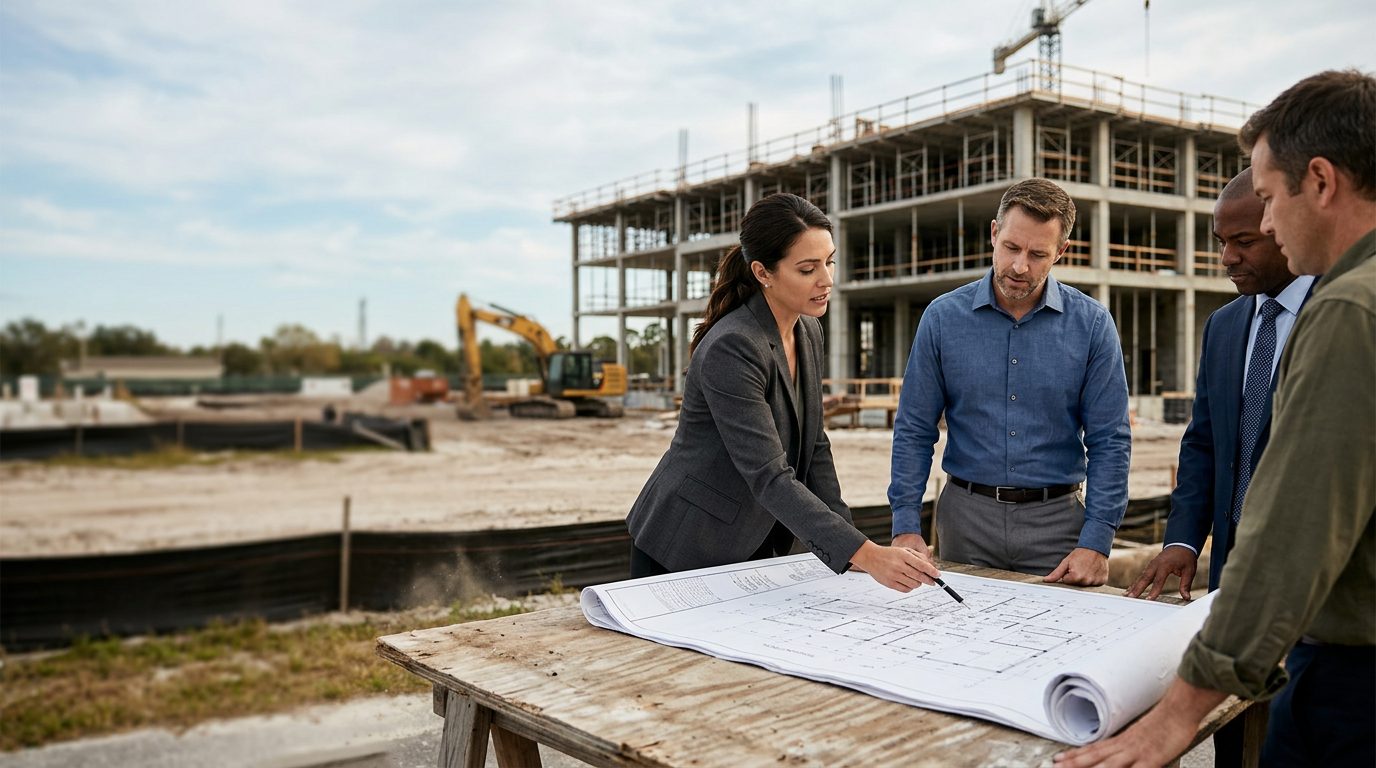
A construction dispute is usually worth a serious look when the money at stake is meaningful, the paperwork is clear, and the deadlines are still open. Construction disagreements in Hillsborough County can involve unpaid bills, disputed change orders, delays, or work that does not match the contract. This page explains the common claims, the Florida rules that shape them, and how a case moves from a demand letter to court or arbitration. Ayala Law PA focuses on business and construction litigation in Florida courts and arbitration. The firm’s only office is at 1646 W Snow Ave in Tampa.
Construction Disputes Business Owners Face in Hillsborough County
Construction disputes in Hillsborough County can range from single houses to large commercial and mixed-use buildings. Projects in Tampa, Brandon, Riverview, Plant City, and Temple Terrace often involve owners, general contractors, subcontractors, suppliers, and developers. Any of them can end up on either side of a fight. Disputes may involve unpaid invoices, disputed change orders, delay claims, defective work, and disagreements over how a contract was ended.
Mixed-use projects add complexity. One job may include residential units, retail space, and shared systems, which makes it harder to pin down who caused a problem. Deadlines can apply to payment claims and construction liens, so acting promptly helps protect your options. Waiting can cost leverage, especially when lien rights and filing deadlines keep running in the background.
If a contractor left you with an unpaid balance or a lien notice to answer, our team can talk through your options with you. Talk it through with our team — we can walk you through how a situation like yours is usually handled and what your options are.
Is It Worth Suing a Contractor?
It can be, but the answer depends on the facts, and no one can predict the outcome from general information. Three factors shape the decision. The first is the amount in dispute, since a small balance rarely justifies the same effort as a large one. The second is the quality of the written contract, including scope, pricing, and how change orders were approved. The third is whether the documents and witnesses still exist.
Timing can also shape leverage.
Some disputes settle before anyone files. When one party asks, a Florida court generally must send many money damages cases to mediation, subject to exceptions. The right path depends on your contract, your deadlines, and the proof you have.
What Kind of Lawyer Do You Need to Sue a Contractor or Builder in Florida?
You need a lawyer who handles construction litigation, which often overlaps with contract, lien, and commercial disputes. One case can involve all of these at once. Ayala Law PA limits its practice to business and commercial litigation, including contract disputes, shareholder disputes, construction litigation, real estate litigation, and international trade litigation. Eduardo A. Maura is the lawyer responsible for this page.
When you contact Ayala Law PA, you can ask how the firm would handle your contract and your lien timeline. Ask how fee terms are set, and ask for those terms in writing. Where you file also matters. Under Fla. Stat. § 47.011, a case is generally brought in the county where the defendant resides, where the claim arose, or where the property is located. For many Tampa Bay projects, that points to Hillsborough County, but the facts control.
Clients in Tampa, Brandon, Riverview, Plant City, Temple Terrace, and across Hillsborough County are served from the firm’s Tampa office. Some matters fall outside the firm’s practice areas. In those cases, the firm may refer you to another lawyer or firm.
Common Contractor and Subcontractor Claims Under Florida Law
Construction litigation can include payment disputes, lien foreclosure, defect claims, and contract fraud. Each follows its own rules and clock. A subcontractor’s payment depends on the subcontract and the pay schedule. In Florida, an ambiguous pay-when-paid clause is generally treated as setting the timing of payment within a reasonable time, while only a clear pay-if-paid clause generally shifts the risk of owner nonpayment to the subcontractor. Retainage holds back part of each payment, and the contract or, on public projects, Fla. Stat. § 255.078 may allow partial release before the job is finished.
Pay applications list the work completed and the amount requested. A missing or late application can complicate a payment claim, so keep copies of every one.
Lien rights run on a separate track. Notices and deadlines under Chapter 713 matter, so check the dates early. Payment bond claims follow a different clock. Deadlines for payment bond claims by contractors, subcontractors, and sub-subcontractors depend on the facts of each project, so timing should be reviewed early.
Under Fla. Stat. § 95.11, actions other than for recovery of real property are subject to set time periods, including five years for a legal or equitable action on a contract founded on a written instrument. Actions founded on the design, planning or construction of an improvement to real property fall under a shorter four-year period with its own accrual rules, so a five-year deadline should not be assumed to run from the date a certificate of occupancy or certificate of completion issues. A contract cannot shorten that window. Under Fla. Stat. § 95.03, a contract term setting a shorter time to sue is void.
Contract fraud claims are different. They often involve a contractor who misstates licensing, bills for work never done, or swaps materials without telling the owner. Florida also bans unfair or deceptive acts in trade or commerce under Fla. Stat. § 501.204.
How Construction Cases Move Through Hillsborough County Courts and Arbitration
Most construction cases move from a written demand to a filed complaint or arbitration demand. From there, they go through discovery and mediation, and then to trial or an arbitration hearing. Many resolve before a final hearing.
Some cases qualify for federal court. Federal cases arising in Hillsborough County may be filed in the Middle District of Florida, which follows its own local rules.
Many construction contracts include arbitration clauses. Under Fla. Stat. § 682.02, a written agreement to arbitrate existing or future disputes is generally valid and enforceable. If one side refuses to arbitrate, the court can order it under Fla. Stat. § 682.03. The related court case is then stayed. The court may not refuse arbitration just because the claim lacks merit.
Challenges to an award have a short window. Under Fla. Stat. § 682.13, a motion to vacate generally must be filed within 90 days after the movant receives notice of the award.
Sections 44.401 to 44.406 are known as the Mediation Confidentiality and Privilege Act. Court-ordered mediation is covered in Fla. Stat. § 44.102.
Settlement pressure also comes from offers of judgment. If an offer is not accepted within 30 days, the statute can shift reasonable costs and attorney’s fees when the judgment falls far enough from the offer.
Civil Contract Fraud in Construction Disputes
Some contractor conduct can raise questions beyond a civil claim. Ayala Law PA does not handle criminal matters, and those questions fall outside the firm’s listed practice areas. A reader facing a criminal inquiry may need a different lawyer.
The firm focuses on the civil side. That includes contract claims, lien rights, payment disputes, and construction litigation. A civil claim for unpaid money or defective work is a separate matter from any criminal question. Keep records for both sides, and keep copies of everything you send or receive.
Not sure what your next step is?
Talk it through with our team — we can walk you through how a situation like yours is usually handled and what your options are.
Documents to Gather Before You Talk to a Lawyer
Gather the signed contract, change orders, invoices, pay applications, lien waivers, notices, permits, and inspection reports before your first meeting. These records show what was agreed, what was done, and what was paid. Organize them by date, and keep originals intact, since retyped or edited copies raise questions.
A short timeline helps too. List key dates, such as when work started, when problems appeared, and when you sent written notice. Start this list now, because the deadlines discussed above keep running while you gather records.
Evidence of the problem matters just as much. Take dated photos and video of defects or unfinished work. Save texts and emails with the contractor, subcontractors, and inspectors. Keep daily logs, and write down the names of anyone who worked on or inspected the project.
Common mistakes include deleting messages, paying a final invoice without reading the lien waiver, and waiting months to put a complaint in writing.
Talk With Ayala Law PA About Your Hillsborough County Construction Dispute
If a contractor left you with an unpaid balance on a finished job, a lien notice that needs a response, or defective work that won’t be corrected, you don’t have to sort out the next steps alone. Call Ayala Law PA at (305) 570-2208, or send a message through the contact page to arrange a case evaluation. Matters are handled from the firm’s Tampa office at 1646 W Snow Ave. Fee terms are discussed directly with the firm, and nothing on this page promises any result.
How long do I have to sue a contractor in Florida?
Latent defects and other exceptions can change the start date, so check deadlines early.
Can a subcontractor sue a contractor for nonpayment in Florida?
Often, yes. The answer depends on the subcontract, the payment terms, and any lien or bond rights.
Do construction contracts have to go to arbitration?
Only if the contract includes a valid arbitration agreement. Florida generally enforces written arbitration agreements, so the contract wording matters.
Can I recover attorney’s fees in a Florida contract dispute?
Sometimes. Under Fla. Stat. § 57.105, a court may allow reasonable fees to the other party when that party prevails on a contract with a fee provision.



