

Can a 50% Shareholder Remove a Director?

The Short Answer for a 50% Shareholder
Whether one owner can act alone depends on the company’s governing documents and the facts of the situation. Whether the answer changes depends on the facts, including the company’s articles, bylaws, share classes and any shareholder agreement.
This page outlines common questions that arise when owners disagree about removing a director. For the broader picture, see our shareholder disputes in Florida overview.
What Florida Law Says About Removing a Director
Florida’s corporate rules sit in Chapter 607 of the Florida Statutes. The Florida Division of Corporations notes that a company’s structure determines how ownership, control and responsibilities are divided among its owners. That division is where most removal fights begin.
The exact removal steps turn on the company’s own papers. Start by reading the articles, bylaws and any shareholder agreement.
Can shareholders remove a director from a company?
Shareholders remove directors through a vote, and that vote must follow the company’s documents and Florida law. Whether a vote that skipped required steps can be challenged depends on the company’s governing documents and the facts.
The company’s governing documents can affect how votes are counted. Check whether your company’s documents use it.
Why a 50% Stake Usually Falls Short
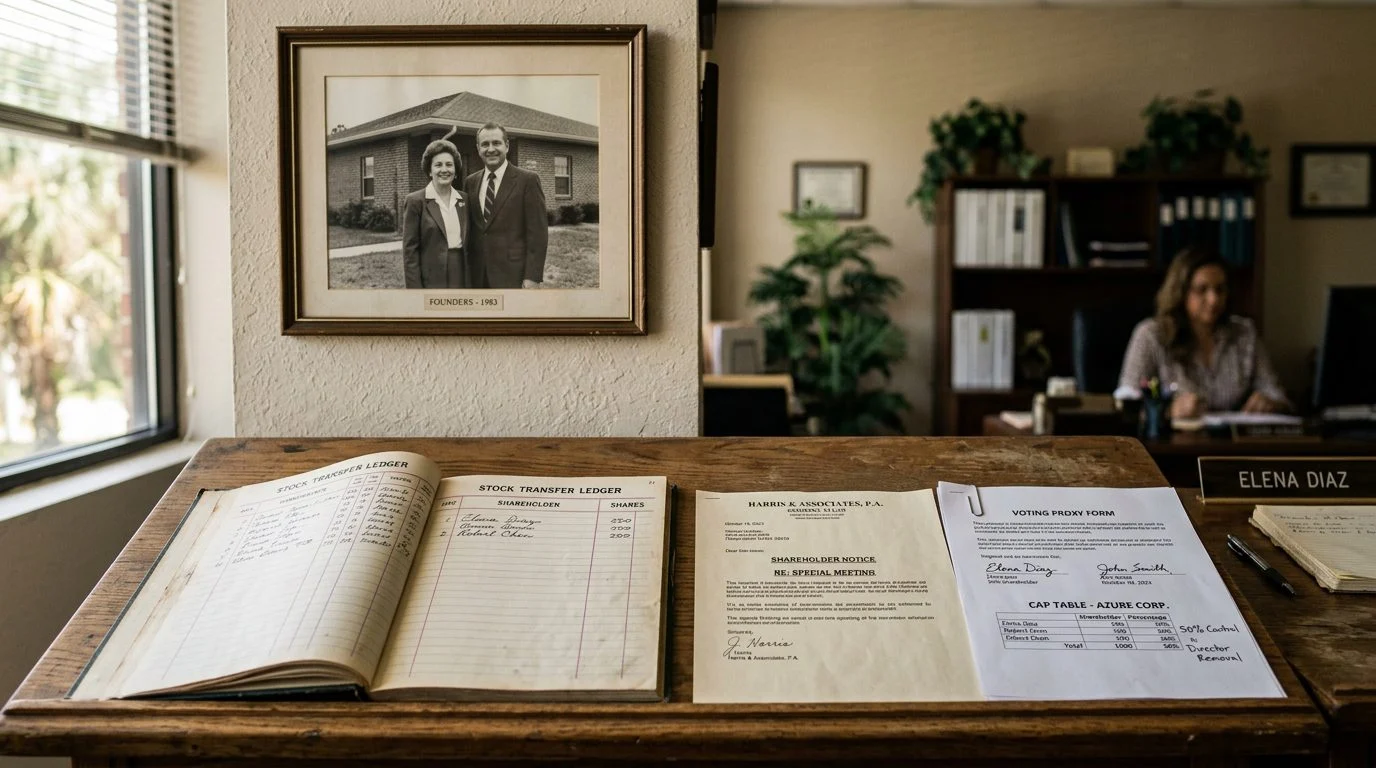
A 50% stake usually produces a tie. Say a company has 100 shares. If 50 shares vote to remove a director and 50 vote no, the removal fails.
What rights does a 50% shareholder have?
An owner’s rights depend on the company’s documents and the size and terms of the owner’s ownership interest. These include notice of meetings, the right to attend and vote, and the right to inspect records. In Florida, a shareholder may inspect and copy certain corporate records during regular business hours if written notice is given at least 5 business days ahead, and the demand must be made in good faith and for a proper purpose. A shareholder can also ask a court for relief in a deadlock, as covered below.
How hard is it to remove a director from a company?
It is hard when the other owner refuses to attend, skips the vote, or blocks the agenda. Meeting notice and voting thresholds are among the details a review of the governing documents can clarify. If the other owner stalls each step, the removal can stay stuck. A 50% holder’s removal vote can succeed only if the governing documents or a voting arrangement give a path to the needed votes.
How Articles, Bylaws, and Shareholder Agreements Change the Answer
The company’s documents often decide the result more than the general rule does. The articles and bylaws set the rules for meetings, notice, quorum and voting. They can also include terms on removal.
A shareholder agreement can change the answer a lot. Under Fla. Stat. § 607.0732, an agreement among shareholders may set who serves as directors and officers, their terms, and the manner of their selection or removal. It may also govern voting power, including weighted voting rights or director proxies. It may also set a mechanism for breaking a deadlock, including in place of judicial dissolution.
Gather these items before you act:
- The articles of incorporation
- The bylaws
- Any shareholder or buy-sell agreement
- Recent meeting minutes and written consents
- Share certificates or ownership records
For a related issue, see our page on forcing out a minority shareholder.
When the Other Owner Blocks the Vote
When a vote cannot happen, the court may be an option in a deadlock. Common blocking tactics include refusing to attend, challenging the notice, disputing the record date, and fighting over the agenda.
Under Fla. Stat. § 607.1430, a circuit court may dissolve a corporation, or order another remedy under s. 607.1434, in the proceedings the statute lists. These include a shareholder proceeding where the statute’s deadlock conditions are met, a proceeding by the Department of Legal Affairs where the corporation obtained its articles of incorporation through fraud, and a proceeding by the corporation to have its voluntary dissolution continued under court supervision. However, if the shareholders are subject to a shareholder agreement that complies with s. 607.0732 and contains a deadlock sale provision, that provision applies to resolve the deadlock instead of a court dissolution order, so long as it is initiated and carried out within the time periods specified for the corporation to act under s. 607.1436 and in accordance with its terms. Dissolution is not the only option. Under Fla. Stat. § 607.1434, in a proceeding under § 607.1430, a court may instead, upon a showing of sufficient merit to warrant such remedy, appoint a receiver or custodian, appoint a provisional director, order a purchase of the petitioning shareholder’s shares, or grant other equitable relief.
A provisional director, appointed as provided in § 607.1435, must be impartial. Fla. Stat. § 607.1435 reads: “A provisional director may be appointed notwithstanding the absence of a vacancy on the board of directors, and such director shall have all the rights and powers of a duly elected director, including the right to notice of and to vote at meetings of directors, until such time as the provisional director is removed by order of the court or, unless otherwise ordered by a court, removed by a vote of the shareholders sufficient either to elect a majority of the board of directors or, if greater than majority voting is required by the articles of incorporation or the bylaws, to elect the requisite number of directors needed to take action.” Under Fla. Stat. § 607.1435, that person cannot be a shareholder or creditor of the corporation.
Timing matters. Under Fla. Stat. § 607.1436, the corporation may elect to purchase the petitioner’s shares at fair value or, if it fails to elect, one or more shareholders may elect to do so. That election may be filed within 90 days after the petition, unless the court allows more time.
Removing a director is a separate question from removing an officer. Under Fla. Stat. § 607.0842, the board may remove an officer at any time, with or without cause. Fla. Stat. § 607.0842 reads: “(b) The appointing officer, unless the bylaws or the board of directors provide otherwise; or.” Removal from day-to-day work is a third question. For that issue, see whether a majority owner can fire a minority owner.
Talk Through Your Situation With Our Team
If you are reading this during a deadlock, you may have a decision due soon. Some readers are looking into this for a co-owner or partner. Either way, the documents and the timing matter.
Ayala Law PA focuses on business litigation, including shareholder and partnership disputes, in Florida courts and arbitration. The firm’s only office is at 1646 W Snow Ave, Tampa, FL, and it takes on matters for businesses in Tampa and Hillsborough County. Eduardo A. Maura is the lawyer responsible for this page.
If a co-owner is blocking a director vote, you don’t have to sort out the documents alone. Call (305) 570-2208 or reach out through the Ayala Law PA contact page.



