
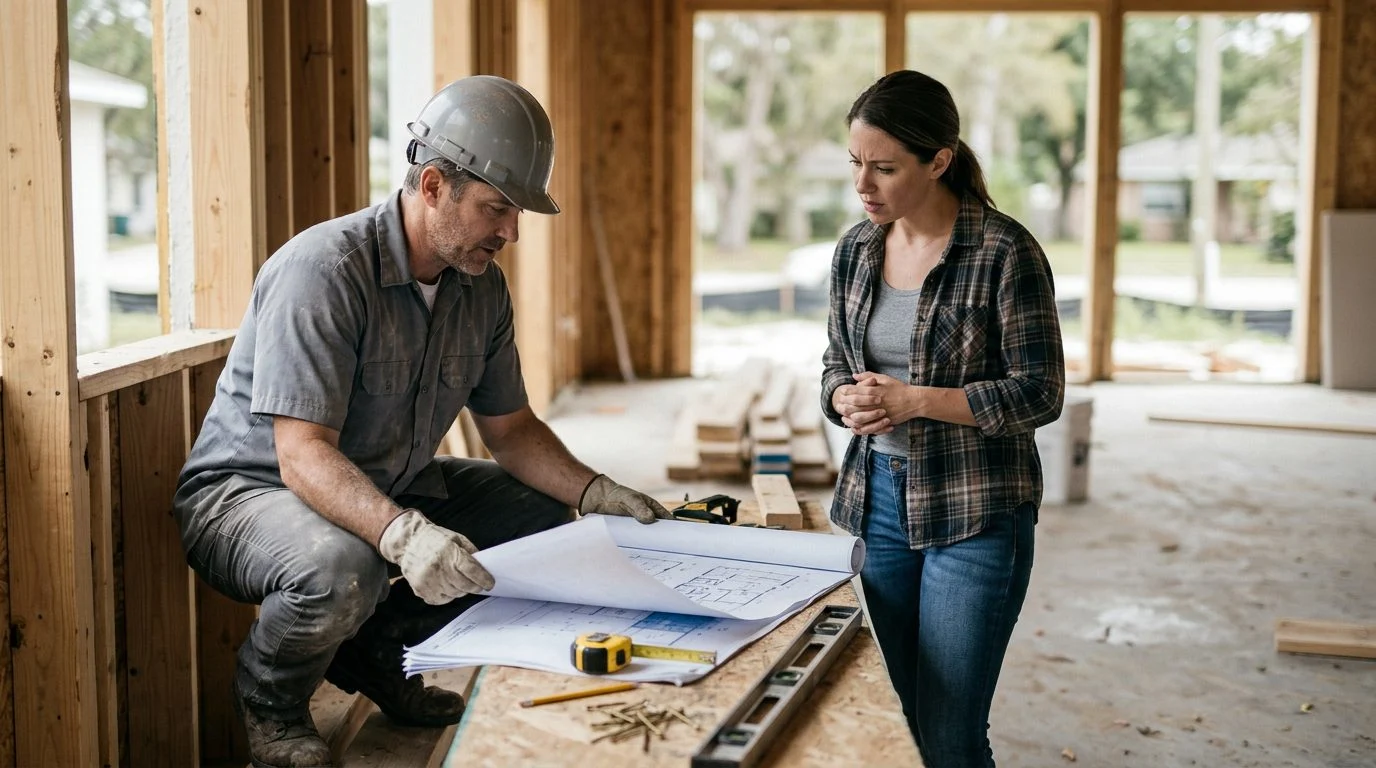
Searching for a contractor dispute attorney Hillsborough County? A contractor dispute attorney helps contractors, subcontractors, and owners resolve fights over payment, changed work, termination, and fraud on a construction job. If you are a contractor or subcontractor, the first question is usually whether you can still enforce the deal in time. Ayala Law PA focuses on construction contract litigation as part of its business litigation practice. The firm works with businesses in Hillsborough County and the Tampa Bay area.
Contractor Dispute Attorney Hillsborough County: What Is Handled on a Construction Job
A contractor dispute attorney represents a party in a fight over a construction agreement, whether the deal was written or made orally. The firm’s construction litigation covers general contractors, trade subcontractors, suppliers, and owners on private projects.
A billing disagreement is usually about an amount. A contract dispute asks what was promised, what the agreement required, and whether it was broken. That difference matters. It decides which claims are available and how fast you must act.
Many disputes start with a missed payment and a short email thread, so the paper trail matters from day one. The work serves businesses in Hillsborough County, including Brandon, Riverview, Plant City, and Temple Terrace, and across the Tampa Bay area. Eduardo A. Maura is the lawyer responsible for the content of this page.
Not sure what your next step is?
Talk it through with our team — we can walk you through how a situation like yours is usually handled and what your options are.
Common Construction Disputes the Firm Handles
The firm handles five common types of construction disputes. Each one turns on the contract, the work performed, and the records that show what happened.
- Unpaid invoices and progress payments: This includes retainage held back until the job closes and payments tied to work the owner calls defective.
- Scope disputes and change orders: The question is whether extra work was in the contract and who approved it.
- Wrongful termination: This covers terminations for cause and whether the contract’s notice terms were followed.
- Construction contract fraud: Examples include misrepresented terms, billing for work not performed, and undisclosed inducements.
- Lien foreclosure: A lien claim on real property can lead to a foreclosure case.
Claim labels matter. One Florida appeals court, the Third District, holds that a party may not recover in tort for a contract dispute unless the tort is independent of any breach of contract. Under the common law principle, a plaintiff may not recover in tort for a contract dispute unless the tort is independent of any breach of contract (Frutafino, S.A.S. v. Dole Chile, S.A.).
How Florida Deadlines and Lien Rules Affect Your Position
Deadlines to sue run from specific dates, so waiting can shorten the time you have. Lien rules and limitation periods can run at the same time, so one job may have several live deadlines.
- Contracts not founded on a written instrument: Under § 95.11(3)(j), a legal or equitable action on a contract, obligation, or liability not founded on a written instrument, including an action for the sale and delivery of goods, wares, and merchandise, and on store accounts, shall be commenced within four years.
- Fraud: An action founded on fraud falls within the four-year group in § 95.11.
Gather these now: the signed contract and amendments, change orders, daily logs, invoices, payment applications, lien waivers, and written messages about payment or scope. How these rules apply depends on the facts of each project.
How a Construction Dispute Moves Forward
Most disputes move from document review to a written demand, then to negotiation, and then to court or arbitration if talks stall.
- Intake: You describe the project, the parties, the contract, and the amount in dispute.
- Document review: The firm reviews the contract, dispute and notice terms, and payment records to identify claims and defenses.
- Demand and negotiation: A written demand or response is often the first formal step.
- Filing or arbitration: If talks stall, the claim may go to a Florida court or to arbitration where the contract requires it.
- Resolution: The matter ends in a settlement, a judgment, or an arbitration award.
Timelines vary by forum and complexity, and they can’t be stated in advance. Document review often shapes the demand, so the early work matters. A common mistake is waiting for a payment promise to materialize while notice deadlines pass without a written response.
Florida Courts and Arbitration: Where Construction Claims Go
A construction claim is filed in a Florida court or in arbitration, and the contract often decides which. Venue, meaning the county where a case is filed, is set by statute.
Under § 47.011 venue rules, actions must be brought only in the county where the defendant resides, where the cause of action accrued, or where the property in litigation is located. This section does not apply to actions against nonresidents. For a Tampa-area project, Hillsborough County may be one of those places.
Arbitration clauses carry weight. Under § 682.02 arbitration enforceability, a written agreement to arbitrate existing or later disputes is valid and enforceable. The exception is a ground that exists to revoke a contract. Fla. Stat. § 682.02 provides: “An agreement contained in a record to submit to arbitration any existing or subsequent controversy arising between the parties to the agreement is valid, enforceable, and irrevocable except upon a ground that exists at law or in equity for the revocation of a contract.”
Read the dispute clause in your contract first. It can set both the forum and the procedure. Bring the project address too, since where the property sits can affect venue.
Why Work with Ayala Law PA on a Construction Dispute
Ayala Law PA focuses on business litigation, and construction litigation is one of its practice areas. The firm handles these practice areas:
- Business litigation and commercial litigation
- Contract disputes and shareholder disputes
- Construction litigation and real estate litigation
- International trade litigation
Our office is at 1646 W Snow Ave in Tampa, Florida, and we represent businesses in Tampa and Hillsborough County. The firm represents businesses in Hillsborough County and the Tampa Bay area. Our lawyers and staff work with business clients on documents, deadlines, and resolution options.
No outcome can be promised in any dispute. If a matter may be referred to another lawyer or firm, the firm will say so.
Not sure what your next step is?
Talk it through with our team — we can walk you through how a situation like yours is usually handled and what your options are.
Questions Contractors and Subcontractors Ask
Most questions come down to whether the deal was in writing and how soon you must act.
Do I need a written contract to get paid?
Not always. Deadlines differ for written and unwritten deals. Under § 95.11(3)(j), a claim on an oral or other unwritten contract, obligation, or liability, including a claim for the sale and delivery of goods, must be filed within 4 years.
Can I sue a property owner as well as a general contractor?
Yes. The firm handles disputes on both sides of a construction project.
Can a contract term be thrown out as unfair?
Florida courts need both procedural and substantive unfairness before refusing to enforce a term (Basulto v. Hialeah Automotive). Both the procedural and substantive aspects of unconscionability must be present, although not necessarily to the same degree. They are evaluated together rather than as separate elements (Basulto v. Hialeah Automotive).
What should I bring to a first conversation?
Bring the contract, change orders, invoices, payment records, lien waivers, and written messages about payment or scope.
Does the firm charge for a case evaluation?
A case evaluation carries a fee. Ayala Law PA explains that fee before you decide to go ahead.
Talk to Ayala Law PA About Your Construction Dispute
If an unpaid balance, a subcontractor who walked off over a payment dispute, or a termination notice that doesn’t match the contract has you stuck, you may have a claim worth reviewing. Call (305) 570-2208 or use the contact form, and bring your contract, invoices, and correspondence. Early review helps you see which deadlines apply.



