
You had a deal, the other side stopped performing, and now you want to know what the claim is worth. No formula sets that number. The amount a breach costs a business depends on the losses it can document and on what the contract says.
This page explains the losses courts look at, the contract terms that change the figure, the deadlines to file, and what the process involves in Florida.
What a Breach of Contract Lawsuit Is and Who It Fits
A breach of contract lawsuit asks a court to make the other side pay for failing to do what its contract required.
A valid contract is an agreement both sides made, with terms they accepted. A breach happens when one side fails to perform a duty it agreed to, and the other side loses money because of it.
This kind of suit often fits business owners and managers facing:
- A vendor or supplier that never delivered, or delivered defective goods
- A customer that owes an unpaid invoice or commercial balance
- A business partner or shareholder who broke an operating or buy-sell agreement
- A contractor or subcontractor left unpaid, or an owner who stopped paying on a construction job in Hillsborough County
Two questions decide whether you have a claim. What did the contract require? Can you prove the loss?
If a company walked away from its contract and left your business short, you may have a claim worth reviewing, and our team can go through the paperwork with you at (305) 570-2208. Talk it through with our team — we can walk you through how a situation like yours is usually handled and what your options are.
What You Can Recover: Direct, Consequential and Incidental Losses
Each claim turns on the losses the breach caused and the evidence available to show them.
- Direct losses: the losses that arise most immediately from the breach itself.
- Consequential losses: losses that go beyond the immediate harm of the breach, such as profit lost on a specific job.
- Incidental costs: expenses a business may incur in response to a breach, such as hiring a replacement vendor or paying to repair defective work.
Interest can add to the total.
A contract claim is about money lost under the deal. It is not a personal injury claim.
Paper proves the number. Keep the signed contract, invoices, change orders, payment records, emails and cost comparisons. An estimate with no records behind it is harder to prove.
Contract Terms That Change the Number
Your contract’s own wording can raise, limit or shift what you can recover.
- Prevailing-party fee clauses. If the contract lets a party recover attorney’s fees when it must act to enforce the contract, a court may award reasonable fees to the other side when it prevails, whether it sued or was sued (§ 57.105(7)). This applies only to contracts entered into on or after October 1, 1988. The clause runs both ways.
- Shortened deadlines. A clause that sets a shorter time to sue than the statute allows is void (§ 95.03).
- Liquidated damages. Some contracts set a fixed sum for a specific breach, such as project delay. Whether that sum holds up turns on the contract wording.
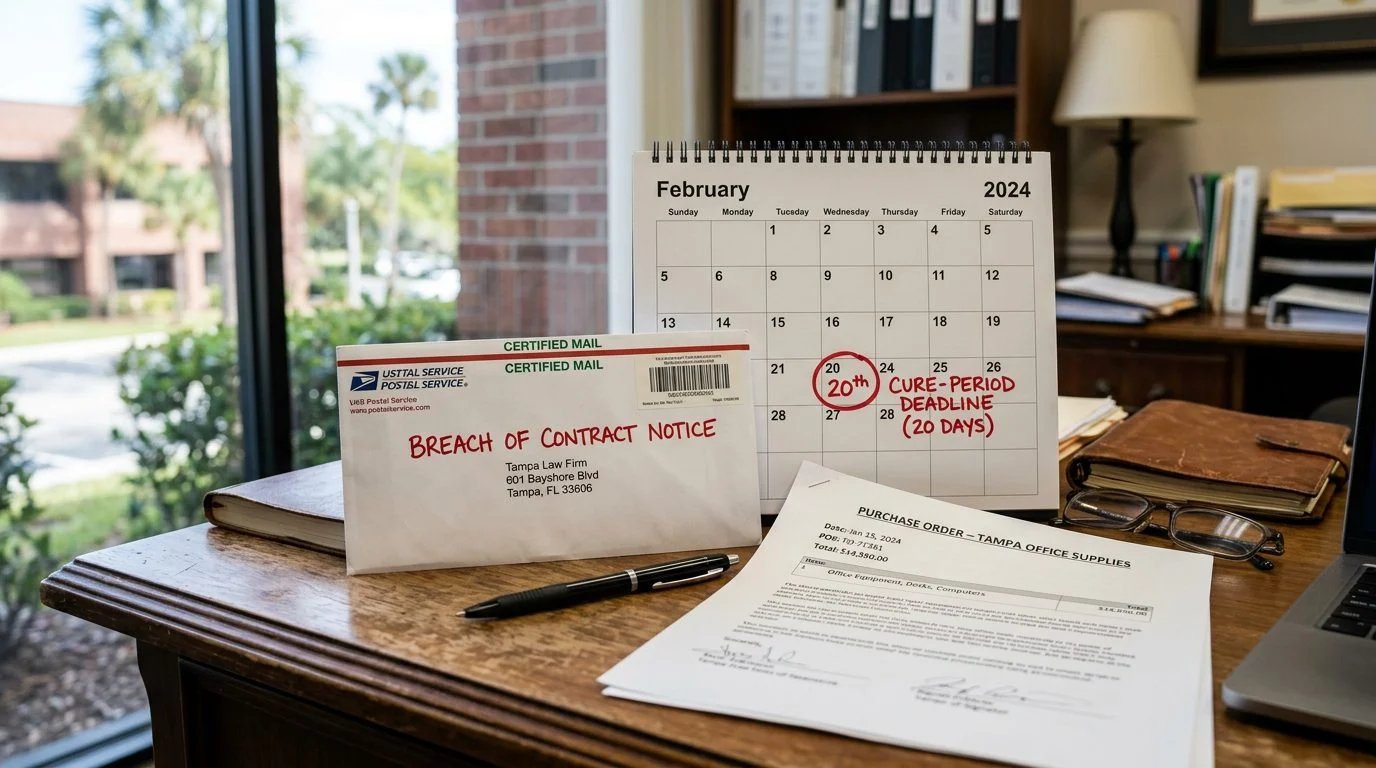
- Notice and cure steps. Many contracts require written notice and time to fix the problem before suit. Skipping those steps can weaken a claim.
- Goods you accepted. A buyer who accepted goods must notify the seller of a breach within a reasonable time after discovering or should have discovered it, or risk losing the remedy (§ 672.607).
If the dispute is about unpaid invoices, read our business collection lawsuit guide.
Which Court Hears It and How Long You Have to File
Florida law gives a party 4 years to bring an action on an oral or unwritten contract, including one for the sale and delivery of goods, under Fla. Stat. § 95.11(3)(j). When a filing deadline begins to run in a particular dispute can depend on its facts, so it helps to review the applicable rules in Florida Statutes chapter 95 early.
Under Fla. Stat. § 95.11, an action on a judgment or decree of a Florida court of record is subject to a twenty-year period. Exceptions turn on the facts, so don’t wait to get the dates checked.
Florida law also limits where you can file. Florida law requires a suit to be brought only in the county where the defendant resides, where the claim arose, or where the property is located, though this rule does not apply to actions against nonresidents (§ 47.011). For many Tampa Bay disputes, that means Hillsborough County. Your claim amount and the complexity of the dispute also shape where the case belongs.
Costs That Reduce What You Keep
Litigation costs come out of pocket as the case moves, and they can cut into any recovery.
- Filing and service fees charged by the court and the person who delivers the papers.
- Discovery: depositions, court reporter fees, records subpoenas and document vendors.
- Valuation witnesses: accountants or industry professionals who testify about lost profits or repair costs, and their fees.
- Mediation. On request, a court must refer most damages cases to mediation, provided the requesting party is willing and able to pay the costs or the costs can be equitably divided between the parties, unless an exception applies, such as a suit to collect a debt (§ 44.102).
- Settlement offers. If you do not accept a defendant’s offer within 30 days and the judgment you win is at least 25 percent less than that offer, you may owe the defendant’s costs and fees from the offer date (§ 768.79).
Compare the amount you can prove with the cost to pursue it.
How Our Team Evaluates a Breach of Contract Claim
A review starts with your documents. The next steps are options, not a promised result.
- Send the paperwork. Share the contract, invoices, notices and a short timeline of the breach.
- Review the terms. We check fee clauses, notice requirements, interest terms and the deadline to sue.
- Measure the losses. We identify which losses you can prove, which court fits, and the likely cost range.
- Choose a path. Options include a demand letter, negotiated settlement, mediation or filing suit.
- Decide. You choose the next step. Outcomes turn on the evidence and the court, and no result can be promised.
Pre-suit steps can move quickly. Court timing follows the court’s calendar, so plan for delays.
Not sure what your next step is?
Talk it through with our team — we can walk you through how a situation like yours is usually handled and what your options are.
Why Work With Ayala Law PA on a Tampa Bay Contract Dispute
Ayala Law PA focuses on business litigation in Florida courts and arbitration. Its work covers commercial litigation, contract disputes, shareholder disputes, construction litigation, real estate litigation and international trade litigation.
The firm serves businesses in Tampa, Hillsborough County, Brandon, Riverview, Plant City, Temple Terrace and the wider Tampa Bay area. The firm’s only office is at 1646 W Snow Ave in Tampa, Florida. Businesses in Tampa and Hillsborough County can contact the firm to discuss a matter.
Eduardo A. Maura is the lawyer responsible for this page. Our team includes assistants and office staff who support our lawyers’ work.
Frequently Asked Questions
How much can you sue a company for breach of contract in Tampa?
There is no set formula. The amount a business seeks depends on the losses it can document and on what the contract provides.
Can you sue for pain and suffering?
A contract claim is about money lost under the deal. It is not a personal injury claim.
How long do you have to sue?
Under Fla. Stat. § 95.11, different contract-based actions fall under different time limits, such as one year for an action for specific performance of a contract.
Can you sue someone 25 years later?
Generally not. Older claims are usually barred, and exceptions turn on the facts.
Where do you file a breach of contract suit?
Generally in the county where the defendant lives, where the claim arose, or where the property is located.
Can you get your attorney fees back?
Only if the contract has a fee clause or a statute applies, and the court decides any award.
Does the case go to mediation first?
If one party asks, a court must refer most damages cases to mediation, unless an exception applies.
If a company stopped paying or delivering under your contract, you may have a claim worth reviewing. Call Ayala Law PA at (305) 570-2208 or request a case evaluation to start.



