
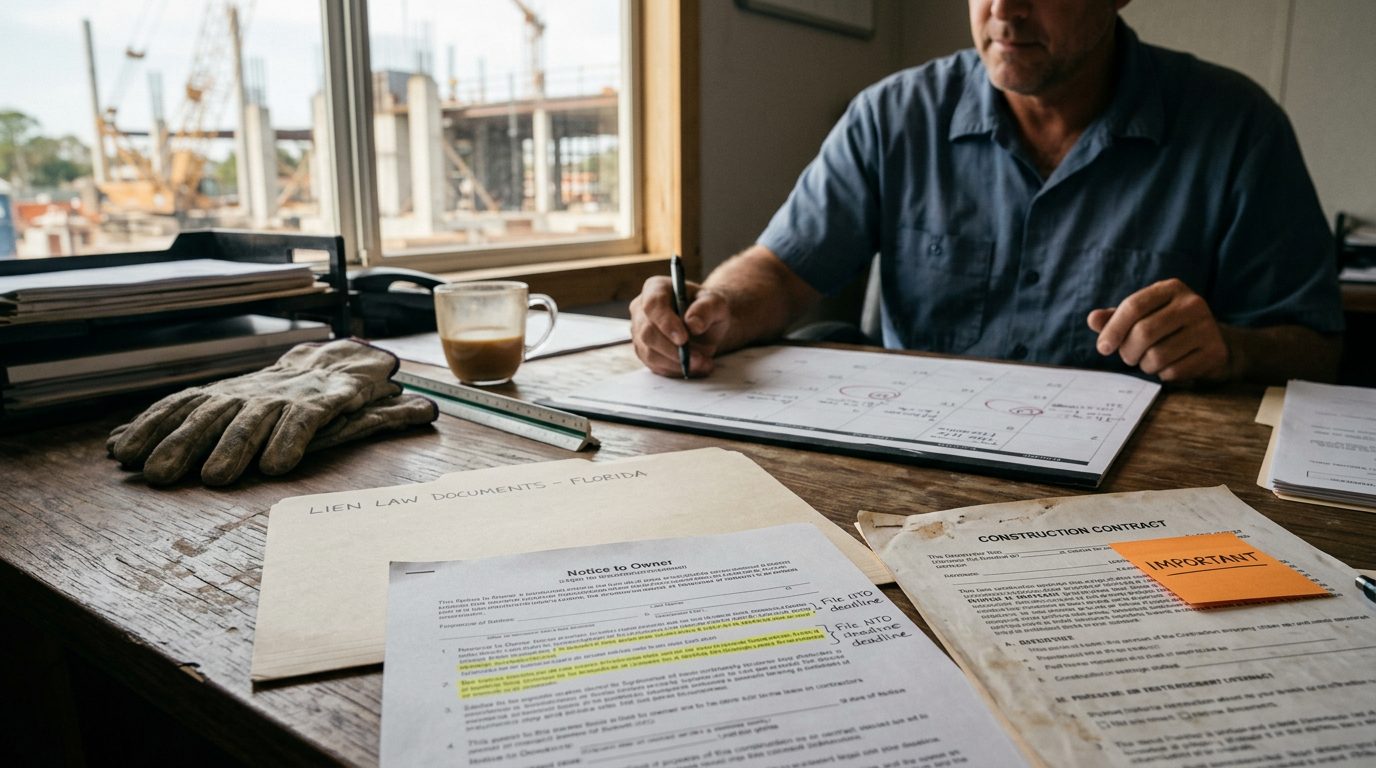
Florida contractors who go unpaid often start with one question: what are the lien rights of contractors in Florida? Construction liens are a topic that can matter to owners, contractors and suppliers on a construction project. The process comes with notices, recording steps and deadlines, and a missed step can weaken a claim. This page walks through that sequence in plain language. It is general information, not legal advice about your project.
The short answer: who can claim a construction lien in Florida
Contractors, subcontractors and suppliers on building and land projects often have questions about getting paid for their work.
Those rules reach people at different levels of a project. A general contractor usually signed the contract with the owner. A subcontractor or supplier usually dealt with the contractor instead. Each level has its own steps and timing, so the first question is always who you contracted with and what you supplied.
The process runs in a rough order. First come notices and public filings. Next, a claim of lien is recorded. If the debt stays unpaid, enforcement may follow through a foreclosure lawsuit. Each stage has its own clock, so the dates on your calendar matter.
If an unpaid project has you holding a lien notice or a deadline you can't place, our team is ready to talk through the dates and paperwork with you. Talk it through with our team — we can walk you through how a situation like yours is usually handled and what your options are.
Direct contractors versus subcontractors and suppliers
A direct contractor generally has the most direct path to a lien, because it signed with the owner. Subcontractors and suppliers usually have more steps to take to protect their rights.
The chain of contracts matters for another reason. It shows who must send notices and to whom. A supplier who sold materials to a subcontractor stands in a different position than the contractor who hired that subcontractor.
Owners should know that paying the general contractor does not always end their exposure. Lower-tier parties who were never paid may still look to the property. Owners who ask for proof of payment to subs and suppliers can spot problems earlier.
Not every unpaid job involves a lien. Florida’s Third District Court of Appeal has applied the rule that when an express contract covers the same subject, a claim for unjust enrichment will not support recovery (Williams v. Johnson). Where an oral deal needs a signed writing, promissory estoppel cannot be used to enforce it (DK Arena, Inc. v. EB Acquisitions I, LLC). Those points shape which claims remain open.
Notices and filings that come before the lien
Florida’s lien process starts before a lien is ever recorded. Notices and public filings tell owners and other parties who is working on the project and what rights may follow.
One early filing is a notice recorded in the public records before work begins. It identifies the project, the owner and the contractor. Others in the chain use it as a reference point when they track their own timing.
Missed or defective notices can put a lien at risk. The exact requirements depend on your position in the project and the facts of the job. Keep copies of every notice, with the date it was sent and how it was delivered. Those records are often the first thing a court or opposing party will ask for.
Notice to the owner: the early warning for subcontractors and suppliers
A notice to the owner is an early written warning that unpaid work is underway and that a lien may follow. It gives the owner a chance to see the problem before a lien is recorded.
Starting the count from the wrong day can throw off the whole timeline.
It is a separate step with its own role. Owners who receive one should treat it as a signal that a claim may be coming, not as routine paperwork.
Recording a claim of lien and its deadline
Recording has its own deadline. The clock is tied to when your work or deliveries ended, not when you sent the final invoice. Counting from the wrong date can leave a claim unprotected, so the final date on your job log is central.
Missing details can give an opposing party a basis to challenge the lien.
Because these deadlines run from specific dates, an early review of the timeline helps. Pulling the contract, change orders, delivery records and notices into one file makes that review faster.
Enforcing the lien through a foreclosure lawsuit
A lien is enforced by filing a lawsuit to foreclose it, and that lawsuit has its own filing window. Missing that window can end enforcement even when the debt is real.
Florida’s general rule for timing is that the clock runs from when a cause of action accrues. Under Fla. Stat. § 95.031, a cause of action accrues when its last element occurs.
If a court enters a judgment, collection follows its own procedures.
Not sure what your next step is?
Talk it through with our team — we can walk you through how a situation like yours is usually handled and what your options are.
Limits, defenses and bonds that can affect a lien
Owners and other parties have several ways to challenge a lien or limit its effect. Knowing those options early helps shape the response.
Some owners look at bonding off a lien, which takes the claim off the property and places it on a bond instead. This is a technical step with its own requirements, so it should be reviewed against the specific claim.
Common defenses include disputes over the quality of the work, the amount owed, or whether the claimant actually furnished the labor or materials. Each defense turns on the records, so the paperwork on both sides matters.
Contract terms can also be tested. Florida’s Supreme Court has said a court will refuse to enforce a term as unconscionable only when both procedural and substantive unfairness are present, weighed together (Basulto v. Hialeah Automotive). That case involved an arbitration agreement, but the same general contract principles apply.

Related disputes that often come up with liens
A lien dispute often overlaps with a broader contract or fraud claim. Florida’s Third District has held that a party generally cannot recover in tort for a contract dispute unless the tort is independent of the breach (Frutafino v. Dole Chile). That rule can limit which claims move forward.
Fraud claims follow their own rules. The same Frutafino decision recognized that a promise of future action can support a fraud claim if the promisor never intended to perform. Florida’s Supreme Court has also said justifiable reliance is not a necessary element of fraudulent misrepresentation (Butler v. Yusem).
Dated records supply the facts these claims depend on. Keep contracts, change orders, invoices, notices and recorded documents together, in date order.
Talking through your project with our team
Our firm focuses on business litigation and construction litigation. That includes contractor and subcontractor disputes, lien foreclosure and construction contract fraud, in Florida courts and arbitration. Eduardo A. Maura is the responsible lawyer for this page.
The firm’s office is at 1646 W Snow Ave in Tampa, and it represents businesses in Tampa and Hillsborough County from that office. Fees are discussed before any engagement.
If a lien notice, an unpaid invoice or a deadline you can’t place has you working through these steps, call (305) 570-2208 or reach out through our contact page. Describe the project and the dates involved, and we can talk through what comes next.
What are the lien rights of contractors in Florida?
Contractors, subcontractors and suppliers who improved a property can generally pursue payment through a construction lien. The lien is subject to notice, recording and enforcement steps.
Is a construction lien the same as a judgment lien?
A judgment lien comes after a court enters a judgment and is handled through clerk procedures.
How long do I have to start a lien lawsuit?
Florida’s general limitations statute, § 95.031, generally starts the clock when the cause of action accrues, but that statute expressly yields to other provisions, and lien-foreclosure deadlines may be set elsewhere, so the deadline for your specific claim should be confirmed promptly by contacting our office. Timing questions should be reviewed against the actual dates.
Can a fraud claim come up in a construction contract dispute?
Yes. Fraud claims can appear in construction contract disputes, but a tort claim must be independent of the contract breach to move forward.



