
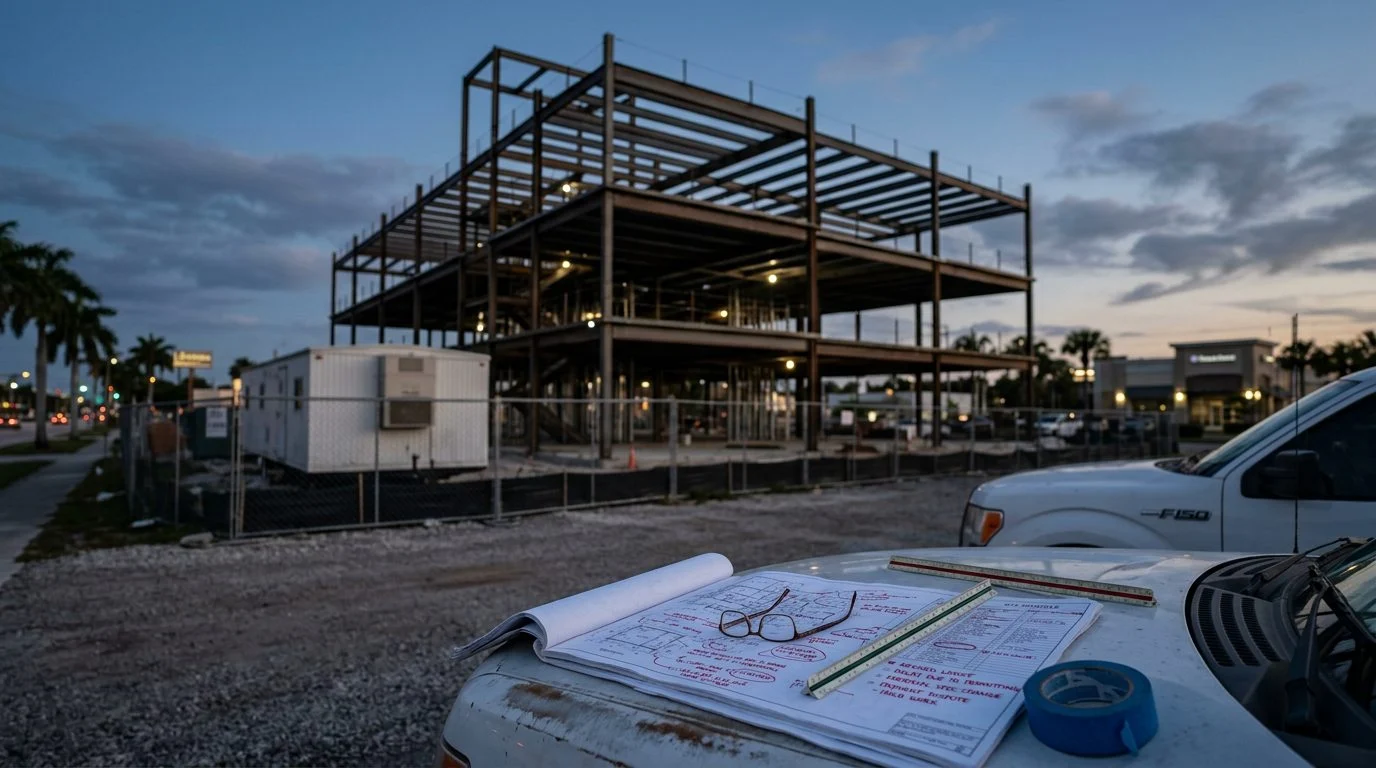
This guide covers Florida construction payment defect case outcomes in plain terms. It explains how these disputes usually end, what damages can come up, and where lien releases and settlements fit in. It is general information for contractors, subcontractors, suppliers, and property owners.
What outcomes do Florida construction payment and defect cases typically produce, including damages, settlements, and lien releases?
Most Florida construction payment and defect disputes end in one of five ways. The usual endings are a negotiated payment or repair plan, a settlement, a lien release, a court judgment, or a dismissal. Which path applies turns on the contract, the paperwork, and how far the dispute has moved.
- Negotiated payment or repair plan. The parties agree on an amount or on specific fixes, often on a schedule.
- Settlement. A written agreement resolves the claims, sometimes with payments over time.
- Lien release. A recorded document removes a claim of lien from the property.
- Judgment. A court orders money or other relief. A money judgment can become a lien on real property once a certified copy is recorded in that county, under Fla. Stat. § 55.10, but only if the judgment contains the address of the person who has the lien or an affidavit with that address is recorded at the same time.
- Dismissal. The claim ends without a payment, such as when a party withdraws it.
No single fact pattern decides the result. Each matter turns on its own documents and records. This page does not promise or predict any outcome.
If an unpaid invoice or a lien on your property has you weighing your options, reach out and we can walk through your records with you. Talk it through with our team — we can walk you through how a situation like yours is usually handled and what your options are.
How does the type of claim shape the likely result?
Payment claims and defect claims follow different paths, so the type of claim shapes the early steps. They often involve unpaid balances, change orders, retainage, and subcontractor or supplier invoices.
Defect claims usually center on the contract’s specifications, the inspection and repair history, and reports from a third-party inspector. The remedy may be a repair, a replacement, the cost to finish the work, or money damages.
Timing rules matter for both. Fla. Stat. § 95.11 lists, among the actions to be commenced within four years, an action founded on the design, planning, or construction of an improvement to real property. The time runs from the earliest of these dates: when the authority having jurisdiction issues a temporary certificate of occupancy, a certificate of occupancy, or a certificate of completion, or when construction is abandoned if not completed. In any event, the action must be commenced within 7 years after that same date, although counterclaims, cross-claims, and third-party claims arising from the same conduct, transaction, or occurrence may be brought up to 1 year after the related pleading is served, even if they would otherwise be time barred. When the action involves a latent defect, the 4-year period runs from when the defect is discovered or should have been discovered with the exercise of due diligence. The four-year period runs from the earliest certificate or abandonment date, unless the action involves a latent defect, in which case it runs from when the defect is discovered or should have been discovered with due diligence. For work performed under a duly issued building permit and covered by a temporary certificate of occupancy, a certificate of occupancy, or a certificate of completion, repairs do not extend that period.
What damages can a Florida construction dispute involve?
Damages in Florida construction disputes usually aim to cover the money lost from the payment problem or the defect. Common categories include the unpaid contract balance, the cost to correct or finish defective work, delay-related costs, and interest.
Interest follows a set rate unless a contract sets one. The Chief Financial Officer sets the statutory rate each quarter, but the rate on a judgment is established when the judgment is obtained and adjusted annually on January 1, except for certain judgments entered by the clerk of the court under ss. 55.141, 61.14, 938.29, and 938.30, which are not adjusted annually. Under Fla. Stat. § 55.03, nothing in that statute affects a rate set by written contract.
Attorney’s fees often surprise people. Under Florida’s American Rule, each party generally bears its own attorneys’ fees unless a contract or statute provides otherwise. A contract fee clause can change that.
Damages are proven with invoices, change orders, daily logs, photos, and correspondence. Missing records can limit what a party can prove.
How do settlements and lien releases fit into how these cases end?
Many construction payment disputes end with a written settlement. The settlement sets the amount, the payment schedule, and what happens to any recorded lien.
A lien release is a recorded document that removes a claim of lien from the property. It usually follows payment or an agreed resolution. Confirm who will record it and when.
Foreclosure has its own procedures and deadlines.
Before signing any release, read its terms carefully and contact our office with questions about what it covers. Read the release language closely before you sign. Mediation talks are generally confidential, but a signed written agreement reached in mediation generally is not confidential unless the parties agree otherwise.
What affects how long a construction dispute takes and where it ends up?
Timing usually turns on the deadlines in play, the complexity of the defects, the number of parties, and whether the parties mediate or arbitrate. The answer depends on the facts of each project and contract, so no timeline is promised here.
Mediation is often part of the path. On request, a court must refer most filed civil actions for money damages to mediation, provided the requesting party is willing and able to pay the costs of the mediation or the costs can be equitably divided between the parties, subject to listed exceptions, under Fla. Stat. § 44.102. Fla. Stat. § 44.102 reads: “(2) A court, under rules adopted by the Supreme Court: (a) Must, upon request of one party, refer to mediation any filed civil action for monetary damages, provided the requesting party is willing and able to pay the costs of the mediation or the costs can be equitably divided between the parties, unless: 1.” A written arbitration agreement can also shape where a dispute goes. Under Fla. Stat. § 682.02, such an agreement is generally enforceable, and the court decides whether one exists.
Early steps help. Keep the contract, change orders, and payment records together. Calendar every notice and lien deadline as soon as a problem appears.
Frequently asked questions
What are typical Florida construction payment defect case outcomes?
Most end in a payment or repair plan, a settlement, a lien release, a judgment, or a dismissal. Each case turns on its own records.
Who pays attorney’s fees in a Florida construction dispute?
Each side generally pays its own, unless a contract or statute says otherwise.
Is a mediated settlement confidential?
Mediation talks are generally confidential, but a signed written agreement reached in mediation generally is not.

Talking through a construction payment or defect situation with Ayala Law PA
If you’re a contractor waiting on an overdue payment, an owner facing a lien on your property, or a partner dealing with work that doesn’t match the contract, the decision in front of you can feel urgent. Ayala Law PA focuses on construction litigation, including contractor and subcontractor disputes, lien foreclosure, and construction contract fraud. The firm also handles commercial and contract disputes for businesses in Tampa, Hillsborough County, and the Tampa Bay area.
Eduardo A. Maura is the responsible lawyer for this page. The firm’s only office is at 1646 W Snow Ave in Tampa, Florida, and the firm represents businesses in Tampa and Hillsborough County.
Consultations carry a fee, and the firm explains its fee arrangement before any engagement.
If an unpaid invoice or a lien has you weighing your next steps, call (305) 570-2208 or use the contact page to request a case evaluation and talk through your records.



