
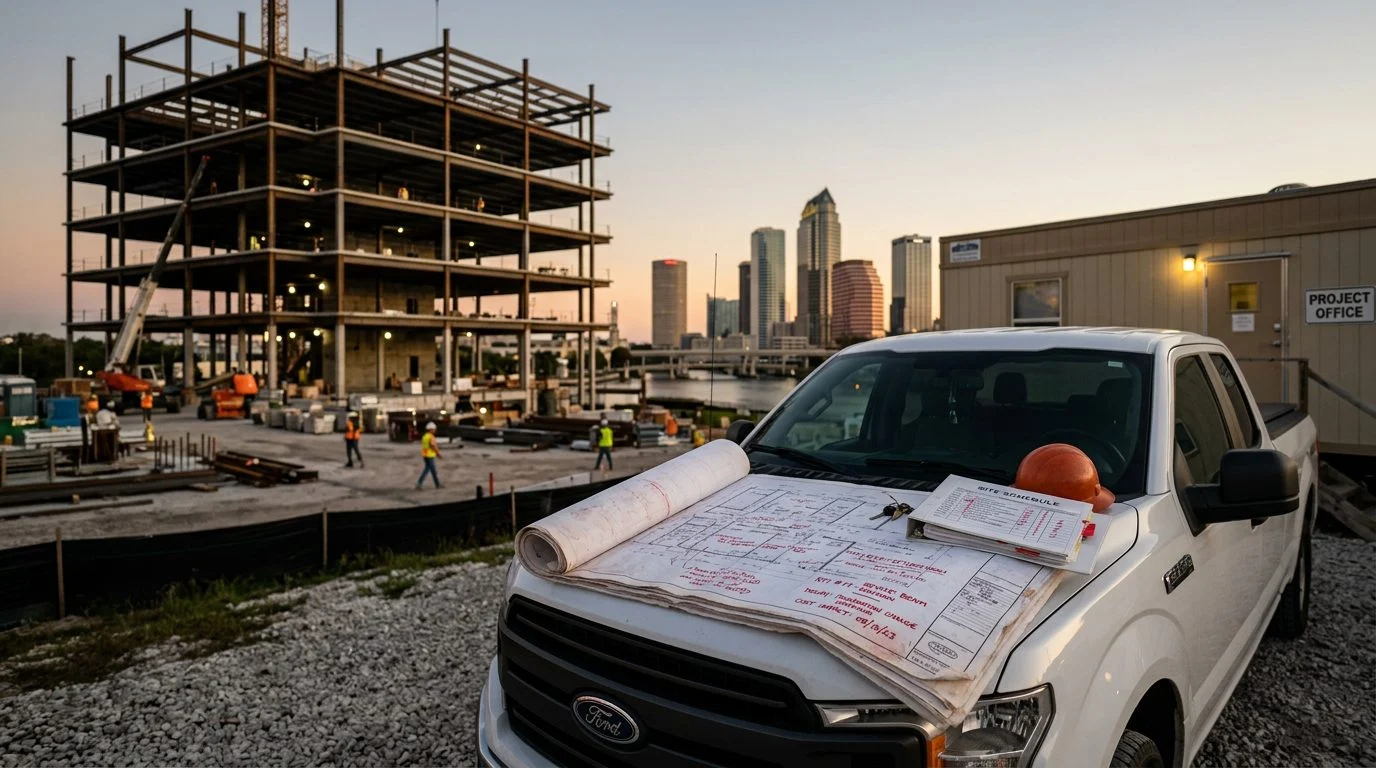
How much does construction litigation cost for business in Tampa, Florida? There’s no single number. The cost depends on the type of dispute, how far it goes, and whether it lands in court or arbitration. This guide covers the factors that drive spending so you can plan before you decide on a lawyer.
Why a Clear Cost Answer Depends on Your Dispute
A clear cost answer starts with the kind of dispute you have. Construction disputes take different paths, and each path has its own steps and workload.
A contractor may be chasing an unpaid invoice. A subcontractor may be filing a construction lien to get paid. An owner may claim a builder committed fraud under a construction contract. Each one moves through different filings, deadlines, and proof.
A simple payment claim may stay narrow. A lien foreclosure or fraud claim usually needs more records and more time. Costs follow the work, so ask what steps your case will need.
If a payment dispute or a lien notice has your project stalled, our team is ready to talk through your matter with you. Talk it through with our team — we can walk you through how a situation like yours is usually handled and what your options are.
Core Cost Drivers in Construction Litigation
The biggest cost drivers are the amount in dispute, the number of parties, the volume of records, and the technical witnesses a case needs.
- Amount and type of claim. Is the dispute about payment, damages, or both? The answer shapes how much proof the case needs.
- Number of parties. Owners, general contractors, subcontractors, suppliers, sureties, and lenders may each need to be part of the case.
- Records. Change orders, daily logs, schedules, invoices, and emails must be gathered. During discovery (the exchange of information between parties), each side reviews them.
- Technical witnesses. Scheduling analysts, cost estimators, or engineers can help explain delays or pricing. Their time adds to the total.
A dispute over one invoice between two companies is usually narrower than a delay claim that spans many companies and a long project schedule.
How Florida Deadlines and Fee Rules Affect Cost
In Florida, each side usually pays its own lawyer unless a contract or statute says otherwise. Deadlines and fee clauses can change the total quickly.
The Florida Supreme Court in Price v. Tyler explained that each party generally bears its own attorneys’ fees. Many construction contracts include a prevailing-party fee clause. Under § 57.105, if a contract lets one party recover fees for enforcing it, a court may also allow fees to the other side when that side wins. The wording of your contract matters.
Fee exposure can also come from weak claims. Under § 57.105, a court may award a reasonable attorney’s fee, to be paid in equal amounts by the losing party and the losing party’s attorney, when the court finds the losing party or its attorney knew or should have known that a claim or defense was not supported by the material facts necessary to establish it, or would not be supported by then-existing law applied to those facts. The statute also limits when monetary sanctions may be awarded, including where a claim was initially presented as a good faith argument for extending, modifying, or reversing existing law. That is one reason to test a claim early.
Deadlines matter too. Filing deadlines for these claims depend on the type of claim and the facts involved, so timing should be reviewed early.
Court Litigation Versus Arbitration and Mediation
Court and arbitration cost different amounts because they follow different procedures. The contract often decides which one applies.
Where a case is filed also matters. Under § 47.011, actions must be brought in the county where the defendant resides, where the cause of action accrued, or where the property in litigation is located, but this section does not apply to actions against nonresidents. The facts of your project decide which county fits.
If a contract requires arbitration, Florida generally enforces it. Under § 682.02, a written agreement to arbitrate disputes is valid, enforceable, and irrevocable except upon a ground that exists at law or in equity for the revocation of a contract. Under § 682.03, a court may not refuse arbitration just because the claim lacks merit. The related court case is paused while the court decides that motion.
Mediation can also come into play. Under § 44.102, a court must refer most filed damages cases to mediation on one party’s request, provided the requesting party is willing and able to pay the costs of the mediation or the costs can be equitably divided between the parties. Fla. Stat. § 44.102 reads: “(2) A court, under rules adopted by the Supreme Court: (a) Must, upon request of one party, refer to mediation any filed civil action for monetary damages, provided the requesting party is willing and able to pay the costs of the mediation or the costs can be equitably divided between the parties, unless: 1.” Fla. Stat. § 44.102 provides that, under rules adopted by the Supreme Court, a court must send a filed civil action for monetary damages to mediation when one party asks for it, as long as that party is willing and able to pay the mediation costs or those costs can be equitably divided between the parties. Fla. Stat. § 44.102 reads: “(2) A court, under rules adopted by the Supreme Court: (a) Must, upon request of one party, refer to mediation any filed civil action for monetary damages, provided the requesting party is willing and able to pay the costs of the mediation or the costs can be equitably divided between the parties, unless: 1.” The statute lists exceptions, including actions filed to collect a debt and cases in which the parties have agreed to binding arbitration. Mediation communications are generally confidential under § 44.405.
Early resolution can cut the workload. A case that goes to trial or appeal generally takes more time and money.
How Costs Are Typically Structured and Discussed
Fee arrangements vary, and the terms should be in writing before work begins.
Ask for a written description of the scope, the phases of work, and the costs you may owe beyond attorney time. Those can include filing fees, deposition transcripts, and consultant charges. Ask how each item is billed.
Readers researching settlement offers may come across § 45.061, a Florida statute under which a written offer stays open for 45 days unless it is withdrawn sooner in writing. Subsection (6), however, states that the section “does not apply to causes of action that accrue after the effective date of this act.” By its own terms, the section does not govern a cause of action that accrued after that effective date, so it should not be assumed to apply to a current construction dispute. Fla. Stat. § 45.061 reads: “The offer shall remain open for 45 days unless withdrawn sooner by a writing served on the offeree prior to acceptance by the offeree.” In civil damages actions, § 768.79 sets similar cost rules for offers of judgment.
Ayala Law PA does not offer a free consultation. Ask about fees in writing before you commit to any work.
Talking Through Your Situation With Ayala Law PA
A payment dispute, a lien notice, or a stalled project often lands on a business owner or office manager at a hard moment. You may be the one deciding what happens next.
Ayala Law PA focuses on business litigation, including construction and contract disputes in Florida courts and arbitration. Eduardo A. Maura is the responsible lawyer for this page. Our only office is at 1646 W Snow Ave, Tampa, FL.
Useful records for an early conversation include the contract and any fee clause, the payment history and invoices, lien notices or demands, key correspondence, and the project timeline.
Frequently asked questions
Who pays attorney’s fees in a Florida construction dispute?
Usually each side pays its own, unless a contract or statute says otherwise.
How long do I have to sue over construction work?
Can a contract shorten the time to sue?
No. Under § 95.03, a contract clause that sets a shorter period than the statute is void.
If your project is on hold over payment or a lien, you don’t have to sort out the next steps alone. Call Ayala Law PA at (305) 570-2208 or use the contact form to talk through your matter.



