
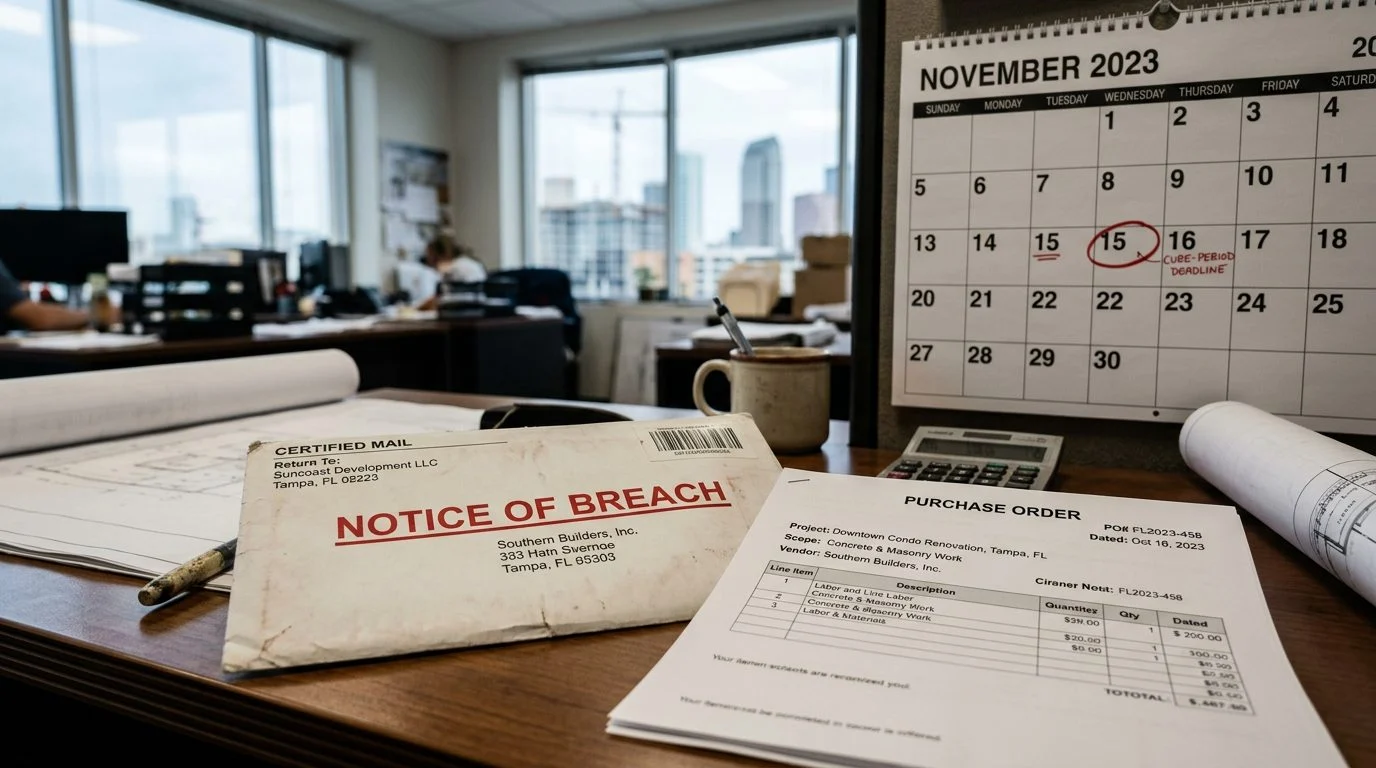
What are the four types of construction contracts?
What are the four types of construction contracts? The four common types are fixed price (lump sum), cost-plus, unit price, and time and materials. The type mainly decides who pays when costs rise, quantities grow, or the job runs late.
Many contracts mix types. One project may pay a fixed price for some work and hourly rates for repairs. The signed document controls, so read how it pays for each part of the job.
You may also see JCT or NEC forms. Those are standard contracts from the United Kingdom. This guide covers the four pricing types that owners and contractors use in Florida projects.
Not sure what your next step is?
Talk it through with our team — we can walk you through how a situation like yours is usually handled and what your options are.
Fixed price (lump sum) contracts
A fixed price contract sets one total price for a defined scope of work. The contractor agrees to finish the listed work for that amount. The contractor takes on the risk of cost overruns, and the owner gets a known total.
Disputes usually start with scope. The parties disagree about whether an item is included or is extra work. A change order is a written change to the scope, price, or schedule. If no one signs one, the contractor may claim more money, and the owner may refuse to pay.
Detailed plans, specifications, and a written change order process reduce that gap. Written terms also matter when extra costs come up. Florida appellate courts have said that when an express contract covers the same subject matter, a claim arising from that contract will not support unjust enrichment (Williams v. Johnson). In plain terms, a written contract often controls the extra-payment fight.
Cost-plus contracts
A cost-plus contract pays the contractor its actual allowable costs plus a fee. The fee may be a fixed amount or a percentage of costs. This type moves the cost risk to the owner, because the final price follows what the work actually costs.
The contract should define what counts as a reimbursable cost. Labor, materials, and equipment rental are common examples, but the list belongs in writing. A variation sets a maximum price cap, often called GMP, on total cost. Savings or overruns are then shared under the contract terms.
Disputes often center on paperwork. Owners ask for invoices, payroll records, and audit rights. Contractors may add overhead and markup the owner did not expect. Both sides argue about whether costs were reasonable and properly charged. Agree on record-keeping and audit terms before work starts.
Unit price contracts
A unit price contract pays a set rate for each unit of work. A unit might be a cubic yard of concrete, a linear foot of pipe, or a ton of material placed. The final price depends on measured quantities, so the owner pays for what is actually installed.
This type fits work where quantities are uncertain at the start, such as excavation or paving. The contract still needs clear rules. Disputes often ask how quantities are measured, who checks them, and what counts as one unit. A measuring method and a sign-off step answer those questions early.
Time and materials contracts
A time and materials contract pays for labor hours at agreed hourly rates, plus the cost of materials. Materials may carry a markup. The total is not fixed in advance, so the owner carries more of the cost and schedule risk.
Typical disputes involve timekeeping, rate disagreements, overtime nobody approved, and materials billed without receipts. Daily or weekly reports help both sides track hours and costs. Written approval before added work starts prevents many later arguments.
What should a construction contract include?
A construction contract needs an offer, an acceptance, payment, and enough detail on the essential terms. The Florida Supreme Court applies these basic requirements to oral contracts too. St. Joe Corp. v. McIver states that rule. Written records can help clarify what the parties agreed to, and that is one reason businesses often put deal terms in writing.
A written contract should cover more than the price. Include the scope, schedule, payment terms, schedule of values, change order steps, insurance, and how disputes will be resolved. Each item removes a common argument.
Payment terms matter most for liens. Construction lien matters often turn on notice and timing, so the specifics of each project and each deadline deserve early review. Payment dates in the contract should line up with those steps.
Not sure what your next step is?
Talk it through with our team — we can walk you through how a situation like yours is usually handled and what your options are.
When does a construction contract become a dispute?
A construction contract becomes a dispute when the parties disagree about what was agreed, what work was done, or what is owed. Common triggers include an unpaid invoice, a disputed change order, a lien claim, a contractor who leaves the job, or a contract you are asked to sign.
Deadlines start running early. Under Fla. Stat. § 95.11, an action founded on the design, planning, or construction of an improvement to real property must be commenced within four years, with the time running from the date the authority having jurisdiction issues a temporary certificate of occupancy, a certificate of occupancy, or a certificate of completion, or the date of abandonment of construction if not completed, whichever date is earliest; when the action involves a latent defect, the time runs from when the defect is discovered or should have been discovered with the exercise of due diligence, and in any event the action must be commenced within 7 years after the date the authority having jurisdiction issues such a certificate or the date of abandonment, whichever date is earliest. Fla. Stat. § 95.11 reads: “(b) An action founded on the design, planning, or construction of an improvement to real property, with the time running from the date the authority having jurisdiction issues a temporary certificate of occupancy, a certificate of occupancy, or a certificate of completion, or the date of abandonment of construction if not completed, whichever date is earliest; except that, when the action involves a latent defect, the time runs from the time the defect is discovered or should have been discovered with the exercise of due diligence.” Exceptions apply, including for latent defects. A contract clause that sets a shorter deadline is void under Fla. Stat. § 95.03.
Some contracts require arbitration. Under Fla. Stat. § 682.02, a written agreement to arbitrate is valid, enforceable, and irrevocable, except on grounds that exist to revoke any contract. When a damages case is filed, a court must, on one party’s request, refer it to mediation in most cases, provided the requesting party is willing and able to pay the costs of the mediation or the costs can be equitably divided between the parties, under Fla. Stat. § 44.102. Fla. Stat. § 44.102 reads: “(2) A court, under rules adopted by the Supreme Court: (a) Must, upon request of one party, refer to mediation any filed civil action for monetary damages, provided the requesting party is willing and able to pay the costs of the mediation or the costs can be equitably divided between the parties, unless: 1.”
What are the four types of construction contracts?
Fixed price (lump sum), cost-plus, unit price, and time and materials. Many contracts combine them, so check the payment terms.
Can a construction contract be oral in Florida?
An oral agreement must still have an offer, acceptance, payment, and clear essential terms.
How long do I have to sue over construction work in Florida?
Florida generally requires actions founded on construction of an improvement to real property to be commenced within 4 years after the date the authority having jurisdiction issues a temporary certificate of occupancy, a certificate of occupancy, or a certificate of completion, or the date of abandonment of construction if not completed, whichever date is earliest, and in no event later than 7 years after that date, with exceptions. The start date and exceptions depend on the facts.
Ayala Law PA focuses on construction litigation in Florida, including construction litigation for contractor and subcontractor disputes, lien foreclosure, and construction contract fraud. The firm’s business litigation practice also handles commercial contract disputes. Eduardo A. Maura is the responsible lawyer for this page. The firm’s only office is at 1646 W Snow Ave, Tampa, FL, and it serves businesses in Tampa Bay and Hillsborough County, including Brandon, Riverview, Plant City, and Temple Terrace.
If you are holding a contract you don’t fully understand, or a payment dispute is stalling your project, reach out through the Ayala Law PA contact page or call (305) 570-2208.



