
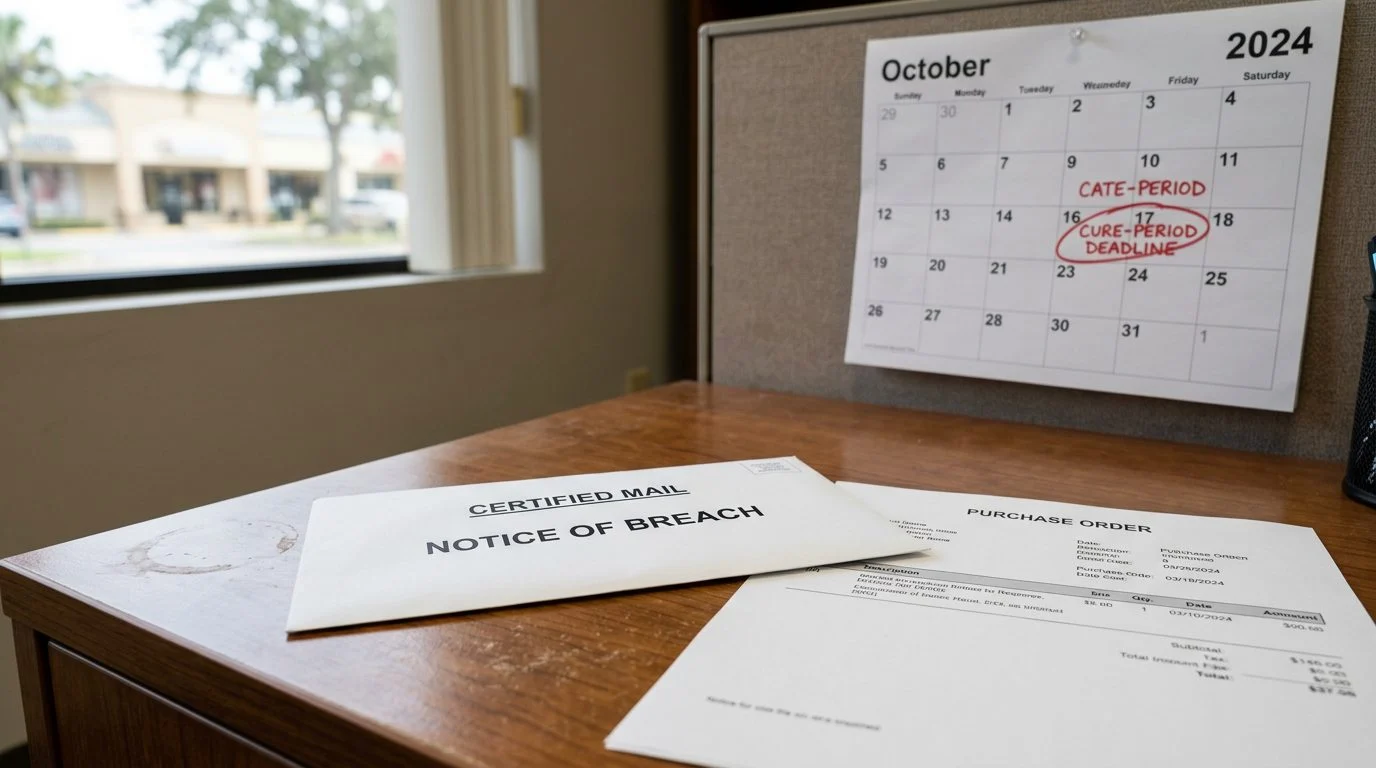
You’ve just been served with a breach of contract lawsuit, or a demand letter says one is coming. Your company’s money, customers and reputation may be on the line, and some deadlines may already be running.
If you need to defend a breach of contract lawsuit in Tampa, start by marking the response date, preserving every record, and reading the contract next to the complaint. The steps below explain what to do first and why each one matters.
What a Breach of Contract Lawsuit Means for a Tampa Business
A breach of contract lawsuit says one party failed to do what a contract required. The other party wants money or another remedy because of that failure.
Each element is a point you can test against the record.
A complaint is not a finding of fault.
Where the case is filed also matters. Under Fla. Stat. 47.011, actions are brought in the county where the defendant resides, where the cause of action accrued, or where the property in litigation is located. This section does not apply to actions against nonresidents. For a Tampa business, that may point to a Hillsborough County court. The facts decide it, so check the venue on the papers you receive.
If a breach of contract complaint or demand letter just reached your business, you may have a short window to respond, and you don't have to face it alone. Our Tampa team can review your papers with you. Talk it through with our team — we can walk you through how a situation like yours is usually handled and what your options are.
The First Steps: Deadlines, Records and Insurance
Your first job is to find the response deadline and protect the evidence. Missing a response date can lead to a default against your business, so treat the date as the top priority.
- Calendar the deadline the day papers arrive. Write down the date you were served and count forward from it.
- Route all contact through one person. Don’t let managers or staff discuss the dispute with the other side.
- Issue an internal litigation hold. Keep emails, texts, invoices, purchase orders, change orders, project logs and drafts. Stop routine deletion.
- Check your insurance. General liability or professional liability policies may respond. Give the carrier prompt notice if the policy requires it.
- Stay quiet publicly. Skip posts or comments about the dispute, because statements made now can become evidence later.
Read the Contract and the Complaint Side by Side
Compare each claim in the complaint with the exact words in the signed contract. Include every amendment, side letter and written change. Small wording details often shape the whole case.
Look for notice-and-cure clauses, dispute resolution or arbitration terms, limits on liability, attorney fee provisions and termination rights. Then check the dates: when the contract was signed, when work happened, when the alleged breach occurred, and when your business first learned of it.
Some contracts require a notice or a chance to fix a problem before a breach exists. Florida courts don’t favor treating a step as a condition that must happen first. They do when plain language or necessary implication requires it, as the Fourth District explained in the Covelli Family opinion.
The Defenses Florida Business Owners Raise Most
Which ones fit turns on your records, and some must be raised early.
- Prior breach. If one party breached first, the other party’s failure to keep performing is not automatically a default, as the Second District explained in the Ryan v. Landsource opinion.
- Under Fla. Stat. 671.205, repeated conduct between the parties can help show how a term was understood. A course of performance involves repeated occasions for performance under the same transaction and requires that the other party, with knowledge of the performance and an opportunity to object, accepts it or acquiesces in it without objection. A course of dealing, by contrast, is conduct concerning previous transactions between the parties that can establish a common basis for interpreting their expressions and other conduct. A course of performance can also show a waiver or modification of any term inconsistent with that performance. Express terms prevail over conflicting conduct only when a consistent reading of them and that conduct is unreasonable, and a course of performance can show a waiver or modification of an inconsistent term.
- Compare the breach date with the filing date.
How the Case Moves: Mediation, Offers and Fees
Most contract cases move through pleadings, document exchange, mediation and settlement talks. Each stage has its own rules and timing, so know what comes next.
- Mediation. Under Fla. Stat. 44.102, a court must send a filed damages case to mediation when one party asks. Exceptions apply, such as an action filed to collect a debt. The requesting party must be able to pay, or the costs must be split fairly.
- Under Fla. Stat. 45.061, any party may serve a written offer more than 60 days after the service of a summons and complaint on a party but not less than 60 days (or 45 days if it is a counteroffer) before trial. The section does not apply to causes of action that accrue after the act’s effective date (subsection (6)), and it does not apply to any class action or shareholder derivative suit or to matters relating to dissolution of marriage, alimony, nonsupport, eminent domain, or child custody (subsection (4)), so whether it applies to a particular contract dispute depends on when the claim accrued and whether the case falls within those exclusions. Fla. Stat. § 45.061 reads: “The offer shall remain open for 45 days unless withdrawn sooner by a writing served on the offeree prior to acceptance by the offeree.” It stays open for 45 days unless withdrawn or accepted. For claims the section covers (it does not apply to causes of action that accrue after the act’s effective date), an offer is presumed to have been unreasonably rejected by a defendant if the judgment entered is at least 25 percent greater than the offer rejected.
- Sanctions timing. Under Fla. Stat. 57.105, a sanctions motion must be served first. It cannot be filed if the challenged paper is withdrawn or corrected within 21 days.
- Fee clauses. If your contract, entered into on or after October 1, 1988, allows attorney fees to the party that enforces it, the court may also award reasonable fees to the other side when it prevails. Review that clause early, because it changes your financial risk. Review that clause early, because it changes your financial risk.
Costs tend to rise with the number of claims, the volume of records, depositions and motions.
Why Work With Ayala Law PA on a Tampa Contract Dispute
Ayala Law PA focuses on business litigation. That includes commercial litigation, contract disputes, shareholder and partnership disputes, construction litigation, real estate litigation and international trade litigation in Florida courts and arbitration.
The firm’s only office is at 1646 W Snow Ave, Tampa, FL 33606. It serves Tampa, Hillsborough County and the Tampa Bay area from that Tampa office.
Eduardo A. Maura is the responsible lawyer for this page. Our team of assistants and office staff supports the firm’s day-to-day work.
If another lawyer or firm would serve your business better, we’ll tell you so at the start. No outcome can be promised. Each matter turns on its own contract language, records and facts.
Not sure what your next step is?
Talk it through with our team — we can walk you through how a situation like yours is usually handled and what your options are.
Frequently Asked Questions
Here are short answers to the questions business owners ask most.
How do you defend a breach of contract lawsuit?
Mark the response date, preserve records, compare the contract with the complaint, and file a timely response that raises the defenses the facts support.
Is it worth suing for breach of contract?
That turns on the contract terms, the damages you can prove, the evidence, and the expected cost of the case.
How much does a breach of contract lawsuit cost?
Costs vary with the claims, the discovery needed and the length of the case. Fees and costs are discussed directly with you during a case evaluation.
Talk Through Your Papers With Ayala Law PA
If a complaint or demand letter just arrived, you’re probably juggling a deadline, staff questions and a business to run. You don’t have to sort out the contract, the timing and the response alone.
Request a case evaluation at lawayala.com/contact or call (813) 414-5715. Bring the contract, the claim and your response date, and we can talk through your next step.



