
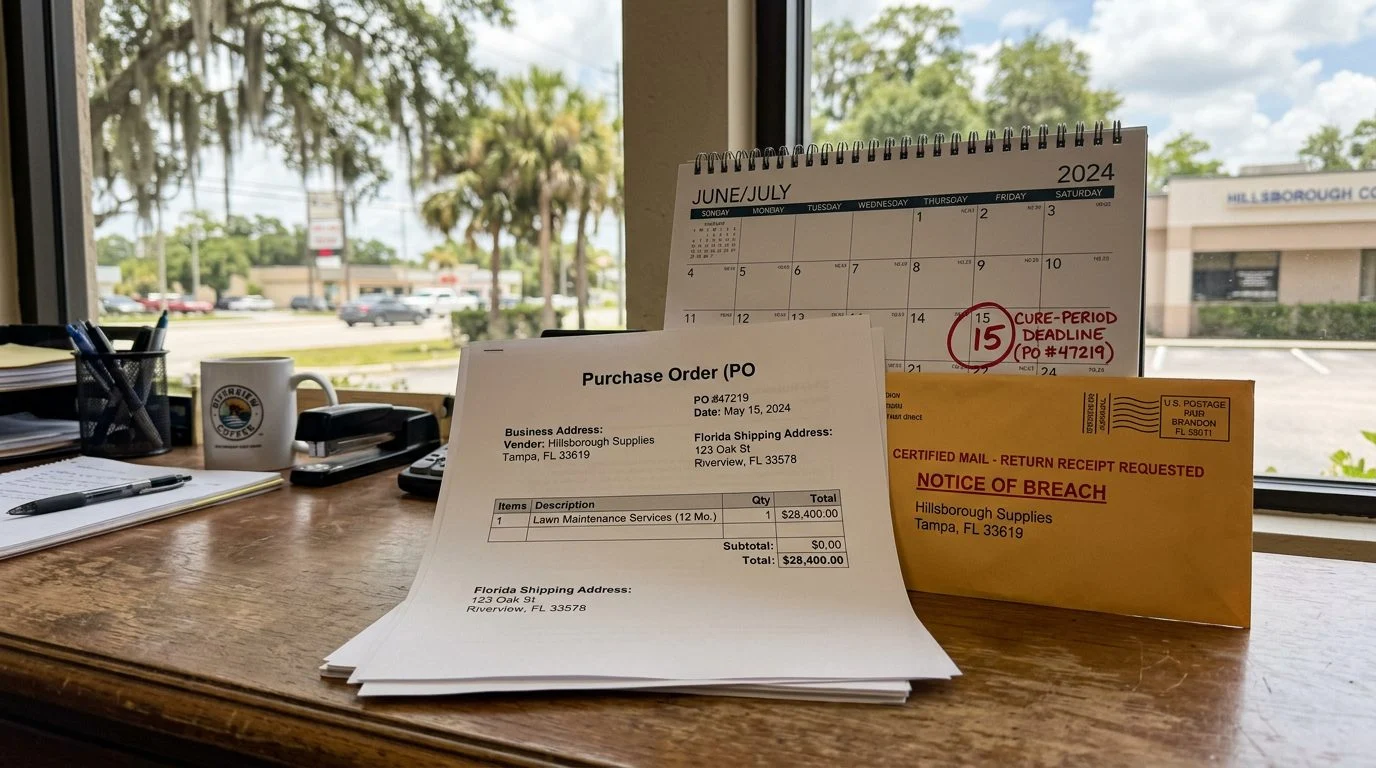
Your company issued a purchase order, and now the supplier is late, short, or disputing it. You want to know whether that PO counts as a contract in Florida.
Whether that applies depends on the facts of each dispute. Under Florida’s rules for sales of goods, a PO becomes a binding contract when the seller accepts it, in writing or through its conduct, and the key terms are clear enough to enforce. This page explains how that works and where the rules get strict.
Short Answer: A Purchase Order Can Be a Contract in Florida
A purchase order is usually the buyer’s offer, and the seller’s acceptance turns that offer into a contract. Acceptance doesn’t always come as a signature. Florida law lets a contract form in any manner that shows agreement, including conduct by both parties (Fla. Stat. § 672.204). Whether a specific PO is enforceable turns on what was sent, how the seller responded, and whether the terms were agreed.
A common mistake is treating a PO as internal paperwork that binds no one. Common acceptance steps include a written confirmation, a promise to ship, or shipping the goods.
This page covers sales of goods, such as equipment, materials, and supplies. Florida’s Uniform Commercial Code for goods, found in Chapter 672 of the Florida Statutes, applies to transactions in goods (Fla. Stat. § 672.102). Real estate purchase agreements are outside this page.
If a supplier is ignoring or disputing a PO your company issued, we're glad to talk through the paperwork with you. Talk it through with our team — we can walk you through how a situation like yours is usually handled and what your options are.
The Elements a Contract Needs in Florida
A Florida PO needs the same basic pieces as any contract: an offer, an acceptance, consideration, and essential terms stated clearly enough. Under Fla. Stat. § 672.201, except as otherwise provided in that section, a contract to sell goods priced at $500 or more cannot be enforced, whether a party sues on it or raises it as a defense, without a record sufficient to indicate that a contract for sale has been made between the parties and signed by the party against whom enforcement is sought or by that party’s authorized agent or broker.
Here is how those pieces usually line up. The buyer’s order is the offer. The seller’s confirmation or shipment is the acceptance. Contract disputes often focus on what each party actually agreed to do. The item, quantity, and price are the essential terms.
A missing term often starts an argument. If a PO leaves out a delivery date, the other side may claim no deal formed. Florida is more flexible on open terms. A contract does not fail just because one or more terms are left open, if the parties meant to contract and there is a reasonably certain basis for a remedy (Fla. Stat. § 672.204).
Quantity is the term to check first. Under the writing rule covered below, a record is enforceable only for the quantity it shows.
How a PO Becomes a Contract: Offer, Acceptance, and Conduct
A PO becomes a contract when the seller accepts it, and Florida law reads acceptance broadly. Unless the language or circumstances clearly indicate otherwise, an offer invites acceptance “in any manner and by any medium reasonable in the circumstances” (Fla. Stat. § 672.206).
For an order for prompt or current shipment, the seller can accept with a prompt promise to ship, or by shipping. Shipping nonconforming goods does not count, however, if the seller promptly tells the buyer the shipment is only an accommodation (§ 672.206(1)(b)).
Here’s a common sequence. A buyer sends a PO. The supplier confirms by email. The goods ship, and an invoice follows. Taken together, those steps show both sides acted as if a deal existed.
The mistake to avoid is assuming a PO is dead because nobody answered it in writing. Florida looks at what both sides actually did.
The Written-Contract Question and the $500 Rule for Goods
For goods priced at $500 or more, Florida generally requires a signed record before a sale can be enforced. A contract for that price is not enforceable unless a record shows a contract was made and is signed by the party being held to it, or by its authorized agent (Fla. Stat. § 672.201).
A record doesn’t fail just because it leaves out or misstates a term. But enforcement stops at the quantity the record shows. A signature can be electronic. Florida gives an electronic signature the same force as a written one (Fla. Stat. § 668.004).
Between merchants, a confirmation works differently. In a transaction between merchants, a record confirming the contract that is sufficient against the sender, if received within a reasonable time by a party who has reason to know its contents, satisfies the signed-record requirement against that receiving party unless notice in a record objecting to its contents is given within 10 days after it is received (Fla. Stat. § 672.201).
The statute also lists exceptions. A sale can be enforced without a signed record for specially manufactured goods the seller has substantially begun. It also applies when a party admits in court that a contract was made, limited to that quantity, and for goods paid for and accepted, or received and accepted. Each exception has its own conditions.
When the Buyer’s PO and the Seller’s Forms Conflict
A contract can form even when the PO and the seller’s acknowledgment say different things. A definite and timely acceptance works as an acceptance even if it states added or different terms. The exception is when the acceptance is expressly conditional on the buyer agreeing to those terms (Fla. Stat. § 672.207).
Those extra terms are treated as proposals. Between merchants, they become part of the contract unless the PO expressly limits acceptance to its own terms, the new terms materially alter the deal, or objection to them has already been given or is given within a reasonable time after notice of them is received (§ 672.207(2)).
If the writings don’t settle it, conduct can. When both parties act as if a contract exists, its terms are the ones the writings agree on, plus supplementary terms (§ 672.207(3)).
Disputes often center on delivery dates, warranties, and caps on the seller’s liability. Read a seller’s acknowledgment when it arrives. Object in writing if it changes your terms.
Can a Buyer Cancel a PO After Sending It?
The answer often depends on the timing of key events and the specific terms of the agreement. Before acceptance, a PO is an offer waiting for an answer. After acceptance, cancelling becomes a contract question.
Acceptance can come quickly. For an order or other offer to buy goods for prompt or current shipment, a prompt promise to ship, or prompt shipment of conforming or nonconforming goods, can count as acceptance, but a shipment of nonconforming goods is not acceptance if the seller seasonably notifies the buyer that it is offered only as an accommodation (§ 672.206(1)(b)). A seller who promptly ships or promises to ship may have accepted before you cancel.
Specially made goods are harder to walk away from. If the seller has substantially begun making goods made for you, the sale can be enforced even without a signed record, under conditions the statute sets out (§ 672.201(3)).
Before you cancel in writing, check what the seller sent back and when.
Not sure what your next step is?
Talk it through with our team — we can walk you through how a situation like yours is usually handled and what your options are.
Documenting a PO So It Can Be Enforced
Keep every document in one file, and make the PO complete. Each PO should show the quantity, price, item description, delivery date, payment terms, and the legal names of both companies.
Keep the seller’s acknowledgment, shipping notices, invoices, and delivery receipts with the PO. Timing and conduct are often what show acceptance, so the sequence matters.
Put change requests in writing, and get the seller’s written agreement before shipping or work changes. An unconfirmed change is easy to dispute later.
Oral orders are harder.
Talk With Ayala Law About a Purchase Order Dispute
A PO dispute usually lands on the owner, manager, or buyer, who has to decide quickly where the company stands. You may be dealing with a late delivery, a short shipment, or a supplier who says the order never became a deal.
Ayala Law PA focuses on business litigation, commercial litigation, contract disputes, shareholder disputes, construction litigation, real estate litigation, and international trade litigation. The firm represents businesses and entrepreneurs in Florida courts and arbitration, including matters arising in Tampa, Hillsborough County, and the Tampa Bay area. Our office is at 1646 W Snow Ave in Tampa, Florida. Eduardo A. Maura is the lawyer responsible for this page. Some matters may be referred to another lawyer or firm. Our team explains fee terms when you call.
Is a purchase order legally binding in Florida?
Yes, a PO can be binding once the seller accepts it and the essential terms are clear enough to enforce.
Does a verbal purchase order count?
Oral deals are subject to basic contract rules. Goods priced at $500 or more generally need a record sufficient to show a contract was made, signed by the party against whom enforcement is sought (Fla. Stat. § 672.201).
Does an email count as a signature?
Unless otherwise provided by law, Florida gives an electronic signature the same force as a written one, so a signed email may meet that requirement (Fla. Stat. § 668.004).
If a supplier is ignoring or disputing a PO your company issued, reach out through our contact page or call (305) 570-2208 to talk through the paperwork.



